Introduction
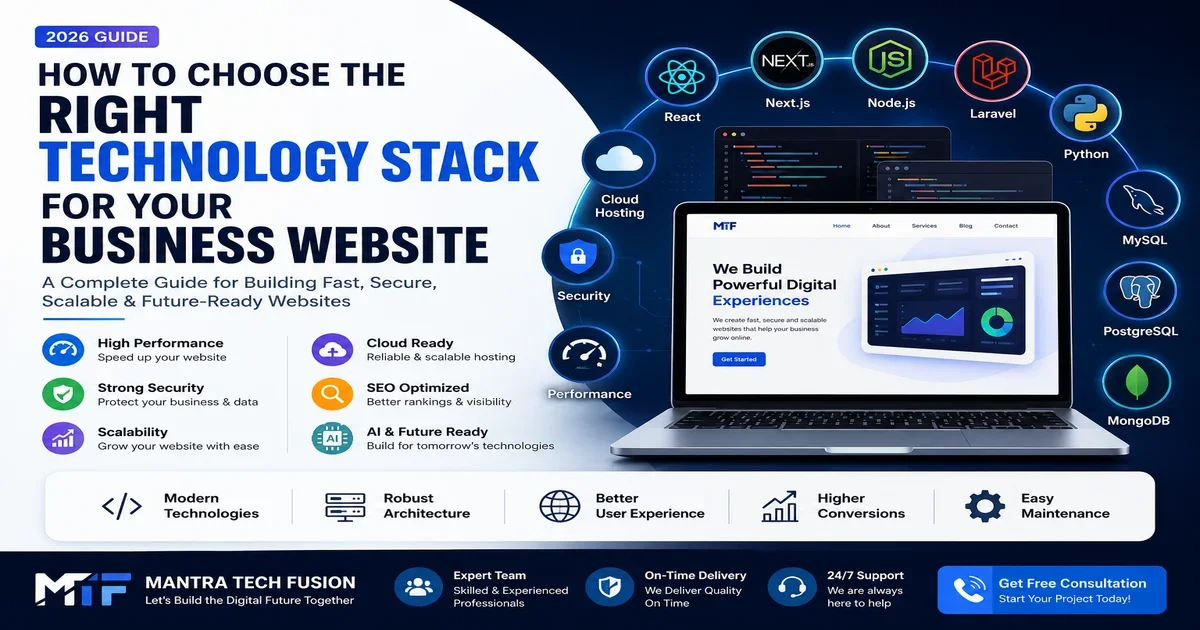
Choosing the right Technology Stack for Business Website projects is one of the most important decisions for any company planning to build a secure, scalable, high-performance, and SEO-friendly website in 2026. A business website is far more than an online brochure. It represents your brand, supports your marketing strategy, generates leads, serves existing customers, and often becomes one of the most valuable digital assets of your business. Whether you run a startup, a manufacturing company, a healthcare organization, an educational institution, or an eCommerce business, your website should be designed to support your current goals while remaining ready for future growth.
Behind every successful website is a carefully planned technology stack. While visitors usually notice the design, content, and navigation first, they rarely see the technologies working behind the scenes. These technologies determine how quickly your website loads, how securely customer information is handled, how well the website performs under heavy traffic, and how easily new features can be added as your business evolves.
Many businesses make technology decisions based only on initial development costs or current market trends. Although this approach may reduce the upfront investment, it often leads to expensive redevelopment projects later. A website built on an unsuitable technology stack may struggle with performance, security, maintenance, or scalability as business requirements change.
Selecting the right technology stack should never be based solely on popularity. Instead, it should align with your business objectives, expected traffic, long-term growth strategy, integration requirements, security expectations, and maintenance capabilities.
This comprehensive guide explains every major component of a modern technology stack in business-friendly language. You'll understand how frontend technologies, backend frameworks, databases, cloud infrastructure, APIs, and security practices work together to build reliable, scalable, and high-performing business websites.
By the end of this guide, you'll be able to make informed technology decisions that support long-term business growth rather than short-term convenience.
Why Choosing the Right Technology Stack Matters
Selecting the right technology stack is one of the most important decisions in any website development project. It influences almost every aspect of your online business—from user experience and search engine visibility to cybersecurity, operational costs, and future scalability.
Unlike visual design, which can be updated relatively easily, changing the core technology stack after launch is often a complex and expensive process. Businesses that invest time in selecting the right technologies during the planning stage usually save significant time and money in the future.
A strong technology stack creates a solid foundation that allows your website to grow alongside your business without requiring major redevelopment.
A Well-Planned Technology Stack Helps You:
- Deliver faster page loading speeds.
- Improve user experience across all devices.
- Strengthen website security.
- Increase search engine visibility.
- Support future feature development.
- Integrate with CRM, ERP, payment gateways, and marketing platforms.
- Reduce long-term maintenance costs.
- Handle increasing website traffic efficiently.
Rather than thinking only about today's requirements, business owners should consider how their website will support future expansion over the next three to five years.
How Technology Directly Impacts Business Success
Many business owners assume that technology is only a concern for developers. In reality, technology decisions directly affect sales, customer satisfaction, marketing performance, and operational efficiency.
Let's examine the key business benefits of selecting the right technology stack.
1. Better Website Performance
Website speed plays a significant role in user satisfaction.
Visitors expect webpages to load almost instantly. Slow websites often cause users to abandon the page before exploring products or services.
A properly optimized technology stack helps reduce loading times through efficient code execution, optimized databases, caching mechanisms, and modern hosting infrastructure.
Benefits include:
- Higher visitor engagement.
- Lower bounce rates.
- Improved conversion rates.
- Better customer satisfaction.
2. Improved Search Engine Optimization (SEO)
Search engines evaluate much more than keywords. Technical performance is now an important ranking factor.
Modern search engines consider:
- Mobile responsiveness.
- Page loading speed.
- HTTPS security.
- Structured content.
- Accessibility.
- Core Web Vitals.
- Crawl efficiency.
- Internal linking structure.
A technically strong website provides an excellent foundation for long-term organic growth.
3. Stronger Website Security
Cybersecurity threats continue to evolve every year.
A secure technology stack helps protect:
- Customer information.
- Business data.
- Payment transactions.
- User accounts.
- Administrative access.
- API communications.
Modern development frameworks include security mechanisms that help reduce risks such as SQL Injection, Cross-Site Scripting (XSS), Cross-Site Request Forgery (CSRF), brute-force attacks, and unauthorized access.
Investing in security from the beginning is significantly more cost-effective than recovering from a security breach.
4. Easier Scalability
Businesses rarely remain the same after launching a website.
As your company grows, you may need:
- Customer dashboards.
- Online booking systems.
- Payment gateways.
- Mobile applications.
- AI-powered search.
- Business automation.
- CRM integration.
- ERP connectivity.
- Multi-language support.
- Multi-location management.
A scalable technology stack allows these features to be added efficiently without rebuilding the entire website.
5. Lower Long-Term Costs
Many businesses focus only on development costs.
However, the Total Cost of Ownership (TCO) includes:
- Maintenance.
- Security updates.
- Hosting.
- Feature enhancements.
- Performance optimization.
- Technical support.
- Infrastructure upgrades.
Choosing reliable technologies with long-term community support often reduces these ongoing expenses.
Real Business Example
Imagine two companies launch similar business websites.
Company A selects technologies based only on the lowest development price.
Company B chooses a scalable technology stack after evaluating future business goals.
After two years:
Company A needs to rebuild significant parts of the website to support online payments, customer dashboards, and CRM integration.
Company B simply extends its existing system by adding new modules because the original architecture was designed with scalability in mind.
Although Company B invested slightly more during development, its long-term costs are significantly lower while delivering a better customer experience.
Expert Insight
A technology stack should never be selected because it is trending on social media or frequently recommended in online discussions. Every business has unique requirements, and the ideal solution depends on your goals, expected growth, security needs, available budget, integration requirements, and long-term maintenance strategy.
Successful businesses choose technologies that solve business problems—not technologies that simply follow industry trends.
Quick Self-Assessment Checklist
Before selecting any technology stack, ask yourself the following questions:
- What are the primary goals of my website?
- How many visitors do I expect within the next three years?
- Will users need secure login functionality?
- Will I sell products or services online?
- Do I require payment gateway integration?
- Will the website connect with CRM or ERP software?
- Is multilingual support planned?
- Who will maintain the website after launch?
- How frequently will content be updated?
- Can the selected technology scale as my business grows?
Answering these questions before development begins helps prevent expensive technical decisions later.
Common Mistakes Businesses Make While Choosing a Technology Stack
Selecting the wrong technology stack is one of the biggest reasons businesses spend unnecessary money on website redevelopment. Many of these mistakes can be avoided with proper planning and a clear understanding of business requirements.
Below are some of the most common mistakes that business owners make during website development.
Choosing Technology Based Only on Price
Every business wants to reduce development costs, but selecting the cheapest technology is rarely the best long-term investment.
Low-cost solutions often result in:
- Poor website performance
- Limited scalability
- Security vulnerabilities
- Higher maintenance costs
- Difficult upgrades
- Expensive redevelopment
Instead of comparing only the development cost, compare the total value the technology provides over the next five years.
Following Technology Trends Without Business Requirements
New programming languages and frameworks are introduced regularly. While many of them are impressive, they may not be suitable for every business.
A local business website does not require the same technology stack as an enterprise SaaS platform.
The best technology stack is the one that solves your business challenges efficiently—not the one that is currently trending.
Ignoring Future Growth
Many businesses build websites only for their current needs.
Later they decide to add:
- Customer portals
- Mobile apps
- Online booking
- Inventory management
- Payment gateways
- AI features
- CRM integration
- Multi-location support
If scalability was not considered from the beginning, these additions often require major redevelopment.
Always choose technologies that can support your business for the next three to five years.
Ignoring Website Security
Security should never be treated as an optional feature.
Every business website stores valuable information such as:
- Customer enquiries
- Contact information
- Employee accounts
- Business documents
- Payment details
- Website credentials
A secure technology stack protects both your business and your customers.
Choosing Without Professional Consultation
Many business owners compare technologies based only on online articles or recommendations from friends.
However, every business has unique requirements.
Factors such as expected traffic, integrations, future expansion, maintenance budget, compliance requirements, and marketing goals should all influence technology decisions.
Professional planning during the early stages often prevents costly mistakes later.
How to Choose the Right Technology Stack
Instead of asking:
"Which technology is the best?"
Ask:
"Which technology is best for my business?"
A structured decision-making process produces far better results.
Step 1: Define Business Goals
Start by identifying what your website needs to achieve.
Examples include:
- Brand awareness
- Lead generation
- Online sales
- Appointment booking
- Customer support
- Business automation
- Digital marketing
- Membership portal
Technology should always support these objectives.
Step 2: Estimate Future Growth
Think beyond the first year.
Consider:
- Expected monthly visitors
- Future products
- New services
- International expansion
- Multiple branches
- Mobile application
- AI integration
- Business automation
Planning ahead reduces redevelopment costs.
Step 3: Consider Integrations
Modern businesses rarely use a website independently.
You may need integrations with:
- CRM software
- ERP systems
- Google Analytics
- Google Business Profile
- Payment gateways
- WhatsApp Business
- Email marketing tools
- SMS gateways
- Accounting software
- Inventory systems
Choose technologies that support these integrations efficiently.
Step 4: Evaluate Maintenance Requirements
Ask yourself:
Who will maintain the website?
Will your internal team manage it?
Will an external agency provide support?
Is the technology widely supported?
Popular, well-documented technologies usually reduce maintenance challenges.
Step 5: Focus on Long-Term Value
Technology should be viewed as a business investment rather than a one-time expense.
Consider:
- Security
- Performance
- Reliability
- Community support
- Developer availability
- Upgrade path
- Hosting compatibility
These factors determine the overall value of your technology stack.
Business Decision Matrix
| Business Type | Recommended Approach |
|---|---|
| Startup | Scalable and cost-effective technologies |
| Local Business | Fast, SEO-friendly website with simple management |
| Manufacturing Company | Custom business website with CRM integration |
| Healthcare Organization | High-security architecture with compliance |
| Educational Institute | Scalable portal with student management |
| eCommerce Store | Performance-focused architecture with secure payments |
| Enterprise Business | Modular architecture supporting future expansion |
Expert Tip
Successful websites are planned for tomorrow—not just today.
When selecting technologies, always ask whether the platform will still meet your business needs after three to five years.
A technology stack that supports future growth is usually more valuable than one that simply reduces initial development costs.
Key Takeaways
Before beginning any website development project, remember these important principles:
- Technology decisions should support business goals.
- Performance affects both user experience and SEO.
- Security should be integrated from day one.
- Scalability reduces future redevelopment costs.
- Maintenance is an ongoing responsibility.
- Popularity should never be the only deciding factor.
- Professional planning saves time and money.
What's Next?
Now that you understand why selecting the right technology stack is important, the next step is understanding what a technology stack actually consists of.
In the following chapter, we'll explore the four core layers of every modern website:
- Frontend
- Backend
- Database
- Cloud Infrastructure
You'll learn how these technologies work together to create secure, scalable, and high-performing business websites.
Chapter 1 Checklist
Before moving to the next chapter, make sure you understand:
- ✅ Why technology selection impacts business success.
- ✅ How technology affects SEO, security, and scalability.
- ✅ The most common mistakes businesses make.
- ✅ How to evaluate technologies based on business goals.
- ✅ Why long-term planning is more valuable than short-term savings.
Chapter 2: Understanding Technology Stack for Business Website? Understanding the Foundation of Modern Business Websites
Every modern website, whether it is a company profile, an online store, a customer portal, or a large enterprise platform, is built using multiple technologies working together. This combination of technologies is known as a technology stack.
Many business owners believe a website is simply a collection of web pages. In reality, every feature a visitor uses from opening the homepage and submitting a contact form to completing an online payment or logging into an account is powered by different technologies working behind the scenes.
A technology stack is the complete set of programming languages, frameworks, databases, servers, cloud services, APIs, and development tools used to build, run, and maintain a website or web application.
Instead of thinking about a website as a single product, imagine it as a building. A beautiful exterior may attract visitors, but the strength of the building depends on its foundation, structure, plumbing, electrical systems, and maintenance. Similarly, a website's design is only one part of the overall system. The technologies underneath determine how fast, secure, reliable, and scalable the website will be.
Why Understanding a Technology Stack Matters
Business owners do not need to become programmers, but understanding the basics of a technology stack helps them make informed decisions during website planning.
When you understand how different technologies work together, you can:
- Communicate more effectively with developers.
- Select technologies that match your business goals.
- Avoid unnecessary redevelopment costs.
- Plan for future growth.
- Improve website performance.
- Reduce maintenance challenges.
- Strengthen website security.
- Make better investment decisions.
A basic understanding of technology also helps business owners identify unrealistic promises and choose development partners more confidently.
The Four Core Layers of a Modern Technology Stack
Every professional business website is typically built using four major layers. Each layer performs a specific role, and together they create a complete digital solution.
1. Frontend (Client Side)
The frontend is the part of the website that visitors see and interact with. It includes everything displayed in the web browser, such as layouts, buttons, navigation menus, images, forms, animations, and content.
The frontend focuses on creating an engaging, responsive, and user-friendly experience across desktops, tablets, and smartphones.
Common frontend technologies include:
- HTML
- CSS
- JavaScript
- React
- Next.js
- Vue.js
- Angular
A well-built frontend improves usability, accessibility, and search engine performance.
2. Backend (Server Side)
The backend works behind the scenes. It processes user requests, performs calculations, manages business logic, communicates with databases, and controls security.
For example, when a customer logs in, submits an enquiry form, or places an order, the backend processes the request and returns the appropriate response.
Popular backend technologies include:
- PHP
- Laravel
- Node.js
- Python
- ASP.NET
A reliable backend ensures that the website remains secure, stable, and capable of handling increasing traffic.
3. Database Layer
The database stores all business information in an organized manner.
Examples of stored data include:
- Customer accounts
- Product information
- Blog articles
- Orders
- Contact enquiries
- Employee records
- Payment history
- Inventory data
Without a properly designed database, websites become slow, inconsistent, and difficult to manage.
Popular database technologies include:
- MySQL
- PostgreSQL
- MongoDB
- Redis (for caching and performance)
Choosing the right database helps improve speed, reliability, and scalability.
4. Cloud Infrastructure and Hosting
Once a website has been developed, it must be hosted on servers so users can access it through the internet.
Cloud infrastructure provides the computing resources required to keep websites online, secure, and available around the clock.
This layer includes:
- Web servers
- Cloud hosting
- SSL certificates
- Content Delivery Networks (CDNs)
- Load balancers
- Firewalls
- Backup systems
- Monitoring tools
Reliable hosting plays a major role in website uptime, speed, and security.
How These Layers Work Together
Whenever a visitor opens your website, several processes happen within seconds.
- The browser sends a request to the hosting server.
- The backend receives and processes the request.
- The backend retrieves the required information from the database.
- The server prepares the response.
- The frontend displays the information in an attractive and user-friendly format.
Although visitors only see the final webpage, all four layers work together continuously to deliver a smooth experience.
Understanding the Request–Response Cycle
Every interaction on a website follows a simple process known as the request–response cycle.
For example, when a user clicks the "Contact Us" button:
- The browser sends the request.
- The server receives it.
- The backend validates the submitted information.
- The database stores the enquiry.
- A confirmation message is generated.
- The user receives a success response.
This entire process usually takes only a fraction of a second, but it involves multiple technologies working together seamlessly.
Static Websites vs Dynamic Websites
Not every website requires the same technology stack.
Static Websites
Static websites display fixed content that changes only when a developer updates the files.
They are suitable for:
- Portfolio websites
- Landing pages
- Event pages
- Small business websites with limited updates
Advantages
- Fast loading speed
- Lower hosting costs
- Simple deployment
- Better security due to limited functionality
Dynamic Websites
Dynamic websites generate content in real time based on user requests and database information.
They are commonly used for:
- Business websites
- Online stores
- Customer portals
- Membership websites
- Booking systems
- Educational platforms
- Healthcare portals
Dynamic websites require a more advanced technology stack but provide significantly greater flexibility and functionality.
Popular Technology Stack Combinations Used by Modern Businesses
Over the years, developers have created several proven technology stack combinations that are reliable, scalable, and widely supported. Each stack combines frontend technologies, backend frameworks, databases, and hosting environments to meet different business requirements.
Rather than selecting technologies individually, many organizations choose a well-established stack that has strong community support and long-term stability.
Below are some of the most commonly used technology stacks.
LAMP Stack
LAMP stands for:
- L – Linux
- A – Apache
- M – MySQL
- P – PHP
The LAMP stack has been one of the most trusted solutions for business websites for many years. It powers millions of websites worldwide and remains an excellent choice for corporate websites, blogs, portals, and custom business applications.
Advantages
- Mature ecosystem
- Affordable hosting
- Excellent documentation
- Large developer community
- Reliable performance
- Easy maintenance
Best For
- Business websites
- Corporate portals
- WordPress websites
- WooCommerce stores
- Service-based businesses
- Small and medium-sized enterprises
MERN Stack
MERN stands for:
- M – MongoDB
- E – Express.js
- R – React
- N – Node.js
The MERN stack allows developers to build modern, interactive web applications using JavaScript across both the frontend and backend.
Advantages
- High performance
- Reusable components
- Fast development
- Excellent for real-time applications
- Strong API support
Best For
- SaaS platforms
- Startup products
- Customer dashboards
- Social platforms
- Real-time applications
MEAN Stack
MEAN consists of:
- M – MongoDB
- E – Express.js
- A – Angular
- N – Node.js
It is commonly used for enterprise-level web applications where structured architecture and long-term maintainability are important.
Best For
- Enterprise software
- Internal business systems
- Large dashboards
- Administrative portals
JAMstack
JAMstack stands for:
- JavaScript
- APIs
- Markup
Unlike traditional websites, JAMstack delivers pre-built pages while relying on APIs for dynamic functionality.
Advantages
- Extremely fast loading
- High security
- Better scalability
- Lower server load
Best For
- Marketing websites
- Documentation websites
- Company profile websites
- Landing pages
Full-Stack Development Explained
The term Full-Stack Development refers to building both the frontend and backend of a website or application.
A full-stack solution includes:
- User Interface (Frontend)
- Server Logic (Backend)
- Database
- APIs
- Hosting Infrastructure
- Security
- Deployment
Businesses often prefer full-stack development because it provides a complete, integrated solution rather than managing multiple vendors for different parts of the project.
Monolithic vs Modern Modular Architecture
The overall architecture of a website also affects scalability, maintenance, and future development.
Monolithic Architecture
In a monolithic application, all features are built into a single codebase.
Advantages
- Simpler development
- Easier deployment
- Lower infrastructure costs
Best For
- Small businesses
- Startups
- Standard business websites
- Company profile websites
Modular (Service-Oriented) Architecture
A modular architecture separates different business functions into independent components or services.
Examples include:
- Authentication service
- Payment service
- CRM integration
- Notification system
- Reporting module
- Inventory management
Advantages
- Easier maintenance
- Better scalability
- Faster updates
- Independent feature development
- Improved reliability
This approach is ideal for businesses expecting continuous growth and feature expansion.
Technology Stack Selection Based on Business Type
Choosing a technology stack becomes much easier when it is aligned with your business model.
| Business Type | Recommended Technology Stack |
|---|---|
| Company Profile Website | HTML, CSS, JavaScript, PHP, MySQL |
| WordPress Business Website | WordPress, PHP, MySQL |
| eCommerce Store | Laravel or WooCommerce with MySQL |
| SaaS Platform | React, Node.js, MongoDB |
| Manufacturing Company | Laravel, MySQL, REST APIs |
| Educational Portal | Laravel or ASP.NET with MySQL/PostgreSQL |
| Healthcare Platform | ASP.NET or Laravel with PostgreSQL |
| Startup MVP | React, Laravel, MySQL |
| Enterprise Portal | React, Laravel, PostgreSQL, Redis |
| AI-Powered Platform | React, Python, PostgreSQL |
Factors to Consider Before Finalizing Your Technology Stack
Before making your final decision, evaluate the following factors carefully:
Business Goals
Choose technologies that support your long-term objectives rather than only current requirements.
Scalability
Ensure the platform can handle increased traffic, additional users, and new features without requiring major redevelopment.
Security
Look for technologies with strong security features, regular updates, and active community support.
Development Speed
Some frameworks allow faster development while maintaining high quality.
Budget
Consider both the initial development cost and the long-term maintenance cost.
Community Support
Technologies with large developer communities usually receive frequent updates, better documentation, and long-term support.
Integration Capabilities
Verify that your technology stack can integrate with:
- Payment gateways
- CRM software
- ERP systems
- Marketing tools
- Analytics platforms
- Third-party APIs
Expert Recommendation
There is no single technology stack that is perfect for every business.
A local service provider, an online retailer, a SaaS startup, and a multinational enterprise all have different technical requirements.
The best technology stack is one that balances:
- Performance
- Security
- Scalability
- Ease of maintenance
- Development efficiency
- Long-term business value
Instead of following technology trends, focus on selecting a stack that supports your business strategy and future growth.
Chapter 2 Key Takeaways
After completing this chapter, you should understand:
- What a technology stack is.
- The four core layers of modern web development.
- How frontend, backend, databases, and hosting work together.
- The differences between static and dynamic websites.
- Popular technology stack combinations such as LAMP, MERN, MEAN, and JAMstack.
- How to choose the right technology stack based on your business type.
- The importance of scalability, security, and long-term planning.
What's Next?
Now that you understand the overall structure of a technology stack, it's time to explore each layer in detail.
In the next chapter, we'll begin with the Frontend, where you'll learn how technologies such as HTML, CSS, JavaScript, React, Next.js, and modern UI frameworks create fast, responsive, accessible, and user-friendly business websites.
Chapter 2 Checklist
Before moving to Chapter 3, confirm that you can answer these questions:
- ✅ What is a technology stack?
- ✅ What are the four main layers of a modern website?
- ✅ How does the request–response cycle work?
- ✅ What is the difference between static and dynamic websites?
- ✅ Which technology stack is suitable for your business model?
- ✅ Why should scalability and security be considered before development begins?
Chapter 3: Frontend Technology Stack for Business Website – Building Fast, Responsive, and User-Friendly Business Websites
When people visit your website, the first thing they notice is not the programming language or the database running behind the scenes. Instead, they see the layout, colors, images, buttons, menus, typography, animations, and overall user experience. Everything a visitor interacts with directly is known as the frontend of a website.
Frontend development focuses on creating an engaging, responsive, and accessible user interface that works consistently across desktops, laptops, tablets, and smartphones. A professionally developed frontend not only enhances visual appeal but also improves website performance, search engine optimization (SEO), user engagement, and conversion rates.
In today's competitive digital environment, businesses have only a few seconds to capture a visitor's attention. A slow, outdated, or confusing interface often causes users to leave before exploring products or services. On the other hand, a clean, responsive, and intuitive design builds trust, encourages interaction, and increases the likelihood of generating enquiries or sales.
For this reason, frontend development should never be treated as just a design task. It plays a critical role in creating a positive user experience and supporting long-term business growth.
What Is Frontend Development?
Frontend development is the process of building the visual and interactive components of a website that users access through a web browser.
It includes everything visitors can see and interact with, such as:
- Navigation menus
- Headers and footers
- Hero sections
- Buttons and call-to-action elements
- Images and videos
- Contact forms
- Product listings
- Blog layouts
- Pricing tables
- Interactive animations
Frontend developers use modern web technologies to ensure that these elements are visually appealing, responsive, fast, and easy to use.
The primary objective is to deliver a seamless user experience while maintaining excellent performance and compatibility across different browsers and devices.
Why Frontend Development Matters for Businesses
A professionally developed frontend provides much more than an attractive appearance.
It directly influences several important business metrics, including:
- User engagement
- Website loading speed
- Search engine rankings
- Mobile usability
- Brand credibility
- Conversion rates
- Customer satisfaction
- Bounce rate
Visitors often form an opinion about a business within the first few seconds of opening its website. A polished frontend creates a strong first impression and encourages users to continue exploring.
Core Technologies Used in Frontend Development
Modern frontend development is built on three fundamental technologies:
- HTML
- CSS
- JavaScript
These technologies work together to create structured, attractive, and interactive web pages.
Think of them as different parts of a building:
- HTML creates the structure.
- CSS controls the design and appearance.
- JavaScript adds interaction and dynamic functionality.
Understanding these technologies helps business owners appreciate how websites are built and why choosing experienced developers is important.
HTML – The Foundation of Every Website
HTML (HyperText Markup Language) is the standard language used to structure web pages. Every website, regardless of its complexity, begins with HTML.
HTML defines the content and layout of a webpage by organizing elements such as headings, paragraphs, images, links, forms, lists, tables, and multimedia content.
Without HTML, a browser would have no way to understand what information should be displayed or how different sections relate to each other.
Why HTML Is Important
A well-structured HTML document provides numerous benefits:
- Better SEO
- Improved accessibility
- Faster rendering
- Easier maintenance
- Improved browser compatibility
- Better user experience
Clean HTML also makes it easier for search engines to understand page content, which contributes to stronger organic visibility.
HTML5 – The Modern Standard
HTML has evolved significantly over the years, with HTML5 becoming the modern standard for website development.
HTML5 introduces new semantic elements that clearly describe different sections of a webpage.
Examples include:
<header><nav><main><section><article><aside><footer>
These semantic elements improve readability for developers while helping search engines understand page structure more effectively.
Why Semantic HTML Matters
Semantic HTML improves both usability and SEO by providing meaningful structure to webpage content.
For example, using an <article> tag for blog content tells search engines that the enclosed information represents a standalone piece of content.
Similarly, the <nav> element clearly identifies website navigation, while the <footer> element indicates footer content.
Benefits include:
- Better search engine understanding
- Improved accessibility
- Cleaner code
- Easier maintenance
- Enhanced screen reader compatibility
Using semantic HTML is considered a best practice for every modern business website.
HTML and Search Engine Optimization
Many people associate SEO only with keywords and backlinks. However, technical SEO begins with clean HTML.
Search engines rely on HTML structure to understand:
- Page hierarchy
- Heading structure
- Images
- Internal links
- Navigation
- Metadata
- Structured content
Poorly organized HTML can make it difficult for search engines to interpret content correctly.
A properly structured HTML document improves crawlability, indexing, and overall search performance.
Best Practices for HTML Development
Professional frontend developers follow established HTML best practices to ensure high-quality websites.
These include:
- Using semantic HTML elements
- Maintaining a logical heading structure (H1 → H2 → H3)
- Writing descriptive page titles
- Adding meaningful image alt text
- Avoiding unnecessary nested elements
- Keeping code clean and organized
- Using valid HTML5 markup
- Supporting accessibility standards
Following these practices creates websites that are easier to maintain and perform better across search engines and browsers.
Accessibility in Frontend Development
Accessibility ensures that websites can be used by everyone, including people with disabilities.
An accessible website benefits users who rely on screen readers, keyboard navigation, or assistive technologies.
Common accessibility improvements include:
- Descriptive image alternative text
- Proper heading hierarchy
- Keyboard-friendly navigation
- High color contrast
- Readable typography
- Clearly labeled forms
- Accessible buttons and links
Accessibility is not only beneficial for users but also supports SEO and demonstrates a commitment to inclusive web design.
Real Business Example
Imagine two businesses offering similar services.
The first website uses proper HTML structure, semantic elements, optimized images, and accessible navigation.
The second website relies on outdated code, inconsistent headings, missing image descriptions, and poor navigation.
Even if both websites have similar content, the first website is more likely to achieve:
- Better search engine visibility
- Faster loading speeds
- Improved accessibility
- Higher user engagement
- Better conversion rates
This example highlights why a strong HTML foundation is essential for long-term digital success.
Expert Tip
Frontend development should always begin with clean, semantic HTML before adding advanced styling or interactive features. A well-structured foundation simplifies future development, improves SEO, enhances accessibility, and makes websites easier to maintain as business requirements evolve.
CSS3 – Transforming Structure into Professional User Interfaces
While HTML provides the structure of a webpage, CSS (Cascading Style Sheets) controls how that structure looks. CSS is responsible for colors, typography, spacing, layouts, animations, buttons, forms, responsive behavior, and the overall visual identity of a website.
Imagine constructing a modern office building. HTML creates the walls, rooms, and floors, while CSS determines the paint, furniture, lighting, decorations, and overall appearance. Without CSS, every website would look like plain text with little visual appeal.
For businesses, professional styling is much more than aesthetics. A clean, consistent design strengthens brand identity, improves readability, increases user trust, and encourages visitors to take action.
Why CSS Matters for Business Websites
Visual presentation has a direct impact on how users perceive your business.
A professionally designed interface helps visitors:
- Navigate information easily.
- Read content comfortably.
- Find products and services quickly.
- Complete forms without confusion.
- Build confidence in your brand.
Research consistently shows that users form an impression of a website within the first few seconds. An outdated or inconsistent design often leads to higher bounce rates and lower conversions.
What Is CSS3?
CSS3 is the latest major version of Cascading Style Sheets and introduces modern features that simplify web design while improving performance.
Some of its most useful capabilities include:
- Responsive layouts
- Flexible grids
- Advanced typography
- Smooth animations
- Rounded corners
- Shadows
- Gradients
- Transitions
- Transformations
- Media queries
These features allow developers to create visually engaging websites without relying heavily on images or complex scripts.
Responsive Web Design
One of the most important responsibilities of modern frontend development is ensuring that a website works perfectly on every screen size.
This approach is known as Responsive Web Design.
Instead of creating separate websites for desktop and mobile devices, responsive design automatically adjusts layouts according to the visitor's screen size.
A responsive website provides a consistent experience across:
- Desktop computers
- Laptops
- Tablets
- Smartphones
- Large displays
Today, mobile devices account for a significant portion of web traffic, making responsive design an essential requirement rather than an optional feature.
Why Mobile Responsiveness Is Critical
Search engines prioritize mobile-friendly websites because they provide a better user experience.
A responsive website offers several business advantages:
- Improved SEO performance.
- Better user engagement.
- Lower bounce rates.
- Higher conversion rates.
- Easier maintenance.
- Consistent branding across devices.
Businesses that ignore mobile responsiveness risk losing valuable traffic and potential customers.
Mobile-First Design
Modern web development often follows a Mobile-First Design strategy.
Instead of designing for large desktop screens first, developers begin with the smallest screens and gradually enhance the layout for tablets and desktops.
This approach encourages developers to prioritize essential content and functionality, resulting in cleaner, faster, and more user-friendly websites.
Benefits of Mobile-First Design include:
- Faster page loading.
- Better usability.
- Improved accessibility.
- Simplified layouts.
- Stronger Core Web Vitals performance.
Flexbox – Building Flexible Layouts
CSS Flexbox is a layout system designed to arrange elements efficiently within a container.
Instead of relying on older layout techniques, Flexbox makes it easy to align and distribute content regardless of screen size.
Common use cases include:
- Navigation menus
- Pricing cards
- Feature sections
- Button groups
- Contact information
- Team member profiles
Flexbox simplifies responsive design while reducing unnecessary code.
CSS Grid – Creating Advanced Page Layouts
For more complex layouts, developers use CSS Grid.
Grid enables precise placement of elements in rows and columns, making it ideal for modern business websites.
Typical applications include:
- Homepage layouts
- Product catalogs
- Portfolio galleries
- Dashboard interfaces
- Blog listings
- Service pages
Grid and Flexbox are often used together to create highly responsive user interfaces.
Typography and Readability
Typography plays a significant role in user experience.
Even valuable content becomes difficult to read if typography is poorly designed.
Professional typography focuses on:
- Clear font selection
- Appropriate font sizes
- Comfortable line spacing
- Proper paragraph spacing
- Consistent heading hierarchy
- Good color contrast
Readable content encourages visitors to spend more time on your website and improves accessibility.
Consistent Color Systems
Colors influence emotions, recognition, and purchasing decisions.
A business website should use a consistent color palette that aligns with its brand identity.
When designing a color system, developers consider:
- Brand colors
- Contrast ratios
- Accessibility standards
- Visual hierarchy
- Call-to-action emphasis
Consistent use of color improves professionalism and creates a stronger brand experience.
White Space and Visual Balance
Many business owners assume that adding more content to a page improves its effectiveness.
In reality, excessive information often overwhelms visitors.
Professional web design uses white space strategically to:
- Improve readability.
- Separate content sections.
- Highlight important information.
- Reduce visual clutter.
- Increase focus on calls to action.
White space is not empty space it is an essential design element that improves usability.
CSS Animations and Transitions
Modern CSS allows developers to create smooth animations without relying heavily on JavaScript.
Common examples include:
- Button hover effects
- Menu animations
- Image transitions
- Loading indicators
- Fade-in sections
- Card interactions
Animations should always enhance usability rather than distract visitors.
Subtle transitions create a polished experience while maintaining performance.
Optimizing CSS Performance
Well-written CSS contributes significantly to website speed.
Professional developers optimize CSS by:
- Removing unused styles.
- Compressing CSS files.
- Combining stylesheets where appropriate.
- Using efficient selectors.
- Loading only required resources.
- Avoiding unnecessary animations.
Efficient CSS reduces page size and improves loading performance, particularly on mobile devices.
Business Example
Consider two company websites offering similar services.
The first website features:
- Responsive layouts
- Consistent typography
- Fast-loading styles
- Clear navigation
- Accessible color contrast
The second website suffers from:
- Inconsistent spacing
- Poor mobile experience
- Tiny text
- Crowded layouts
- Outdated styling
Although both companies provide similar services, visitors are far more likely to trust and engage with the professionally designed website.
This demonstrates how CSS directly influences business credibility and user behavior.
Expert Tip
A visually attractive website should never sacrifice usability for appearance. Professional frontend development balances aesthetics, accessibility, performance, and responsiveness to create interfaces that not only look impressive but also help businesses generate enquiries, improve customer satisfaction, and achieve higher conversion rates.
Quick Checklist
Before launching your website, verify that it:
- Uses responsive layouts.
- Adapts to different screen sizes.
- Maintains consistent typography.
- Follows a unified color system.
- Provides sufficient white space.
- Meets accessibility guidelines.
- Optimizes CSS for performance.
- Delivers a consistent experience across modern browsers.
A professionally styled frontend strengthens brand credibility while supporting long-term SEO and user engagement.
JavaScript – Bringing Websites to Life
While HTML creates the structure of a webpage and CSS controls its appearance, JavaScript adds intelligence and interactivity. It transforms static pages into dynamic, engaging experiences by responding to user actions in real time.
Without JavaScript, modern websites would be limited to displaying static information. Features such as image sliders, search suggestions, live form validation, interactive maps, chat widgets, product filters, shopping carts, dashboards, and real-time notifications all rely on JavaScript.
Today, JavaScript is one of the most widely used programming languages in web development and forms the foundation of many modern frontend frameworks.
Why JavaScript Is Important for Business Websites
Modern users expect websites to respond instantly. They want quick navigation, smooth animations, intelligent search, interactive forms, and personalized experiences.
JavaScript makes these experiences possible while reducing unnecessary page reloads.
A well-implemented JavaScript solution helps businesses:
- Improve user engagement.
- Increase conversion rates.
- Deliver faster interactions.
- Enhance customer satisfaction.
- Support advanced website functionality.
- Reduce server requests.
- Create modern user experiences.
When used correctly, JavaScript improves usability without compromising website performance.
Common Business Features Powered by JavaScript
Many of the features users interact with every day are powered by JavaScript.
Examples include:
- Interactive navigation menus
- Search suggestions
- Image galleries
- Product filtering
- Shopping carts
- Multi-step forms
- Live chat support
- Appointment booking calendars
- Customer dashboards
- Notification systems
- Interactive pricing calculators
- Progress indicators
These features create a more engaging and user-friendly experience.
Understanding the Document Object Model (DOM)
Whenever a webpage loads, the browser converts its HTML into a structured representation called the Document Object Model (DOM).
The DOM allows JavaScript to access and modify webpage elements dynamically.
For example, JavaScript can:
- Update text without refreshing the page.
- Show or hide content.
- Validate forms instantly.
- Change styles dynamically.
- Load additional information.
- Display notifications.
- Build interactive dashboards.
This capability enables websites to respond immediately to user actions.
Form Validation
One of the most common uses of JavaScript is validating forms before information is submitted.
Instead of waiting for the server to detect errors, JavaScript provides instant feedback.
Examples include:
- Required field validation.
- Email format verification.
- Password strength indicators.
- Phone number validation.
- Character limits.
- Duplicate input prevention.
Instant validation improves user experience while reducing server workload.
Dynamic Content Loading
Modern websites no longer need to reload entire pages whenever information changes.
JavaScript allows businesses to update only the necessary sections of a webpage.
Examples include:
- Loading additional blog posts.
- Infinite scrolling.
- Product filtering.
- Customer reviews.
- Live inventory updates.
- Search results.
- Dashboard statistics.
This creates smoother navigation and faster user interactions.
ES6 and Modern JavaScript
JavaScript has evolved significantly over the years. Modern developers use ECMAScript 6 (ES6) and newer versions because they provide cleaner syntax, improved readability, and better performance.
Some important ES6 features include:
- Arrow functions
- Template literals
- Modules
- Classes
- Destructuring
- Promises
- Async/Await
- Default parameters
These improvements simplify development while making applications easier to maintain.
AJAX and Fetch API
Earlier websites required complete page reloads whenever new information was requested.
Today, JavaScript uses technologies such as AJAX and the Fetch API to retrieve data without refreshing the entire page.
Common business applications include:
- Live search
- Customer dashboards
- Notification updates
- Shopping cart synchronization
- Product availability
- Analytics reporting
This approach improves speed and creates a more seamless browsing experience.
Lazy Loading
Performance plays a major role in user satisfaction.
Instead of loading every image and section immediately, modern websites often use lazy loading.
With lazy loading:
- Images load only when needed.
- Videos load when visible.
- Additional content loads during scrolling.
Benefits include:
- Faster page loading.
- Reduced bandwidth usage.
- Improved Core Web Vitals.
- Better mobile performance.
Lazy loading is particularly valuable for image-heavy business websites and online stores.
Code Splitting
Large JavaScript files can slow down website performance.
Professional developers use code splitting to load only the code required for a specific page.
Advantages include:
- Faster initial loading.
- Better user experience.
- Reduced file sizes.
- Improved website performance.
- Better SEO.
This technique is widely used in modern frameworks such as React and Next.js.
Improving Core Web Vitals
Search engines use Core Web Vitals to measure real-world user experience.
JavaScript should be optimized to improve these important performance metrics:
Largest Contentful Paint (LCP)
Measures how quickly the main content becomes visible.
Interaction to Next Paint (INP)
Measures how quickly a website responds to user interactions.
Cumulative Layout Shift (CLS)
Measures visual stability while the page loads.
Optimizing JavaScript helps improve all three metrics, leading to better user experience and stronger search engine performance.
JavaScript Performance Best Practices
Professional developers follow several best practices to maintain fast and reliable websites.
These include:
- Minifying JavaScript files.
- Removing unused code.
- Loading scripts asynchronously.
- Using browser caching.
- Compressing assets.
- Avoiding unnecessary third-party scripts.
- Optimizing event listeners.
- Reducing excessive animations.
Following these practices helps maintain high performance even as websites become more feature-rich.
Common Mistakes to Avoid
Many websites experience performance issues because JavaScript is not implemented efficiently.
Avoid these common mistakes:
- Loading large libraries unnecessarily.
- Blocking page rendering with scripts.
- Adding too many third-party plugins.
- Ignoring browser compatibility.
- Creating excessive animations.
- Failing to optimize mobile performance.
- Neglecting accessibility considerations.
Careful planning ensures JavaScript enhances the user experience rather than slowing it down.
Real Business Example
Imagine an eCommerce website with thousands of products.
Without JavaScript optimization:
- Product filters reload the entire page.
- Search results appear slowly.
- Shopping cart updates are delayed.
- Customers become frustrated and abandon purchases.
With optimized JavaScript:
- Product filters update instantly.
- Search suggestions appear in real time.
- Shopping cart totals refresh immediately.
- Checkout becomes faster and smoother.
The result is a better customer experience and higher conversion rates.
Expert Tip
JavaScript should enhance the user experience, not dominate it. Every interactive feature should serve a clear business purpose, improve usability, and maintain excellent performance across all devices. A fast, responsive, and accessible website consistently outperforms one filled with unnecessary animations and heavy scripts.
Quick Checklist
Before launching your website, verify that your JavaScript implementation:
- Improves user interaction without slowing the site.
- Uses modern ES6+ features where appropriate.
- Implements efficient form validation.
- Supports lazy loading for media.
- Optimizes Core Web Vitals.
- Loads scripts efficiently.
- Avoids unnecessary third-party libraries.
- Provides a smooth experience on desktop and mobile devices.
A well-optimized JavaScript implementation creates interactive, high-performing business websites that improve engagement, customer satisfaction, and long-term digital success.
Modern Frontend Frameworks – Building Scalable and Future-Ready Business Websites
As businesses demand faster, smarter, and more interactive websites, traditional frontend development using only HTML, CSS, and JavaScript is often not enough. Modern web applications require reusable components, better performance, easier maintenance, and the ability to scale as business needs evolve.
To meet these requirements, developers use frontend frameworks and libraries that simplify development while delivering a better user experience.
A frontend framework provides a structured approach to building websites and web applications. Instead of writing the same code repeatedly, developers create reusable components that improve development speed, consistency, and maintainability.
For growing businesses, startups, and enterprise organizations, choosing the right frontend framework can significantly impact project cost, scalability, and long-term success.
React – The Most Popular Frontend Library
React is one of the most widely used JavaScript libraries for building interactive user interfaces. Developed to create fast and responsive applications, React follows a component-based architecture where each part of a webpage is built as an independent, reusable component.
For example, a navigation bar, testimonial section, pricing table, or contact form can each be developed as separate components and reused across multiple pages. This approach reduces development time and makes updates much easier.
Key Advantages of React
- Component-based architecture
- Virtual DOM for faster updates
- Large developer community
- Rich ecosystem of libraries
- Excellent scalability
- Strong support for single-page applications (SPAs)
Best Business Use Cases
React is ideal for:
- SaaS platforms
- Customer dashboards
- CRM systems
- Online booking portals
- Interactive business websites
- Large eCommerce platforms
- Enterprise web applications
Because of its flexibility, React is often chosen for projects that require continuous feature updates and complex user interactions.
Next.js – Optimized for Performance and SEO
While React focuses on building user interfaces, Next.js extends React by adding features that improve performance, scalability, and search engine optimization.
Next.js supports Server-Side Rendering (SSR), Static Site Generation (SSG), and Incremental Static Regeneration (ISR), enabling websites to load quickly while remaining highly search-engine friendly.
These capabilities make Next.js particularly valuable for businesses that depend on organic search traffic.
Benefits of Next.js
- Excellent SEO performance
- Faster initial page loading
- Image optimization
- Automatic code splitting
- Built-in routing
- API routes
- Improved Core Web Vitals
Best Business Use Cases
Next.js is highly recommended for:
- Corporate websites
- SEO-focused business websites
- Content-heavy blogs
- Marketing websites
- Portfolio websites
- Enterprise platforms
- High-performance eCommerce stores
Businesses investing in long-term digital marketing often choose Next.js because it combines modern user experience with excellent search engine visibility.
Vue.js – Simple, Flexible, and Developer-Friendly
Vue.js is a progressive JavaScript framework known for its simplicity and ease of learning. It offers many of the advantages of larger frameworks while maintaining a relatively gentle learning curve.
Vue is well suited for businesses that need interactive features without the complexity of large enterprise frameworks.
Advantages of Vue.js
- Easy to learn
- Lightweight
- Flexible architecture
- Fast rendering
- Excellent documentation
- Smooth integration with existing projects
Best Business Use Cases
Vue.js works well for:
- Startup websites
- Small business portals
- Customer dashboards
- Internal business tools
- Progressive web applications (PWAs)
Its simplicity makes it a popular choice for organizations seeking rapid development and straightforward maintenance.
Angular – Enterprise Level Application Development
Angular is a comprehensive frontend framework designed for large-scale enterprise applications. It provides built-in solutions for routing, dependency injection, state management, testing, and application architecture.
Although Angular has a steeper learning curve, it excels in projects that require long-term maintainability and complex business logic.
Advantages of Angular
- Strong architecture
- TypeScript support
- Enterprise security features
- Built-in testing tools
- Scalable application structure
- Consistent coding standards
Best Business Use Cases
Angular is commonly used for:
- Banking platforms
- Healthcare systems
- ERP software
- Government portals
- Enterprise dashboards
- Large internal business systems
Organizations managing extensive workflows and multiple development teams often prefer Angular for its structured approach.
Tailwind CSS – Utility First Styling for Modern Interfaces
In addition to JavaScript frameworks, many developers now use Tailwind CSS to build responsive and visually consistent user interfaces.
Rather than relying on predefined design components, Tailwind provides utility classes that allow developers to create custom layouts directly within HTML.
Advantages of Tailwind CSS
- Faster UI development
- Highly customizable
- Small production file sizes
- Responsive design utilities
- Consistent spacing and typography
- Easy maintenance
Best Business Use Cases
Tailwind CSS is widely used for:
- Startup websites
- SaaS platforms
- Landing pages
- Admin dashboards
- Corporate websites
- Custom web applications
Its flexibility makes it a preferred choice for businesses seeking unique, performance-focused designs.
Bootstrap – Rapid Development with Pre-Built Components
Bootstrap remains one of the most popular CSS frameworks for quickly building responsive websites.
It includes ready-made components such as:
- Navigation bars
- Forms
- Buttons
- Cards
- Modals
- Tables
- Alerts
Advantages of Bootstrap
- Fast development
- Mobile-first framework
- Large component library
- Strong community support
- Consistent responsiveness
Best Business Use Cases
Bootstrap is suitable for:
- Small business websites
- Landing pages
- MVPs (Minimum Viable Products)
- Internal dashboards
- Rapid prototyping
While Bootstrap accelerates development, businesses seeking a unique visual identity often combine it with custom styling.
Choosing the Right Frontend Framework
Selecting the right framework depends on several factors, including project complexity, SEO requirements, team expertise, and long-term business goals.
Below is a simplified comparison:
| Framework | Best For | SEO | Scalability | Learning Curve |
|---|---|---|---|---|
| React | Interactive web applications | Good | Excellent | Moderate |
| Next.js | SEO-focused business websites | Excellent | Excellent | Moderate |
| Vue.js | Small to medium projects | Good | Good | Easy |
| Angular | Enterprise applications | Good | Excellent | Advanced |
| Tailwind CSS | Custom UI design | Supports SEO | Excellent | Easy |
| Bootstrap | Rapid development | Supports SEO | Moderate | Easy |
Expert Recommendation
There is no universally perfect frontend framework. The right choice depends on your business objectives, technical requirements, and future growth plans.
For example:
- A local business website focused on search visibility may benefit most from Next.js.
- A growing SaaS company may prefer React for its flexibility.
- A government or enterprise platform may choose Angular for its structured architecture.
- A startup building its first product may adopt Vue.js for faster development.
Instead of selecting a framework based on popularity, businesses should evaluate performance, maintainability, scalability, SEO requirements, and available development expertise.
Key Takeaways
Modern frontend frameworks simplify development while improving performance, consistency, and scalability.
When chosen carefully, they enable businesses to:
- Deliver faster user experiences.
- Improve SEO.
- Simplify future maintenance.
- Build reusable interfaces.
- Scale applications as business needs grow.
- Reduce long-term development costs.
Investing in the right frontend technology creates a strong foundation for future digital growth.
Frontend Performance Optimization – Delivering Speed, Reliability, and Better User Experience
Creating an attractive website is only one part of frontend development. A visually impressive website that loads slowly or responds poorly can frustrate visitors and reduce business opportunities. Modern users expect websites to load almost instantly, respond smoothly, and work consistently across every device.
Frontend performance optimization focuses on reducing loading times, improving responsiveness, and delivering a seamless browsing experience. These improvements not only increase customer satisfaction but also contribute to better search engine rankings and higher conversion rates.
Businesses that prioritize performance often experience lower bounce rates, increased engagement, and stronger online credibility.
Understanding Core Web Vitals
Search engines evaluate website performance using a set of user-focused metrics known as Core Web Vitals. These metrics measure how quickly content appears, how responsive a page feels, and how visually stable it remains while loading.
The three primary Core Web Vitals are:
Largest Contentful Paint (LCP)
LCP measures how quickly the largest visible element on a webpage loads.
Examples include:
- Hero banners
- Large images
- Main headlines
- Featured content sections
A faster LCP creates a positive first impression and reassures visitors that the website is responsive.
Interaction to Next Paint (INP)
INP evaluates how quickly a website responds after a visitor interacts with it.
Examples include:
- Clicking buttons
- Opening menus
- Submitting forms
- Navigating between sections
A responsive interface improves usability and encourages users to continue exploring the website.
Cumulative Layout Shift (CLS)
CLS measures visual stability while a webpage is loading.
Poor CLS occurs when page elements unexpectedly move, causing users to click the wrong buttons or lose their reading position.
Common causes include:
- Images without defined dimensions
- Late-loading advertisements
- Dynamic content inserted above existing content
- Unoptimized fonts
Maintaining visual stability improves user confidence and reduces frustration.
Image Optimization
Images often account for the largest portion of a webpage's file size. Proper optimization significantly improves loading speed without sacrificing visual quality.
Professional image optimization includes:
- Using modern formats such as WebP.
- Compressing images before upload.
- Serving responsive image sizes.
- Adding descriptive ALT text.
- Defining image width and height.
- Lazy loading images below the fold.
Well-optimized images contribute to faster loading times and better accessibility.
Browser Compatibility
Business websites should provide a consistent experience across all major browsers.
Developers should verify compatibility with:
- Google Chrome
- Microsoft Edge
- Mozilla Firefox
- Apple Safari
Testing across different browsers helps identify layout issues, styling inconsistencies, and functionality problems before launch.
Accessibility and Inclusive Design
A professional business website should be accessible to everyone, including users with disabilities.
Accessibility benefits include:
- Better usability.
- Wider audience reach.
- Improved SEO.
- Compliance with accessibility standards.
- Enhanced brand reputation.
Important accessibility practices include:
- Clear heading hierarchy.
- Keyboard navigation support.
- Descriptive ALT text.
- High color contrast.
- Readable typography.
- Properly labeled forms.
- Accessible buttons and links.
Designing with accessibility in mind creates a more inclusive digital experience.
Cross-Device Testing
Today's users browse websites on a wide variety of devices with different screen sizes and resolutions.
Before launching a website, developers should test it on:
- Desktop computers
- Laptops
- Tablets
- Android smartphones
- iPhones
Cross-device testing helps ensure consistent layouts, navigation, readability, and interactive functionality.
Common Frontend Mistakes to Avoid
Even professionally designed websites can encounter performance issues if frontend best practices are ignored.
Some of the most common mistakes include:
- Using oversized images.
- Loading unnecessary JavaScript libraries.
- Blocking page rendering with heavy scripts.
- Ignoring responsive design principles.
- Inconsistent typography.
- Poor color contrast.
- Missing image ALT attributes.
- Excessive animations.
- Too many third-party plugins.
- Failing to optimize Core Web Vitals.
Avoiding these issues improves both user experience and long-term maintainability.
Frontend Technology Decision Framework
Choosing frontend technologies should always begin with business objectives rather than trends.
Consider the following questions:
- What type of website are you building?
- How important is SEO?
- Will the website require frequent updates?
- Does it need advanced user interactions?
- What is the expected traffic volume?
- What level of scalability is required?
- What development expertise is available?
- What is the long-term maintenance plan?
Answering these questions helps businesses select technologies that support both current needs and future growth.
Real Business Scenario
Imagine two companies launching similar online service platforms.
Company A invests in a modern frontend architecture with responsive design, optimized images, accessibility improvements, and strong Core Web Vitals.
Company B focuses only on appearance while ignoring performance optimization.
After several months:
- Company A experiences faster loading times, improved search visibility, lower bounce rates, and increased customer enquiries.
- Company B struggles with slower performance, reduced engagement, and lower conversion rates despite offering similar services.
This comparison demonstrates how frontend quality directly influences business success.
Expert Recommendation
Frontend development should never be viewed as only a design activity. It is a strategic investment that affects search visibility, customer trust, usability, accessibility, and long-term business growth.
Organizations should prioritize clean code, responsive layouts, optimized assets, accessibility compliance, and performance optimization throughout the development process. These practices create websites that not only look professional but also perform exceptionally well under real-world conditions.
Chapter 3 Summary
Throughout this chapter, we explored the technologies and principles that power modern frontend development.
You learned about:
- HTML and semantic structure.
- CSS for responsive, visually appealing interfaces.
- JavaScript for dynamic functionality.
- Modern frontend frameworks such as React, Next.js, Vue.js, and Angular.
- Tailwind CSS and Bootstrap for efficient UI development.
- Performance optimization and Core Web Vitals.
- Accessibility and inclusive design.
- Browser compatibility and cross-device testing.
- Frontend technology selection strategies.
- Best practices for building scalable, high-performing business websites.
Understanding these concepts provides a strong foundation for creating websites that deliver excellent user experiences while supporting long-term business objectives.
Chapter 3 Checklist
Before proceeding to the next chapter, confirm that you understand:
- ✅ The role of HTML, CSS, and JavaScript in frontend development.
- ✅ The advantages of modern frontend frameworks.
- ✅ Why responsive design is essential.
- ✅ How Core Web Vitals influence user experience and SEO.
- ✅ The importance of accessibility and browser compatibility.
- ✅ Best practices for frontend performance optimization.
- ✅ How to choose frontend technologies based on business requirements.
Transition to Chapter 4
A beautiful and responsive frontend is only one part of a successful website. Every user action—whether logging in, submitting a form, placing an order, or retrieving business data—is handled by the backend.
In the next chapter, we will explore backend development, including server-side programming languages, frameworks, APIs, authentication, databases, caching, security, and the architectural decisions that keep modern business websites fast, secure, and scalable.
Chapter 4: Backend Technology Stack for Business Website – The Engine That Powers Every Business Website
When visitors browse a website, they only see the frontend—the pages, buttons, forms, images, and content displayed in their browser. However, every action performed behind the scenes is managed by the backend.
Whether a customer logs into an account, submits a contact form, places an online order, books an appointment, downloads a document, or makes a payment, the backend processes these requests securely and efficiently.
Backend development is responsible for handling business logic, managing databases, authenticating users, integrating third-party services, and ensuring that every interaction works reliably.
For businesses, the backend is far more than just code running on a server. It is the foundation that keeps operations organized, protects sensitive information, supports future growth, and delivers a seamless digital experience.
Without a well-designed backend, even the most visually attractive website can suffer from slow performance, security vulnerabilities, data loss, and operational inefficiencies.
What Is Backend Development?
Backend development refers to the server-side technologies that process requests, manage business rules, communicate with databases, and deliver information to users.
Unlike frontend development, backend systems are not visible to visitors. Instead, they work continuously in the background, ensuring that websites function correctly.
Typical backend responsibilities include:
- Processing user requests.
- Managing business logic.
- Connecting to databases.
- Authenticating users.
- Handling file uploads.
- Sending emails and notifications.
- Managing payments.
- Securing sensitive information.
- Integrating external APIs.
- Generating reports and analytics.
Every time a visitor interacts with a website, the backend determines what should happen next.
Why Backend Development Matters for Businesses
As businesses grow, websites become more than digital brochures. They evolve into platforms that manage customers, products, orders, appointments, marketing campaigns, and internal operations.
A reliable backend provides several business benefits:
- Improved security.
- Faster processing.
- Better scalability.
- Reliable data management.
- Easier system integration.
- Consistent user experience.
- Reduced operational costs.
- Long-term maintainability.
A strong backend allows organizations to expand confidently without rebuilding their digital infrastructure from scratch.
Understanding the Request–Response Lifecycle
Every interaction with a website follows a structured process known as the request–response lifecycle.
For example, when a customer submits a contact form:
- The browser sends the request to the web server.
- The server forwards the request to the backend application.
- The backend validates the submitted information.
- Business rules are applied.
- Data is stored in the database.
- Confirmation emails or notifications may be triggered.
- A response is returned to the browser.
- The user receives a success message.
Although this process usually takes less than a second, multiple backend components work together to complete it.
The Role of Business Logic
Business logic defines the rules that determine how a website behaves.
Examples include:
- Allowing users to log in only with valid credentials.
- Preventing duplicate registrations.
- Calculating taxes during checkout.
- Applying promotional discounts.
- Checking inventory availability.
- Validating appointment schedules.
- Restricting administrative actions.
- Managing subscription renewals.
These rules ensure that every business process operates consistently and accurately.
Server-Side Processing Explained
Unlike frontend code, which runs inside the user's browser, backend code executes on a web server.
The server performs tasks such as:
- Processing forms.
- Generating dynamic pages.
- Validating data.
- Communicating with databases.
- Creating invoices.
- Sending emails.
- Handling payment confirmations.
- Returning requested information.
Because sensitive operations occur on the server, important business data remains protected from unauthorized access.
Dynamic Websites vs Static Websites
Static websites display pre-built pages that remain unchanged until a developer updates them.
Dynamic websites generate content based on user requests and stored data.
For example:
A static website may display the same "About Us" page to every visitor.
A dynamic website can display:
- Personalized dashboards.
- Customer order history.
- Product recommendations.
- Real-time inventory.
- Membership content.
- Booking schedules.
- Live pricing.
Most modern business websites rely on dynamic backend systems because they provide greater flexibility and automation.
Common Backend Responsibilities
Professional backend systems manage a wide variety of business functions.
These include:
- User authentication.
- Authorization and permissions.
- Database operations.
- File storage.
- Payment processing.
- API communication.
- Session management.
- Logging and monitoring.
- Security enforcement.
- Backup management.
- Performance optimization.
Each responsibility contributes to the stability and reliability of the overall system.
Real Business Example
Imagine an online training company.
A visitor purchases a course through the website.
The backend automatically:
- Verifies the payment.
- Creates the customer's account.
- Grants access to purchased courses.
- Generates an invoice.
- Sends a confirmation email.
- Records the transaction.
- Updates reporting dashboards.
The customer experiences a smooth process, while the business benefits from automation and reduced manual work.
Characteristics of a High-Quality Backend
A professionally developed backend should be:
Secure
Protect customer information and prevent unauthorized access.
Scalable
Support increasing numbers of users and transactions without performance issues.
Reliable
Operate consistently with minimal downtime.
Maintainable
Allow developers to update and improve features efficiently.
Efficient
Process requests quickly while minimizing server resources.
Flexible
Integrate easily with third-party services such as payment gateways, CRM systems, ERP software, analytics platforms, and marketing tools.
Backend and Business Growth
As organizations expand, backend requirements become more complex.
Businesses often need to support:
- Multiple user roles.
- Customer portals.
- Inventory management.
- CRM integration.
- Marketing automation.
- Analytics dashboards.
- Multi-location operations.
- Multi-language websites.
- API integrations.
- Cloud infrastructure.
Planning for future growth during backend development reduces long-term redevelopment costs and minimizes operational disruptions.
Expert Tip
A business website should never be evaluated only by its design. The true strength of a digital platform lies in its backend architecture. Investing in secure, scalable, and well-structured backend development ensures that your website can support business growth, protect customer data, integrate with modern technologies, and deliver reliable performance for years to come.
Chapter 4 – Part 1 Summary
In this section, you learned:
- What backend development is.
- Why it is essential for business websites.
- How the request–response lifecycle works.
- The role of business logic.
- Server-side processing fundamentals.
- The differences between static and dynamic websites.
- Core backend responsibilities.
- The characteristics of a high-quality backend.
These concepts provide the foundation for understanding the programming languages and frameworks used in modern backend development.
PHP – A Proven Backend Technology for Business Websites
PHP is one of the world's most widely used server-side programming languages and has powered millions of websites for more than two decades. From small business websites to large enterprise applications, PHP continues to be a trusted choice because of its flexibility, reliability, and continuous improvements.
Many popular content management systems, including WordPress, are built using PHP. This means businesses can benefit from a large ecosystem of developers, frameworks, plugins, and long-term community support.
Modern versions of PHP are significantly faster, more secure, and more efficient than earlier releases. Combined with the right framework and coding standards, PHP can power high-performance business websites capable of handling thousands of daily users.
Why Businesses Choose PHP
Businesses continue to choose PHP because it offers an excellent balance between development speed, affordability, and long-term maintainability.
Some of the biggest advantages include:
- Open-source and cost-effective
- Large global developer community
- Wide hosting support
- Fast execution speed in modern PHP versions
- Easy integration with databases
- Excellent compatibility with CMS platforms
- Mature ecosystem with extensive documentation
- Reliable performance for business applications
These benefits make PHP an excellent option for startups, SMEs, and enterprise organizations alike.
Common Business Applications Built with PHP
PHP is suitable for a wide range of digital solutions, including:
- Corporate websites
- Business portals
- Customer dashboards
- CRM systems
- ERP platforms
- eCommerce websites
- Learning Management Systems (LMS)
- Booking platforms
- Membership websites
- News portals
- Healthcare applications
- Inventory management systems
Its flexibility allows developers to create both simple websites and highly customized enterprise platforms.
Laravel – The Modern PHP Framework
While PHP provides the programming language, Laravel provides a modern framework that simplifies application development through clean architecture, reusable components, and built-in security features.
Laravel follows the Model–View–Controller (MVC) architecture, helping developers organize code efficiently and making projects easier to maintain as they grow.
For businesses planning long-term digital expansion, Laravel is one of the most recommended backend frameworks.
Key Features of Laravel
Laravel includes many enterprise-ready capabilities out of the box, such as:
- Elegant routing system
- Authentication and authorization
- Database migrations
- ORM (Eloquent)
- Task scheduling
- Queue management
- Email services
- File storage management
- RESTful API development
- Built-in security protections
These features reduce development time while maintaining high coding standards.
Security Features in Laravel
Security is a critical requirement for every business website. Laravel includes built-in protections against many common web attacks.
These include:
- SQL Injection protection
- Cross-Site Request Forgery (CSRF) protection
- Cross-Site Scripting (XSS) safeguards
- Password hashing
- Secure authentication
- Role-based authorization
- Encrypted sessions
- Input validation
By using Laravel's built-in security mechanisms correctly, businesses can significantly reduce the risk of common vulnerabilities.
Laravel Performance and Scalability
Laravel is designed to support growing businesses. As website traffic increases, Laravel applications can scale through:
- Database optimization
- Query caching
- Redis integration
- Queue workers
- Load balancing
- Cloud deployment
- Background job processing
This makes Laravel suitable not only for small businesses but also for enterprise-level applications handling large volumes of users and data.
Best Business Use Cases for Laravel
Laravel is an excellent choice for:
- Custom business websites
- Enterprise web applications
- CRM software
- ERP systems
- SaaS platforms
- Multi-vendor marketplaces
- Customer portals
- API-first applications
- Membership platforms
- Business automation systems
Its clean architecture also makes it easier to add new features without rewriting the entire application.
Real Business Example
Imagine a manufacturing company that manages distributors across multiple cities.
Using Laravel, the business can build a secure web application where:
- Distributors log in to personalized dashboards.
- Orders are placed online.
- Inventory updates in real time.
- Invoices are generated automatically.
- Notifications are sent instantly.
- Reports are available to administrators.
Instead of relying on multiple disconnected systems, the company operates through one centralized platform, improving efficiency and reducing manual work.
PHP vs Laravel – Understanding the Difference
A common misconception is that PHP and Laravel are competitors. In reality, Laravel is built on PHP.
Think of PHP as the foundation and Laravel as the advanced toolkit that makes development faster, more secure, and easier to manage.
| Feature | PHP | Laravel |
|---|---|---|
| Type | Programming Language | PHP Framework |
| Learning Curve | Easy to Moderate | Moderate |
| Development Speed | Good | Excellent |
| Built-in Security | Basic | Advanced |
| Code Organization | Developer-defined | MVC Architecture |
| Scalability | High | Very High |
| API Development | Manual | Built-in Support |
| Enterprise Projects | Possible | Highly Recommended |
Expert Recommendation
For simple websites or lightweight applications, PHP alone may be sufficient. However, for modern business platforms that require scalability, security, maintainability, and faster development, Laravel is generally the preferred choice.
Businesses planning future growth should consider Laravel as a long-term investment because its structured architecture simplifies maintenance, supports enterprise-grade features, and adapts well to evolving business requirements.
Key Takeaways
- PHP remains one of the most reliable backend technologies for business websites.
- Laravel enhances PHP with modern architecture and enterprise-ready features.
- Both technologies support secure, scalable, and high-performance applications.
- Choosing Laravel can reduce development time while improving code quality and maintainability.
- Businesses should select technologies based on long-term goals, project complexity, and future scalability rather than short-term trends.
Node.js – High-Performance Backend for Modern Web Applications
As businesses demand faster digital experiences, real-time communication, and seamless integrations, Node.js has become one of the most popular backend technologies. Unlike traditional server-side platforms, Node.js uses an event-driven, non-blocking architecture that allows it to handle many requests efficiently with minimal resource usage.
Node.js is built on Google's V8 JavaScript engine, enabling developers to use JavaScript for both frontend and backend development. This reduces development complexity and allows teams to work with a unified programming language across the entire application.
For businesses building interactive platforms, Node.js offers speed, scalability, and flexibility.
Why Businesses Choose Node.js
Organizations choose Node.js because it is designed for performance and real-time communication.
Key advantages include:
- High-speed request processing
- Non-blocking architecture
- Efficient memory usage
- Excellent scalability
- Large open-source ecosystem
- Fast API development
- JavaScript across the full stack
- Strong community support
These benefits make Node.js particularly suitable for applications where responsiveness is critical.
Common Business Applications Built with Node.js
Node.js is widely used for:
- Real-time chat applications
- Video conferencing platforms
- Live notification systems
- Online collaboration tools
- Food delivery platforms
- Ride-booking applications
- Financial dashboards
- Streaming services
- SaaS platforms
- API gateways
- IoT dashboards
Businesses that require continuous real-time updates often prefer Node.js over traditional backend technologies.
Express.js – The Most Popular Framework for Node.js
While Node.js provides the runtime environment, Express.js simplifies backend development by offering a lightweight and flexible framework.
Express.js helps developers build secure web applications and APIs with less code and a well-organized project structure.
Some important features include:
- Simple routing
- Middleware support
- REST API development
- Session management
- Authentication integration
- Error handling
- Easy third-party integration
Its simplicity makes it one of the most widely adopted frameworks in the Node.js ecosystem.
Python – A Powerful Backend Technology Beyond AI
Although Python is often associated with artificial intelligence and data science, it is also an excellent backend programming language for modern business applications.
Python emphasizes readability and clean code, allowing development teams to build secure and maintainable software efficiently.
Its versatility makes it suitable for startups, enterprise organizations, educational institutions, healthcare providers, and financial services.
Advantages of Python
Python offers several benefits for backend development:
- Easy-to-read syntax
- Rapid development
- Extensive library ecosystem
- Strong community support
- Excellent scalability
- AI and machine learning integration
- Automation capabilities
- Cloud compatibility
These strengths make Python an attractive choice for businesses planning long-term digital transformation.
Django – Enterprise-Ready Python Framework
Django is one of Python's most mature web frameworks. It follows the philosophy of rapid development while maintaining strong security and clean architecture.
Django includes many built-in features that reduce development time, including:
- Authentication system
- ORM (Object Relational Mapping)
- Admin dashboard
- Security protections
- URL routing
- Form validation
- Session management
- Caching support
Its "batteries included" approach allows developers to focus more on business functionality than repetitive infrastructure code.
Business Applications Using Django
Django is well suited for:
- Enterprise portals
- Healthcare systems
- Educational platforms
- Financial software
- Government portals
- CRM systems
- Content management platforms
- Large business websites
Organizations that require strong security and rapid development frequently choose Django.
FastAPI – Modern API Development with Python
In recent years, FastAPI has gained popularity for building high-performance APIs.
FastAPI is designed specifically for speed and developer productivity.
Important advantages include:
- High performance
- Automatic API documentation
- Data validation
- Async support
- Easy integration with AI services
- Clean architecture
Businesses building microservices, AI-powered platforms, or mobile app backends often benefit from FastAPI.
Node.js vs Python – Business Perspective
Choosing between Node.js and Python depends on project requirements rather than popularity.
| Feature | Node.js | Python |
|---|---|---|
| Speed | Excellent | Very Good |
| Real-Time Applications | Excellent | Good |
| API Development | Excellent | Excellent |
| AI Integration | Moderate | Excellent |
| Machine Learning | Limited | Excellent |
| Ease of Learning | Moderate | Easy |
| Large Enterprise Projects | Excellent | Excellent |
| Automation | Good | Excellent |
Choosing the Right Technology
Different businesses have different priorities.
A business that needs:
- Live chat
- Real-time dashboards
- Streaming
- Instant notifications
may benefit more from Node.js.
A business focusing on:
- AI automation
- Data analytics
- Machine learning
- Business intelligence
- Process automation
may find Python a better long-term choice.
There is no universal winner. The right decision depends on business goals, expected traffic, required integrations, available development expertise, and future scalability.
Real Business Example
Consider two growing companies.
The first operates an online trading platform where stock prices, charts, and notifications update every second. For this business, Node.js provides the responsiveness needed to deliver real-time data efficiently.
The second company develops an AI-powered customer support system that analyzes customer questions, predicts responses, and automates workflows. Python is a strong choice because of its extensive ecosystem for artificial intelligence, automation, and natural language processing.
Both companies achieve success because they select technologies that align with their operational requirements rather than following industry trends.
Expert Recommendation
Node.js and Python are both excellent backend technologies, but they solve different business challenges.
Choose technologies based on:
- Business objectives
- Application type
- Expected user growth
- Integration requirements
- Security needs
- Long-term maintenance
- Team expertise
A thoughtful technology selection process reduces development risks and creates a stronger foundation for future expansion.
Key Takeaways
- Node.js excels in real-time applications and high-performance APIs.
- Express.js simplifies backend development within the Node.js ecosystem.
- Python provides exceptional flexibility for automation, analytics, and AI-driven solutions.
- Django offers enterprise-grade features with strong security.
- FastAPI enables rapid, high-performance API development.
- Technology choices should always support business goals, scalability, and long-term maintainability rather than short-term popularity.
ASP.NET Core – Enterprise-Grade Backend Development for Large Organizations
As businesses grow, they often require software capable of managing thousands of users, complex workflows, and mission-critical operations. ASP.NET Core, developed by Microsoft, is a modern cross-platform backend framework designed specifically for building secure, scalable, and high-performance web applications.
ASP.NET Core supports Windows, Linux, and macOS, allowing businesses to deploy applications on a wide range of cloud platforms. Its strong integration with the Microsoft ecosystem makes it a preferred choice for organizations already using Microsoft technologies such as Azure, SQL Server, Microsoft 365, or Active Directory.
For industries where reliability, security, and compliance are essential, ASP.NET Core is often one of the strongest backend options.
Why Businesses Choose ASP.NET Core
ASP.NET Core offers several enterprise-focused advantages:
- High performance and efficient resource utilization
- Cross-platform deployment
- Strong security architecture
- Built-in dependency injection
- Advanced authentication and authorization
- Cloud-native development support
- Excellent scalability
- Long-term Microsoft support
- Easy integration with enterprise software
These capabilities help organizations build applications that remain stable as user numbers and business requirements grow.
Common Business Applications
ASP.NET Core is widely used for:
- Enterprise Resource Planning (ERP) systems
- Banking and financial applications
- Healthcare management platforms
- Insurance portals
- Government services
- Large eCommerce platforms
- Corporate intranets
- Human Resource Management Systems (HRMS)
- Supply chain management software
- Enterprise customer portals
Because of its strong architecture, ASP.NET Core is especially suitable for organizations handling sensitive business data.
Java with Spring Boot – Building Large-Scale Business Platforms
Java has been one of the most trusted programming languages for enterprise software development for decades. Combined with the Spring Boot framework, Java enables developers to create highly scalable, secure, and maintainable backend systems.
Spring Boot reduces configuration complexity and provides production-ready features such as monitoring, dependency management, embedded servers, and REST API development.
Large organizations often select Spring Boot because it supports long-term growth while maintaining high reliability.
Advantages of Spring Boot
Some key benefits include:
- Enterprise-grade architecture
- Rapid application development
- Built-in security integration
- RESTful API support
- Microservices compatibility
- Cloud deployment readiness
- Automatic configuration
- Comprehensive monitoring tools
These features make Spring Boot an excellent choice for applications that require consistent performance under heavy workloads.
Typical Business Use Cases
Spring Boot is commonly used for:
- Banking platforms
- Airline reservation systems
- Telecom applications
- Enterprise SaaS products
- Logistics management systems
- Manufacturing software
- Government digital services
- Financial transaction platforms
- Large-scale customer relationship management systems
Its proven stability has made it one of the most trusted technologies for enterprise software worldwide.
Ruby on Rails – Rapid Development for Startups
Ruby on Rails is a backend framework designed to accelerate application development by emphasizing convention over configuration. It allows development teams to build feature-rich web applications with less repetitive code.
For startups and businesses that need to validate ideas quickly, Ruby on Rails can significantly reduce development time.
Advantages of Ruby on Rails
- Rapid development
- Clean and readable code
- Strong community support
- Built-in testing tools
- High developer productivity
- Extensive plugin ecosystem
Although its popularity has declined compared to some newer technologies, Ruby on Rails remains a reliable choice for many web-based products.
Best Business Applications
Ruby on Rails works well for:
- Startup platforms
- MVP (Minimum Viable Product) development
- Membership websites
- Online marketplaces
- Content management platforms
- Booking systems
- Subscription-based services
Businesses focused on launching products quickly often benefit from its development efficiency.
Go (Golang) – High Performance for Cloud-Native Applications
Developed by Google, Go, commonly known as Golang, is a modern programming language built for simplicity, speed, and scalability.
Go is particularly effective for cloud-native services, distributed systems, and applications that require efficient handling of large numbers of concurrent users.
Its lightweight architecture and fast execution make it increasingly popular among technology companies building modern infrastructure.
Advantages of Go
Go provides several technical and business advantages:
- Fast compilation
- Excellent concurrency support
- Low memory usage
- Simple syntax
- High reliability
- Strong cloud integration
- Easy deployment
- Efficient performance
These qualities help organizations reduce infrastructure costs while maintaining excellent application performance.
Common Business Applications
Go is widely used for:
- Cloud infrastructure services
- API gateways
- Containerized applications
- DevOps platforms
- Monitoring systems
- High-performance web services
- Network tools
- Distributed systems
- SaaS infrastructure
Technology companies that prioritize performance and operational efficiency increasingly adopt Go for backend development.
Monolithic vs Microservices Architecture
Selecting the right programming language is only one part of backend planning. Businesses must also decide how their application should be structured.
The two most common architectural approaches are Monolithic and Microservices.
Monolithic Architecture
In a monolithic architecture, all application components operate within a single codebase and deployment unit.
Advantages
- Simpler initial development
- Easier deployment for small projects
- Lower infrastructure complexity
- Suitable for startups and small businesses
Limitations
- Harder to scale individual components
- Large codebases become difficult to maintain
- Deploying updates may affect the entire application
Monolithic architecture is often appropriate during the early stages of product development.
Microservices Architecture
Microservices divide an application into multiple independent services that communicate through APIs.
Each service performs a specific business function and can be developed, deployed, and scaled independently.
Advantages
- Independent scaling
- Faster feature deployment
- Better fault isolation
- Easier technology flexibility
- Improved team collaboration
- Enhanced system resilience
Limitations
- Increased infrastructure complexity
- More advanced monitoring requirements
- Higher operational overhead
- Requires experienced development teams
Microservices are commonly adopted by growing businesses that require flexibility and continuous deployment.
Business Decision Framework
Every organization has unique technical requirements. Rather than selecting technologies based on popularity, businesses should evaluate several practical factors:
- Project size and complexity
- Expected traffic volume
- Budget and development timeline
- Security and compliance requirements
- Long-term maintenance strategy
- Integration with existing systems
- Availability of skilled developers
- Future scalability goals
Choosing technologies that align with these requirements helps reduce technical debt and supports sustainable business growth.
Key Takeaways
-
ASP.NET Core is ideal for enterprise applications requiring strong security and Microsoft ecosystem integration.
- Spring Boot enables scalable, production-ready enterprise software development.
- Ruby on Rails accelerates product development for startups and MVPs.
- Go delivers exceptional performance for cloud-native and distributed applications.
- Monolithic architecture works well for simpler applications, while microservices provide greater scalability and flexibility for growing businesses.
- Successful backend planning combines the right technology with the right architecture.
APIs – Connecting Modern Business Applications
Modern business websites rarely operate in isolation. Most organizations use multiple software platforms for customer relationship management (CRM), accounting, marketing automation, payment processing, inventory management, analytics, and communication.
To enable these systems to exchange information automatically, developers use Application Programming Interfaces (APIs).
An API acts as a secure bridge that allows two or more software applications to communicate with each other without requiring manual intervention.
For example, when a customer places an order on an eCommerce website, APIs may be used to:
- Process online payments
- Update inventory
- Generate invoices
- Send email confirmations
- Notify the shipping provider
- Update CRM records
- Trigger marketing automation
Without APIs, these tasks would require manual work, increasing both time and operational costs.
REST APIs – The Industry Standard
REST (Representational State Transfer) is one of the most widely used architectural styles for building APIs.
REST APIs are popular because they are:
- Lightweight
- Scalable
- Easy to integrate
- Language-independent
- Well supported across modern development platforms
Business websites commonly use REST APIs for:
- Mobile applications
- Payment gateways
- Google Maps integration
- Authentication services
- Shipping providers
- Social media integrations
- ERP and CRM systems
Because of their simplicity and flexibility, REST APIs remain the preferred choice for many business applications.
GraphQL – Flexible Data Retrieval
GraphQL is an alternative approach to API development that allows clients to request only the data they need.
Unlike traditional REST APIs, GraphQL reduces unnecessary data transfer, making applications more efficient and responsive.
GraphQL is particularly beneficial for:
- Mobile applications
- Complex dashboards
- SaaS platforms
- Multi-device applications
- Enterprise portals
Organizations managing large volumes of interconnected data often benefit from GraphQL's flexibility.
Authentication vs Authorization
Although these terms are often used together, they represent different security concepts.
Authentication
Authentication verifies who the user is.
Examples include:
- Username and password
- One-Time Password (OTP)
- Fingerprint recognition
- Face recognition
- Multi-Factor Authentication (MFA)
Authentication confirms a user's identity before access is granted.
Authorization
Authorization determines what an authenticated user is allowed to access.
For example:
- Customers can view their own orders.
- Employees can manage internal records.
- Managers can approve requests.
- Administrators can configure system settings.
Role-based access control helps organizations protect sensitive information and maintain operational security.
JWT and OAuth
Modern applications often use standardized authentication methods to improve security and user experience.
JSON Web Tokens (JWT)
JWT enables secure communication between users and servers by storing authentication information in encrypted tokens.
Benefits include:
- Stateless authentication
- Improved scalability
- Faster API communication
- Secure session management
JWT is commonly used in:
- Mobile applications
- Single Page Applications (SPAs)
- SaaS products
- API-driven systems
OAuth
OAuth allows users to sign in using existing accounts from trusted providers.
Common examples include:
- Sign in with Google
- Sign in with Microsoft
- Sign in with Apple
- Sign in with GitHub
OAuth improves convenience while reducing password management challenges.
Caching – Improving Backend Performance
As website traffic grows, repeatedly processing identical requests can increase server load and slow response times.
Caching temporarily stores frequently accessed information so it can be delivered more quickly.
Benefits include:
- Faster page loading
- Reduced database queries
- Lower server resource usage
- Improved scalability
- Better user experience
Popular caching technologies include:
- Redis
- Memcached
Effective caching plays an important role in maintaining consistent performance during high traffic periods.
Message Queues and Background Processing
Some business operations take longer to complete and should not delay the user's experience.
Examples include:
- Sending emails
- Generating reports
- Processing uploaded files
- Creating invoices
- Synchronizing external systems
Instead of executing these tasks immediately, applications can place them into message queues for background processing.
Popular queue technologies include:
- RabbitMQ
- Apache Kafka
- Amazon SQS
- Redis Queues
This approach improves responsiveness while allowing large workloads to be processed efficiently.
Backend Security Best Practices
Security should be integrated into every stage of backend development.
Professional applications typically implement:
- HTTPS encryption
- Strong password hashing
- Multi-factor authentication
- Role-based access control
- Secure session management
- Input validation
- SQL injection prevention
- Cross-Site Scripting (XSS) protection
- Cross-Site Request Forgery (CSRF) protection
- Rate limiting
- Activity logging
- Regular security updates
- Automated backups
A proactive security strategy helps protect business data, maintain customer trust, and reduce operational risks.
Backend Performance Optimization
High-performance backend systems rely on continuous optimization.
Important optimization techniques include:
- Efficient database indexing
- Optimized SQL queries
- Load balancing
- Content Delivery Networks (CDNs)
- Server-side caching
- Background job processing
- Connection pooling
- API optimization
- Monitoring and performance analysis
Performance optimization should be an ongoing process rather than a one-time activity.
Real-World Backend Architecture Example
Imagine a nationwide eCommerce platform serving thousands of customers every day.
A modern backend architecture may include:
- Frontend: Next.js
- Backend: Laravel
- Database: MySQL
- Cache: Redis
- Search: Elasticsearch
- Cloud Storage: Amazon S3
- Payment Gateway: Razorpay or Stripe
- Authentication: JWT with Multi-Factor Authentication
- Queue System: Redis Queue
- Monitoring: Grafana and Prometheus
- Cloud Hosting: AWS or Microsoft Azure
Each component has a specific responsibility, allowing the platform to remain secure, scalable, and reliable even during peak traffic.
Expert Recommendation
Backend development should never focus solely on selecting a programming language. Successful business applications combine secure architecture, efficient APIs, scalable infrastructure, optimized databases, robust authentication, and continuous performance monitoring.
Organizations that invest in backend quality create digital platforms capable of supporting future growth, reducing operational costs, and delivering exceptional customer experiences.
Chapter 4 Summary
In this chapter, we explored the technologies and architectural principles that power modern backend systems.
You learned about:
- Backend fundamentals
- PHP and Laravel
- Node.js and Express.js
- Python, Django, and FastAPI
- ASP.NET Core
- Java with Spring Boot
- Ruby on Rails
- Go (Golang)
- REST APIs and GraphQL
- Authentication and authorization
- JWT and OAuth
- Caching strategies
- Background job processing
- Backend security
- Performance optimization
- Enterprise backend architecture
These concepts form the foundation of secure, scalable, and high-performing business applications.
Chapter 4 Checklist
Before moving to the next chapter, ensure you understand:
- ✅ The purpose of backend development.
- ✅ Differences between major backend technologies.
- ✅ How APIs connect business systems.
- ✅ Authentication vs authorization.
- ✅ Benefits of caching and background processing.
- ✅ Essential backend security practices.
- ✅ Techniques for improving backend performance.
- ✅ How enterprise backend architectures are designed.
Transition to Chapter 5
While backend technologies process requests and manage business logic, all valuable business information such as customer records, product catalogs, transactions, and reports must be stored securely and efficiently.
In the next chapter, we will explore database technologies, including relational databases, NoSQL systems, indexing, normalization, replication, backups, performance optimization, and strategies for selecting the right database for different business requirements.
📌 Pro Tip
A scalable backend is not defined by the programming language alone. It is the result of thoughtful architecture, secure coding practices, efficient database design, well-structured APIs, and infrastructure that can adapt as your business grows.
Chapter 5: Database Technology Stack for Business Website – The Foundation of Every Modern Business Website
Every business website depends on data. Whether it is customer information, product catalogs, employee records, orders, invoices, appointments, or analytics, every digital interaction generates valuable information that must be stored securely and retrieved efficiently.
This responsibility belongs to the database.
A database is much more than a storage system. It is the backbone of every modern web application, ensuring that business information remains organized, accurate, secure, and available whenever it is needed.
Without a properly designed database, even the most advanced website can experience slow performance, inconsistent data, security issues, and operational inefficiencies.
As organizations grow, database planning becomes increasingly important because the amount of information generated every day continues to increase. Selecting the right database technology at the beginning of a project helps businesses avoid costly migrations, performance bottlenecks, and scalability challenges in the future.
What Is a Database?
A database is an organized collection of information that allows applications to store, retrieve, update, and manage data efficiently.
Unlike spreadsheets or text files, databases are specifically designed to handle large volumes of structured or unstructured information while maintaining accuracy and consistency.
Whenever users perform actions on a website, the backend communicates with the database.
For example:
- Customer registration
- Login authentication
- Product management
- Shopping cart updates
- Order processing
- Appointment booking
- Invoice generation
- Blog publishing
- Contact form submissions
Every one of these activities depends on the database working reliably.
Why Databases Are Important for Businesses
As digital operations expand, businesses rely on databases to manage critical information.
A well-designed database provides several advantages:
- Secure storage of business information
- Fast access to customer records
- Accurate reporting
- Better decision-making
- Reduced data duplication
- Improved collaboration
- Reliable backup and recovery
- Easier scalability
- Strong data consistency
These benefits allow organizations to automate operations while maintaining confidence in the accuracy of their business data.
Types of Databases
Modern applications generally use two primary database categories:
Relational Databases (SQL)
Relational databases organize information into structured tables consisting of rows and columns.
Each table represents a specific type of information, such as customers, products, invoices, or employees.
Relationships between tables allow applications to retrieve connected information efficiently.
Examples include:
- MySQL
- PostgreSQL
- Microsoft SQL Server
- Oracle Database
SQL databases are widely used because they provide strong consistency, structured relationships, and reliable transaction management.
Non-Relational Databases (NoSQL)
Unlike relational databases, NoSQL databases do not rely on fixed table structures.
Instead, they store information using flexible formats such as:
- Documents
- Key-value pairs
- Graphs
- Wide-column structures
This flexibility makes NoSQL suitable for rapidly changing applications and large-scale distributed systems.
Popular NoSQL databases include:
- MongoDB
- Redis
- Cassandra
- Couchbase
Many modern applications use both SQL and NoSQL databases together, selecting each technology based on the type of information being managed.
SQL vs NoSQL – Understanding the Difference
Choosing between SQL and NoSQL depends on the nature of the application rather than which technology is newer.
SQL databases are ideal for:
- Banking systems
- Financial software
- ERP solutions
- CRM platforms
- Hospital management systems
- Inventory management
- Accounting software
These applications require accurate transactions and strong relationships between data.
NoSQL databases are ideal for:
- Social media platforms
- Chat applications
- Real-time analytics
- IoT systems
- Recommendation engines
- Large-scale content platforms
- AI-driven applications
Their flexible structure enables rapid development and horizontal scalability.
Real Business Example
Imagine an online retail company.
Its relational database stores:
- Customer accounts
- Product inventory
- Orders
- Payments
- Shipping details
At the same time, the company uses Redis to cache frequently accessed product information, reducing database load and improving page speed.
By combining different database technologies, the business delivers faster performance while maintaining reliable transaction records.
Characteristics of a High-Quality Database
A professionally designed database should provide:
Data Integrity
Ensures information remains accurate and consistent.
High Performance
Processes thousands of requests efficiently.
Security
Protects sensitive business and customer information.
Scalability
Supports future business growth without requiring major redesign.
Reliability
Maintains continuous availability with minimal downtime.
Backup and Recovery
Allows businesses to restore data quickly in the event of accidental deletion or system failures.
These characteristics form the foundation of every successful digital platform.
Common Database Operations
Every database performs four essential operations, often referred to as CRUD:
- Create – Add new records.
- Read – Retrieve existing information.
- Update – Modify stored data.
- Delete – Remove outdated records.
Whether managing customer profiles, blog posts, invoices, or inventory, nearly every business application relies on these core operations.
Expert Recommendation
Businesses should treat database design as a long-term strategic investment rather than a technical afterthought. Selecting the right database architecture early in a project improves security, performance, scalability, and maintainability while reducing future development costs.
Chapter 5 – Part 1 Summary
In this section, you learned:
- What a database is
- Why databases are essential for business websites
- The difference between SQL and NoSQL
- Common database categories
- Core database operations (CRUD)
- Characteristics of high-quality databases
These concepts provide the foundation for understanding specific database technologies such as MySQL, PostgreSQL, MongoDB, and Redis, which we will explore in the next section.
MySQL – The World's Most Popular Open-Source Relational Database
Among all relational database management systems, MySQL is one of the most widely used technologies for business websites and web applications. It is trusted by startups, small businesses, large enterprises, and developers worldwide because of its reliability, speed, security, and ease of management.
MySQL stores information in structured tables using rows and columns. It follows the Structured Query Language (SQL) standard, allowing developers to create, retrieve, update, and manage business data efficiently.
Many modern content management systems and business platforms rely on MySQL because it provides an excellent balance between performance and simplicity.
Why Businesses Choose MySQL
MySQL offers numerous advantages for business applications, including:
- High performance for web applications
- Reliable transaction processing
- Excellent security features
- Cross-platform compatibility
- Easy integration with PHP and Laravel
- Strong community support
- Cost-effective open-source licensing
- Scalable architecture for growing businesses
These benefits make MySQL a practical choice for organizations of all sizes.
Common Applications Built with MySQL
Businesses commonly use MySQL for:
- Corporate websites
- eCommerce platforms
- Customer Relationship Management (CRM) systems
- Inventory management software
- Content Management Systems (CMS)
- Learning Management Systems (LMS)
- Booking platforms
- Hospital management software
- Human Resource Management Systems (HRMS)
- Accounting applications
Because of its stability and performance, MySQL remains one of the preferred databases for modern web development.
PostgreSQL – Advanced Database for Enterprise Applications
While MySQL focuses on simplicity and speed, PostgreSQL provides advanced features for organizations managing complex business operations and large-scale enterprise systems.
PostgreSQL is known for its strong compliance with SQL standards, advanced indexing capabilities, powerful data types, and high reliability.
It is often selected by businesses that require sophisticated reporting, analytical processing, and highly structured data management.
Advantages of PostgreSQL
Key strengths include:
- Advanced SQL compliance
- Excellent performance for complex queries
- Support for JSON and JSONB data
- Strong indexing mechanisms
- High data integrity
- Excellent concurrency handling
- Built-in replication support
- Extensive extension ecosystem
These capabilities make PostgreSQL suitable for applications requiring high precision and scalability.
Business Applications Using PostgreSQL
PostgreSQL is frequently used for:
- Financial management systems
- Banking applications
- Geographic Information Systems (GIS)
- Healthcare platforms
- Government databases
- Enterprise Resource Planning (ERP)
- Business Intelligence (BI) platforms
- SaaS products
- Analytics dashboards
Organizations with demanding workloads often choose PostgreSQL because of its flexibility and enterprise-grade capabilities.
Microsoft SQL Server – Enterprise Data Management
Microsoft SQL Server is another powerful relational database platform designed primarily for enterprise environments.
Businesses that rely on Microsoft technologies often integrate SQL Server with applications built on ASP.NET Core, Azure, Microsoft 365, and Power BI.
SQL Server provides robust security, advanced reporting, business intelligence tools, and high availability features that help organizations manage mission-critical information.
Benefits of Microsoft SQL Server
Important advantages include:
- Enterprise-grade security
- Advanced backup and recovery
- Business intelligence integration
- Data warehousing capabilities
- High availability and disaster recovery
- Comprehensive monitoring tools
- Excellent Microsoft ecosystem compatibility
These features support organizations requiring dependable database management and advanced analytics.
Common Business Applications
Microsoft SQL Server is widely used for:
- Enterprise ERP systems
- Banking software
- Government applications
- Manufacturing management systems
- Insurance platforms
- Healthcare information systems
- Retail management software
- Corporate reporting solutions
Its strong integration with Microsoft's technology stack makes it a popular choice for large organizations.
Comparing MySQL, PostgreSQL, and SQL Server
Although all three databases are relational systems, each serves different business needs.
| Feature | MySQL | PostgreSQL | SQL Server |
|---|---|---|---|
| Ease of Use | Excellent | Very Good | Good |
| Performance | Excellent | Excellent | Excellent |
| Complex Queries | Good | Excellent | Excellent |
| Enterprise Features | Very Good | Excellent | Excellent |
| Open Source | Yes | Yes | Limited |
| Microsoft Integration | Basic | Moderate | Excellent |
| Business Intelligence | Moderate | Good | Excellent |
| Scalability | Excellent | Excellent | Excellent |
There is no universal winner. The right database depends on project complexity, business goals, existing technology stack, and long-term growth plans.
How to Choose the Right Relational Database
Before selecting a relational database, businesses should evaluate several factors:
- Expected number of users
- Data volume
- Transaction frequency
- Reporting requirements
- Security and compliance standards
- Cloud deployment strategy
- Budget
- Development expertise
- Future scalability
Making an informed decision early helps reduce future migration costs and improves long-term application stability.
Real-World Business Scenario
Imagine three different companies:
A local retail business launching its first online store may choose MySQL because it is cost-effective, easy to maintain, and integrates seamlessly with popular web development technologies.
A nationwide healthcare provider managing complex patient records and advanced reporting may prefer PostgreSQL because of its strong data integrity and analytical capabilities.
A multinational corporation already using Microsoft Azure and Microsoft 365 may select SQL Server to benefit from tight integration, enterprise security, and advanced reporting tools.
Each database serves a different business requirement, demonstrating that technology selection should always align with organizational objectives.
Best Practices for Relational Database Design
To build a reliable and efficient relational database, organizations should follow these best practices:
- Normalize data to reduce redundancy.
- Create appropriate indexes for frequently searched fields.
- Enforce primary and foreign key relationships.
- Validate data before storing it.
- Schedule regular backups.
- Monitor database performance continuously.
- Restrict user permissions based on roles.
- Encrypt sensitive business information.
- Keep database software updated with the latest security patches.
These practices improve performance, maintain data integrity, and strengthen overall system security.
Chapter 5 – Part 2 Summary
In this section, you learned about the three most widely used relational database systems:
- MySQL for fast, reliable, and cost-effective web applications.
- PostgreSQL for advanced enterprise workloads and complex data processing.
- Microsoft SQL Server for organizations using the Microsoft ecosystem and enterprise reporting.
Understanding their strengths helps businesses choose a database that aligns with their operational needs and future growth.
MongoDB – A Flexible NoSQL Database for Modern Applications
As businesses build more dynamic applications, traditional relational databases are not always the best solution. Applications that manage rapidly changing data structures, large volumes of user-generated content, or real-time information often benefit from a more flexible approach.
MongoDB is one of the world's most popular NoSQL databases. Instead of storing information in rows and columns like SQL databases, MongoDB stores data as JSON-like documents inside collections.
This document-based structure allows developers to modify data models without redesigning the entire database, making MongoDB an excellent choice for fast-growing businesses.
Why Businesses Choose MongoDB
MongoDB offers several important advantages:
- Flexible document structure
- High scalability
- Fast development
- Horizontal scaling support
- Excellent cloud compatibility
- High availability
- Easy integration with modern programming languages
- Efficient handling of large datasets
These features allow businesses to develop applications more quickly while adapting to changing customer and market requirements.
Common Business Applications
MongoDB is widely used for:
- Social media platforms
- Content management systems
- Online marketplaces
- Product catalogs
- Mobile applications
- Real-time analytics
- Customer data platforms
- IoT applications
- AI-powered systems
- SaaS products
Businesses that require rapid feature updates often choose MongoDB because its flexible schema reduces development time.
Redis – High-Speed In-Memory Database
While databases such as MySQL and MongoDB permanently store business information, some data must be accessed almost instantly.
Redis is an in-memory database that stores information in RAM instead of reading it from disk every time.
Because memory access is extremely fast, Redis significantly improves website performance.
Why Redis Is Important
Redis is commonly used for:
- Website caching
- User session management
- Login authentication
- Shopping cart storage
- Frequently accessed product information
- API response caching
- Real-time leaderboards
- Notification systems
Rather than replacing a primary database, Redis works alongside databases like MySQL or PostgreSQL to reduce server load and improve response times.
Benefits of Redis
Organizations use Redis because it provides:
- Extremely fast performance
- Low latency
- Reduced database queries
- Better scalability
- Improved user experience
- Efficient caching
- Session persistence
- Pub/Sub messaging support
Large eCommerce platforms, news websites, and SaaS products frequently rely on Redis to maintain consistent performance during high traffic.
Apache Cassandra – Built for Massive Scale
Some organizations manage billions of records across multiple data centers around the world.
For these environments, Apache Cassandra offers exceptional scalability and fault tolerance.
Unlike traditional databases, Cassandra is designed to distribute data across multiple servers without creating a single point of failure.
Advantages of Cassandra
Key strengths include:
- Distributed architecture
- Automatic replication
- High availability
- Excellent fault tolerance
- Horizontal scalability
- Fast write performance
- Multi-region deployment support
These capabilities make Cassandra suitable for organizations processing enormous amounts of information continuously.
Business Applications
Apache Cassandra is commonly used for:
- Telecommunications
- Banking transaction logs
- Social media platforms
- IoT sensor networks
- Video streaming services
- Logistics tracking
- Cloud infrastructure
- Real-time monitoring systems
Large enterprises often choose Cassandra because it can continue operating even if individual servers fail.
Understanding NoSQL Database Models
NoSQL databases are available in several different models, each designed for specific business needs.
Document Databases
Store information as structured documents.
Examples:
- MongoDB
- Couchbase
Best for:
- Product catalogs
- CMS platforms
- User profiles
- Mobile applications
Key-Value Databases
Store information as simple key-value pairs.
Examples:
- Redis
- Amazon DynamoDB
Best for:
- Session storage
- Shopping carts
- Caching
- Authentication tokens
Column-Family Databases
Store information by columns rather than traditional rows.
Examples:
- Cassandra
- Apache HBase
Best for:
- Big data
- Analytics
- IoT
- Large-scale logging
Graph Databases
Store relationships between connected data.
Examples:
- Neo4j
- Amazon Neptune
Best for:
- Recommendation engines
- Fraud detection
- Social networking
- Knowledge graphs
- Route optimization
SQL vs NoSQL – Which Should You Choose?
There is no single database that fits every business.
Choose a SQL database when your application requires:
- Financial transactions
- Strong data consistency
- Structured relationships
- Complex reporting
- Regulatory compliance
- Inventory management
Choose a NoSQL database when your application requires:
- Flexible data structures
- High scalability
- Rapid feature development
- Large volumes of unstructured information
- Real-time analytics
- Distributed architecture
Many successful businesses combine both SQL and NoSQL databases to leverage the strengths of each.
Hybrid Database Architecture
Modern enterprise applications often use multiple databases together.
For example:
- MySQL stores customer accounts and orders.
- MongoDB stores product descriptions and dynamic content.
- Redis caches frequently accessed information.
- Elasticsearch powers advanced search functionality.
Each database performs the tasks it is best suited for, creating a scalable and efficient architecture.
Database Selection Checklist
Before choosing a database, ask these questions:
- What type of data will the application store?
- How quickly will the data grow?
- Will the structure change frequently?
- How many users are expected?
- Does the application require real-time updates?
- What level of security is required?
- Are backups and disaster recovery essential?
- Will cloud deployment be used?
- What development expertise is available?
Answering these questions helps businesses make informed technology decisions.
Best Practices for NoSQL Databases
To maximize performance and reliability:
- Design collections carefully.
- Keep documents focused and manageable.
- Index frequently queried fields.
- Monitor memory usage.
- Configure replication for high availability.
- Implement automated backups.
- Encrypt sensitive information.
- Limit database access using role-based permissions.
- Continuously monitor database performance.
Following these practices improves scalability, reliability, and long-term maintainability.
Chapter 5 – Part 3 Summary
In this section, you learned:
- How MongoDB stores flexible document-based data.
- Why Redis is essential for caching and high-speed performance.
- How Cassandra supports massive distributed systems.
- Different types of NoSQL databases.
- When SQL and NoSQL databases should be used.
- How hybrid database architectures combine multiple technologies for maximum efficiency.
Modern business applications often rely on a combination of database technologies to achieve the best balance of performance, scalability, flexibility, and reliability.
Database Indexing – Improving Search Speed and Performance
As business websites grow, the amount of stored information increases rapidly. A database containing millions of customer records, products, blog posts, invoices, or transactions can become slow if every search scans the entire database.
This is where database indexing becomes essential.
An index works much like the index section of a book. Instead of reading every page to find a topic, you use the index to locate the exact page instantly. Database indexes perform the same function by helping the database locate records much faster.
Without proper indexing, applications may experience slower search results, delayed page loading, and reduced overall performance.
Benefits of Database Indexing
A well-planned indexing strategy provides several advantages:
- Faster search results
- Improved application performance
- Reduced server workload
- Better user experience
- Faster report generation
- Improved API response times
- Better scalability for growing databases
However, creating too many indexes can slow down data insertion and updates. Businesses should therefore create indexes only for fields that are searched or filtered frequently.
Database Normalization vs Denormalization
Designing an efficient database involves deciding how information should be organized.
Database Normalization
Normalization is the process of organizing data into separate related tables to reduce duplication and improve consistency.
Benefits include:
- Reduced data redundancy
- Better data integrity
- Easier maintenance
- Consistent updates
- Lower storage requirements
Normalization is commonly used in banking systems, ERP software, CRM platforms, and accounting applications where accuracy is critical.
Database Denormalization
Denormalization combines related information to reduce the number of joins required during data retrieval.
Benefits include:
- Faster read performance
- Simpler reporting
- Improved dashboard loading
- Better performance for analytical queries
Many large applications use a balanced approach, combining normalized transactional databases with denormalized reporting systems.
Database Replication – Ensuring High Availability
Business websites cannot afford extended downtime. If a primary database server fails, customer orders, payments, and business operations may be interrupted.
Replication solves this problem by maintaining one or more synchronized copies of the primary database.
If the primary server becomes unavailable, a replica can continue serving requests with minimal interruption.
Advantages of Replication
- Improved availability
- Better disaster recovery
- Load distribution
- Reduced downtime
- Improved reliability
- Read scalability
Replication is widely used by eCommerce platforms, financial institutions, and enterprise applications.
Database Sharding – Scaling Large Applications
As data volume grows into hundreds of millions or billions of records, a single database server may no longer be sufficient.
Sharding divides a database into smaller, independent partitions called shards. Each shard stores a portion of the total data while collectively functioning as a single logical database.
Benefits of Sharding
- Horizontal scalability
- Faster query performance
- Better resource utilization
- Reduced server bottlenecks
- Improved fault isolation
Global platforms serving millions of users often rely on sharding to maintain consistent performance.
Backup and Disaster Recovery
Data is one of a company's most valuable assets. Hardware failures, cyberattacks, accidental deletions, or software errors can lead to significant data loss if backups are not available.
Every business should implement a comprehensive backup strategy.
Recommended Backup Practices
- Schedule automatic daily backups
- Store backups in multiple locations
- Encrypt backup files
- Regularly test backup restoration
- Maintain version history
- Document recovery procedures
A disaster recovery plan ensures that business operations can resume quickly after unexpected incidents.
Database Security Best Practices
Protecting business and customer information is a fundamental responsibility.
Essential security measures include:
- Encrypt sensitive data at rest and in transit
- Use strong authentication methods
- Implement role-based access control (RBAC)
- Apply the principle of least privilege
- Monitor database activity
- Keep software updated
- Validate user input to prevent SQL injection
- Enable audit logging
- Restrict public database access
- Use secure network configurations
A strong security posture reduces the risk of data breaches and helps organizations comply with regulatory requirements.
Database Performance Optimization
Performance optimization should be an ongoing process throughout the life of an application.
Important optimization techniques include:
- Optimizing SQL queries
- Creating efficient indexes
- Removing unnecessary data
- Archiving historical records
- Using connection pooling
- Implementing caching with Redis
- Monitoring slow queries
- Partitioning large tables when appropriate
Regular performance reviews help maintain a fast and reliable user experience.
Database Monitoring and Maintenance
Monitoring allows businesses to identify performance issues before they affect customers.
Important metrics include:
- Query response time
- CPU utilization
- Memory consumption
- Disk usage
- Active database connections
- Replication status
- Backup success rate
- Error logs
Continuous monitoring enables proactive maintenance and reduces the likelihood of unexpected outages.
Real-World Enterprise Database Architecture
Consider a nationwide eCommerce platform handling thousands of transactions every hour.
A modern database architecture may include:
- MySQL for orders, customers, and payments
- MongoDB for product catalogs and dynamic content
- Redis for caching sessions and frequently accessed data
- Elasticsearch for fast product search
- Read replicas for reporting and analytics
- Automated backups stored securely in the cloud
- Monitoring tools to track performance and availability
By combining multiple database technologies, the platform achieves excellent scalability, reliability, and performance.
Expert Recommendation
There is no single database technology that meets every business requirement.
Successful organizations evaluate:
- Business objectives
- Data structure
- Expected growth
- Performance requirements
- Security needs
- Compliance obligations
- Budget
- Cloud strategy
- Development expertise
Choosing the right database architecture early in a project reduces future costs, improves operational efficiency, and supports long-term business growth.
Chapter 5 Summary
In this chapter, you explored the essential concepts of modern database technologies.
You learned about:
- The role of databases in business applications
- SQL and NoSQL database models
- MySQL, PostgreSQL, and Microsoft SQL Server
- MongoDB, Redis, and Apache Cassandra
- Database indexing
- Normalization and denormalization
- Replication and sharding
- Backup and disaster recovery
- Database security
- Performance optimization
- Monitoring and enterprise database architecture
Understanding these concepts enables businesses to build secure, scalable, and high-performing digital platforms capable of supporting future growth.
Chapter 5 Checklist
Before moving to the next chapter, ensure you understand:
- ✅ Differences between SQL and NoSQL databases.
- ✅ When to use MySQL, PostgreSQL, SQL Server, MongoDB, Redis, and Cassandra.
- ✅ The importance of indexing and database optimization.
- ✅ How replication and sharding improve scalability.
- ✅ Best practices for backup and disaster recovery.
- ✅ Essential database security measures.
- ✅ The value of continuous monitoring and maintenance.
Transition to Chapter 6
A powerful database is only one part of a successful web application. To deliver fast performance, high availability, and global accessibility, businesses also need reliable infrastructure.
In Chapter 6, we will explore Cloud Infrastructure and Hosting, including shared hosting, VPS, dedicated servers, cloud platforms, load balancing, Content Delivery Networks (CDNs), containerization, auto-scaling, and strategies for selecting the right hosting environment based on business goals.
Chapter 6: Cloud Infrastructure & Hosting – Building a Reliable Foundation for Modern Business Websites
Developing a high-quality website is only the first step in creating a successful digital presence. Once the website is built, it needs a reliable environment where it can operate efficiently, securely, and continuously. This environment is known as hosting infrastructure.
Every visitor who opens a website sends a request to the hosting server. The server processes that request, retrieves the required information from the database, and delivers the web page to the user's browser. If the hosting environment is slow, unstable, or poorly configured, even the most professionally designed website can experience long loading times, downtime, and poor user satisfaction.
For this reason, choosing the right hosting infrastructure is just as important as selecting the right frontend, backend, and database technologies.
Modern businesses must evaluate hosting based on performance, reliability, security, scalability, backup capabilities, maintenance requirements, and future growth rather than focusing only on price.
What Is Web Hosting?
Web hosting is a service that stores website files, databases, applications, and other digital assets on internet-connected servers, making them accessible to users around the world.
Whenever someone enters a website address into a browser, the hosting server receives the request, processes it, and returns the requested content.
Without hosting, a website cannot be accessed online.
Hosting providers are responsible for maintaining server hardware, internet connectivity, operating systems, storage, and basic infrastructure that keeps websites available twenty-four hours a day.
Why Hosting Matters for Business Growth
Hosting directly influences several critical business factors, including:
- Website speed
- Search engine optimization (SEO)
- User experience
- Security
- Reliability
- Customer trust
- Conversion rates
- Revenue generation
A slow website can increase bounce rates, reduce conversions, and negatively affect search rankings. In contrast, a high-performance hosting environment improves responsiveness, enhances customer satisfaction, and supports long-term business growth.
Different Types of Web Hosting
Businesses have several hosting options, each designed for different requirements.
Shared Hosting
Shared hosting allows multiple websites to operate on the same physical server.
Because server resources are shared among many users, this option is generally the most affordable.
Advantages
- Low cost
- Easy setup
- Beginner-friendly
- Suitable for small websites
Limitations
- Limited performance
- Shared resources
- Lower scalability
- Less control over server configuration
Shared hosting is often suitable for personal websites, small blogs, or businesses with limited traffic.
Virtual Private Server (VPS)
A Virtual Private Server divides a physical server into multiple isolated virtual servers.
Each VPS receives dedicated resources while still sharing the underlying hardware.
Advantages
- Better performance than shared hosting
- Dedicated CPU and RAM allocation
- Greater security
- Root server access
- Custom software installation
Best For
- Growing businesses
- Medium-sized websites
- Business portals
- eCommerce stores
- CRM applications
VPS hosting provides an excellent balance between affordability and performance.
Dedicated Server Hosting
Dedicated hosting provides an entire physical server exclusively for one organization.
Because resources are not shared, businesses receive maximum performance, security, and control.
Advantages
- Highest performance
- Complete server control
- Advanced security
- Full customization
- Excellent reliability
Best For
- Enterprise applications
- Large eCommerce platforms
- Financial systems
- Government websites
- High-traffic portals
Dedicated servers are ideal for organizations requiring predictable performance and complete infrastructure control.
Cloud Hosting
Cloud hosting distributes applications across multiple interconnected servers rather than relying on a single physical machine.
If one server experiences problems, another server automatically continues handling traffic.
This architecture significantly improves availability and scalability.
Advantages
- High availability
- Automatic scalability
- Flexible resource allocation
- Better disaster recovery
- Pay-as-you-use pricing
- Global infrastructure
Cloud hosting has become the preferred choice for businesses expecting continuous growth and fluctuating traffic levels.
Comparing Hosting Options
| Hosting Type | Performance | Scalability | Cost | Best For |
|---|---|---|---|---|
| Shared Hosting | Basic | Low | Low | Small websites |
| VPS Hosting | Good | Medium | Moderate | Growing businesses |
| Dedicated Server | Excellent | High | High | Large enterprises |
| Cloud Hosting | Excellent | Excellent | Flexible | Modern scalable applications |
The right hosting solution depends on business size, expected traffic, budget, and future expansion plans.
Factors to Consider Before Choosing Hosting
Before selecting a hosting environment, businesses should evaluate:
- Expected monthly traffic
- Website complexity
- Security requirements
- Storage needs
- Backup options
- Server location
- Technical support availability
- Scalability
- Budget
- Future growth plans
A careful evaluation helps ensure the hosting platform can support both current operations and long-term business objectives.
Real Business Example
Imagine a startup launching its first corporate website. Initially, a VPS may provide sufficient performance and flexibility.
As the company expands into online sales, introduces customer portals, and begins serving thousands of visitors daily, migrating to a cloud hosting environment with automatic scaling allows the business to maintain fast performance during peak traffic while avoiding unnecessary infrastructure costs during quieter periods.
This gradual approach enables businesses to scale efficiently without overinvesting in infrastructure too early.
Expert Recommendation
Hosting should be viewed as a strategic business investment rather than simply an operational expense. Selecting reliable infrastructure improves website performance, strengthens security, supports search engine visibility, and creates a better experience for customers.
Businesses that anticipate future growth should prioritize hosting solutions capable of scaling alongside their digital operations.
Chapter 6 – Part 1 Summary
In this section, you learned:
- What web hosting is
- Why hosting is critical for business success
- Differences between shared hosting, VPS, dedicated servers, and cloud hosting
- Key factors to evaluate before selecting a hosting solution
- How hosting decisions affect performance, security, and scalability
These concepts establish the foundation for understanding advanced cloud platforms and enterprise infrastructure.
Amazon Web Services (AWS) – The Global Leader in Cloud Computing
As businesses expand their digital operations, they require infrastructure that can scale quickly, remain highly available, and deliver excellent performance worldwide. Amazon Web Services (AWS) is one of the world's leading cloud computing platforms, offering hundreds of services for hosting websites, applications, databases, storage, networking, analytics, and artificial intelligence.
AWS allows organizations to deploy applications without investing in expensive physical servers. Businesses can increase or decrease computing resources based on demand, helping reduce operational costs while maintaining high performance.
Because of its global infrastructure and mature ecosystem, AWS is trusted by startups, enterprises, government organizations, and multinational companies.
Why Businesses Choose AWS
AWS provides several important benefits:
- Global network of data centers
- High availability
- Automatic scalability
- Pay-as-you-use pricing
- Advanced security features
- Excellent disaster recovery options
- Wide range of cloud services
- Reliable infrastructure
- Continuous innovation
These capabilities help businesses maintain reliable digital services even during periods of high traffic.
Popular AWS Services
Some of the most commonly used AWS services include:
- Amazon EC2 – Virtual servers for hosting applications.
- Amazon S3 – Secure cloud storage for images, videos, documents, and backups.
- Amazon RDS – Managed relational database services.
- Amazon CloudFront – Content Delivery Network (CDN) for faster global content delivery.
- AWS Lambda – Serverless computing for event-driven applications.
- Elastic Load Balancer (ELB) – Distributes traffic across multiple servers.
- Auto Scaling – Automatically adjusts server capacity based on demand.
Together, these services allow organizations to build highly available and scalable applications.
Microsoft Azure – Enterprise Cloud for Business Applications
Microsoft Azure is Microsoft's cloud computing platform, designed to support modern business applications, enterprise software, and hybrid cloud environments.
Azure integrates seamlessly with technologies such as Windows Server, SQL Server, Microsoft 365, Active Directory, and ASP.NET Core, making it an excellent choice for organizations already using Microsoft's ecosystem.
Azure supports both cloud-native and hybrid deployments, allowing businesses to combine on-premises infrastructure with cloud services.
Advantages of Microsoft Azure
Businesses choose Azure because it offers:
- Strong enterprise security
- Global cloud infrastructure
- Hybrid cloud capabilities
- Built-in disaster recovery
- AI and machine learning services
- Identity management with Microsoft Entra ID (formerly Azure Active Directory)
- Advanced compliance certifications
- Excellent Microsoft ecosystem integration
Azure is particularly popular among medium and large enterprises that rely heavily on Microsoft technologies.
Common Business Applications
Azure is frequently used for:
- Enterprise web applications
- Government platforms
- Healthcare systems
- Financial software
- ERP and CRM solutions
- Business intelligence dashboards
- Corporate collaboration tools
- Internal business portals
Its flexibility allows organizations to modernize existing systems while supporting future digital transformation.
Google Cloud Platform (GCP) – Cloud Infrastructure for Innovation
Google Cloud Platform (GCP) provides a comprehensive suite of cloud services built on Google's global infrastructure.
Known for its strength in data analytics, artificial intelligence, machine learning, and container technologies, GCP is widely used by organizations developing modern digital products.
Google's expertise in operating large-scale internet services makes GCP a reliable choice for businesses requiring high performance and advanced analytics.
Benefits of Google Cloud Platform
Key advantages include:
- Global infrastructure
- Advanced AI and machine learning tools
- Powerful analytics services
- High-performance networking
- Kubernetes leadership
- Flexible pricing
- Strong security controls
- Carbon-conscious infrastructure
These capabilities help organizations innovate while maintaining operational efficiency.
Common Business Applications
GCP is widely used for:
- AI-powered applications
- Big data analytics
- Machine learning platforms
- SaaS products
- Mobile applications
- Data warehousing
- Cloud-native web applications
- Containerized deployments
Businesses focusing on analytics and innovation often choose Google Cloud for its advanced technology ecosystem.
Virtual Machines in the Cloud
A Virtual Machine (VM) is a software-based computer that runs inside a physical server.
Cloud providers allow businesses to create virtual machines with customized operating systems, memory, processors, and storage.
Benefits include:
- Flexible resource allocation
- Easy deployment
- Independent environments
- Better resource utilization
- Simplified maintenance
- Rapid scalability
Virtual machines provide organizations with greater flexibility than traditional physical servers.
Object Storage for Business Data
Modern applications store large amounts of images, videos, documents, backups, and media files.
Instead of storing these files directly on application servers, businesses often use object storage services.
Benefits include:
- Unlimited scalability
- High durability
- Global accessibility
- Cost-effective storage
- Secure backup options
- Easy integration with web applications
Object storage helps reduce server workload while improving reliability and accessibility.
Auto Scaling – Handling Traffic Automatically
Website traffic rarely remains constant.
Seasonal sales, marketing campaigns, product launches, and viral content can generate sudden spikes in visitors.
Auto Scaling automatically increases or decreases server resources based on real-time demand.
Advantages include:
- Improved availability
- Better user experience
- Reduced downtime
- Lower operational costs
- Efficient resource utilization
Businesses only pay for the resources they actually use, making cloud infrastructure both scalable and cost-effective.
Load Balancing – Distributing Traffic Efficiently
When thousands of users access a website simultaneously, a single server may become overloaded.
A load balancer distributes incoming requests across multiple servers, preventing any single machine from becoming a bottleneck.
Benefits include:
- Higher availability
- Better reliability
- Improved response times
- Fault tolerance
- Seamless maintenance
Load balancing is an essential component of enterprise cloud architecture.
Choosing the Right Cloud Provider
There is no universal cloud platform suitable for every business.
When selecting a provider, organizations should evaluate:
- Business requirements
- Budget
- Security standards
- Regulatory compliance
- Existing technology stack
- Geographic coverage
- Performance expectations
- Technical expertise
- Future scalability
The best choice depends on long-term business goals rather than short-term pricing alone.
Real Business Example
A growing eCommerce company may host its website on AWS using EC2 instances, store product images in Amazon S3, deliver content globally through CloudFront, and automatically scale server capacity during major sales events.
Meanwhile, a healthcare organization using Microsoft technologies may deploy patient management software on Azure for seamless integration with its existing infrastructure.
A technology startup focused on AI-powered analytics may choose Google Cloud Platform to leverage its advanced machine learning services.
Each organization selects the cloud platform that best aligns with its technical requirements and strategic objectives.
Chapter 6 – Part 2 Summary
In this section, you learned:
- The strengths of Amazon Web Services (AWS)
- Enterprise capabilities of Microsoft Azure
- Innovation-focused services offered by Google Cloud Platform
- The role of virtual machines and object storage
- How auto scaling and load balancing improve reliability
- Factors to consider when selecting a cloud provider
These concepts provide the foundation for building resilient, scalable, and globally accessible cloud infrastructure.
Docker – Simplifying Application Deployment
As modern business applications become more complex, maintaining consistency across development, testing, and production environments becomes increasingly challenging. An application that works perfectly on a developer's computer may behave differently when deployed to a live server due to differences in operating systems, software versions, or server configurations.
Docker solves this problem through containerization.
A Docker container packages an application together with all of its dependencies, libraries, runtime environments, and configuration files into a single portable unit. This ensures that the application behaves consistently regardless of where it is deployed.
For businesses, Docker reduces deployment errors, accelerates software releases, and simplifies infrastructure management.
Benefits of Docker
Organizations adopt Docker because it offers:
- Consistent deployment across environments
- Faster application delivery
- Efficient resource utilization
- Simplified dependency management
- Easier scaling
- Improved developer productivity
- Faster disaster recovery
- Better DevOps workflows
These advantages make Docker a standard technology for modern software development.
Business Applications of Docker
Docker is commonly used for:
- Business websites
- SaaS platforms
- APIs and microservices
- Mobile application backends
- Enterprise software
- Cloud-native applications
- Continuous Integration and Continuous Deployment (CI/CD)
- Testing environments
Businesses aiming for faster releases and reliable deployments often make Docker a core part of their infrastructure.
Kubernetes – Managing Containers at Scale
Running a few Docker containers is straightforward, but managing hundreds or thousands of containers across multiple servers requires automation.
Kubernetes, often abbreviated as K8s, is an open-source container orchestration platform that automates deployment, scaling, monitoring, and management of containerized applications.
Large organizations use Kubernetes to ensure applications remain available, scalable, and resilient even during infrastructure failures.
Advantages of Kubernetes
Key benefits include:
- Automatic scaling
- Self-healing containers
- Load balancing
- Rolling updates
- Automatic rollback
- Efficient resource management
- High availability
- Multi-cloud compatibility
These capabilities help businesses maintain uninterrupted services while reducing manual operational tasks.
Common Business Applications
Kubernetes is widely used for:
- Enterprise SaaS platforms
- Cloud-native applications
- Large eCommerce websites
- Financial systems
- Streaming platforms
- AI and machine learning services
- DevOps automation
- Multi-region deployments
Organizations with rapidly growing infrastructure often adopt Kubernetes to manage complex application environments efficiently.
Content Delivery Network (CDN)
Users today expect websites to load almost instantly, regardless of their geographic location.
A Content Delivery Network (CDN) is a network of servers distributed across multiple locations around the world. Instead of delivering website assets from a single server, a CDN serves content from the location closest to the visitor.
This significantly reduces latency and improves page loading speed.
Benefits of a CDN
Businesses use CDNs to achieve:
- Faster global website performance
- Reduced latency
- Lower server load
- Improved scalability
- Better availability
- Protection against traffic spikes
- Enhanced user experience
CDNs are especially valuable for websites with visitors from multiple countries.
DNS – Directing Users to Your Website
The Domain Name System (DNS) acts as the internet's address book.
When a user types a domain name such as mantratechfusion.com, DNS translates that human-readable address into the IP address of the server hosting the website.
Without DNS, users would need to remember numerical IP addresses instead of simple domain names.
Reliable DNS services improve website availability and reduce access delays.
Best Practices for DNS Management
Businesses should:
- Use reliable DNS providers.
- Configure redundant name servers.
- Enable DNS security features.
- Monitor DNS performance.
- Regularly review DNS records.
- Implement DNS failover where appropriate.
Proper DNS management contributes to both performance and business continuity.
SSL Certificates – Securing Data Transmission
Every modern business website should use HTTPS, which encrypts data exchanged between users and the server.
SSL/TLS certificates establish this encrypted connection, helping protect sensitive information such as passwords, payment details, and customer records.
Web browsers also display security indicators for HTTPS websites, increasing user confidence.
Benefits of SSL Certificates
Using SSL provides:
- Encrypted communication
- Improved customer trust
- Better search engine optimization
- Protection against data interception
- Compliance with security best practices
- Secure online transactions
For eCommerce and business websites, HTTPS is considered a standard requirement rather than an optional feature.
Domain Management
A domain name is an important business asset.
Effective domain management includes:
- Renewing domains before expiration
- Protecting ownership information
- Enabling domain lock
- Using strong account security
- Monitoring DNS changes
- Managing subdomains effectively
Proper domain management reduces the risk of downtime, unauthorized transfers, and service interruptions.
Cloud Security Best Practices
Cloud infrastructure offers excellent flexibility, but security must remain a top priority.
Organizations should implement:
- Multi-Factor Authentication (MFA)
- Identity and Access Management (IAM)
- Role-based permissions
- Encryption at rest and in transit
- Network firewalls
- Web Application Firewalls (WAF)
- Security monitoring
- Regular vulnerability assessments
- Automated backups
- Continuous software updates
Security should be integrated into every stage of cloud infrastructure planning rather than added after deployment.
High Availability Architecture
Business websites must remain accessible even when hardware failures or unexpected events occur.
A high availability architecture minimizes downtime through redundancy.
Common techniques include:
- Multiple application servers
- Database replication
- Load balancing
- Redundant storage
- Automatic failover
- Multiple availability zones
These measures ensure that services continue operating even if one component fails.
Multi-Region Deployment
Global businesses often deploy applications across multiple geographic regions.
Benefits include:
- Faster access for international users
- Improved disaster recovery
- Lower latency
- Better business continuity
- Compliance with regional regulations
Multi-region deployments help organizations deliver reliable digital services to customers around the world.
Disaster Recovery Strategy
Unexpected incidents such as cyberattacks, hardware failures, or natural disasters can disrupt business operations.
A disaster recovery strategy prepares organizations to recover quickly by defining:
- Backup procedures
- Recovery objectives
- Failover systems
- Data restoration processes
- Communication plans
- Infrastructure testing schedules
Regular disaster recovery testing helps ensure that recovery plans work effectively when needed.
Chapter 6 – Part 3 Summary
In this section, you learned:
- How Docker simplifies application deployment.
- Why Kubernetes is essential for managing containerized applications.
- How CDNs improve website performance worldwide.
- The importance of DNS management.
- Why SSL certificates are critical for security.
- Best practices for domain management.
- Essential cloud security principles.
- High availability and multi-region deployment strategies.
- The role of disaster recovery planning in business continuity.
Together, these technologies create a secure, scalable, and resilient infrastructure capable of supporting modern business applications.
Cloud Cost Optimization – Maximizing Value Without Overspending
Cloud computing offers tremendous flexibility, but without proper planning, costs can increase quickly. Many businesses pay for unused resources simply because their infrastructure is not monitored or optimized regularly.
An effective cloud cost optimization strategy focuses on balancing performance, reliability, and operational expenses.
Businesses should continuously review their cloud usage to ensure they are paying only for the resources they actually need.
Best Practices for Cloud Cost Optimization
Organizations can reduce unnecessary expenses by:
- Choosing the right server size
- Enabling Auto Scaling
- Shutting down unused development environments
- Using reserved or savings plans for predictable workloads
- Optimizing storage usage
- Removing unused cloud resources
- Monitoring monthly cloud bills
- Reviewing resource utilization regularly
Cost optimization should be an ongoing process rather than a one-time activity.
Monitoring and Logging
Building a reliable infrastructure requires continuous monitoring. Businesses should know immediately if servers become slow, applications generate errors, or unusual activity occurs.
Monitoring tools provide real-time visibility into system health, while logging helps developers investigate problems and improve application stability.
Important Metrics to Monitor
Businesses should monitor:
- CPU utilization
- Memory usage
- Disk storage
- Network traffic
- Server uptime
- Application response time
- Error rates
- Database performance
- API response time
- Security events
Regular monitoring enables teams to identify issues before they impact customers.
DevOps – Connecting Development and Operations
Traditional software development often separates developers from operations teams, leading to slower deployments and communication challenges.
DevOps is a collaborative approach that brings development and operations together to automate software delivery and infrastructure management.
The goal is to release updates more quickly while maintaining stability and security.
Benefits of DevOps
Organizations implementing DevOps often experience:
- Faster software releases
- Better collaboration
- Reduced deployment failures
- Improved application quality
- Automated testing
- Continuous monitoring
- Faster incident recovery
- Higher customer satisfaction
DevOps practices have become standard for organizations building modern digital products.
CI/CD – Continuous Integration and Continuous Deployment
Modern businesses frequently update their websites and applications. Manual deployments increase the risk of errors and downtime.
Continuous Integration (CI) automatically tests new code whenever developers submit changes.
Continuous Deployment (CD) automatically releases approved updates to production after successful testing.
Together, CI/CD enables organizations to deliver improvements quickly while maintaining software quality.
Advantages of CI/CD
A well-designed CI/CD pipeline provides:
- Automated testing
- Faster releases
- Improved software quality
- Reduced human error
- Reliable deployments
- Easier rollback of failed updates
- Consistent development workflows
CI/CD is especially valuable for businesses releasing new features regularly.
Infrastructure as Code (IaC)
Managing cloud infrastructure manually becomes increasingly difficult as environments grow.
Infrastructure as Code (IaC) allows servers, networks, storage, and cloud resources to be defined using configuration files rather than manual setup.
This approach improves consistency, simplifies deployment, and reduces configuration errors.
Benefits of Infrastructure as Code
Organizations adopting IaC benefit from:
- Repeatable deployments
- Faster infrastructure provisioning
- Version-controlled configurations
- Reduced manual errors
- Easier disaster recovery
- Improved scalability
- Better collaboration between teams
IaC has become a key practice for enterprise cloud environments.
Cloud Migration Strategy
Many businesses eventually move from traditional hosting to cloud infrastructure.
A successful migration requires careful planning rather than simply copying files to a new server.
Recommended Migration Process
A structured migration typically includes:
- Assess existing infrastructure.
- Identify business requirements.
- Select an appropriate cloud provider.
- Migrate databases securely.
- Transfer application files.
- Test performance and security.
- Update DNS records.
- Monitor the new environment after launch.
Careful planning minimizes downtime and reduces migration risks.
Hosting Decision Matrix
Choosing the right hosting environment depends on business goals.
| Business Type | Recommended Hosting |
|---|---|
| Personal Blog | Shared Hosting |
| Startup Website | VPS Hosting |
| Corporate Website | Cloud VPS |
| eCommerce Store | Cloud Hosting |
| SaaS Platform | Kubernetes + Cloud |
| Enterprise Portal | Multi-Region Cloud Infrastructure |
| Financial Application | Dedicated Cloud Infrastructure |
| Government Platform | High Availability Cloud Architecture |
The most suitable solution depends on expected traffic, security requirements, and future scalability.
Real Enterprise Infrastructure Example
Imagine a rapidly growing online retail company serving customers across multiple countries.
A modern infrastructure might include:
- Cloud hosting for application servers
- Docker containers for deployment consistency
- Kubernetes for orchestration
- Redis for caching
- MySQL for transactional data
- MongoDB for product content
- CDN for faster global content delivery
- Load balancers for traffic distribution
- Auto Scaling for peak shopping seasons
- Daily encrypted backups
- Continuous monitoring and security alerts
This architecture supports high performance, scalability, and business continuity while remaining flexible enough to accommodate future growth.
Expert Recommendation
Infrastructure decisions should always align with long-term business objectives.
When evaluating hosting and cloud solutions, organizations should consider:
- Current business requirements
- Future growth projections
- Performance expectations
- Security standards
- Disaster recovery planning
- Technical expertise
- Operational costs
- Compliance obligations
Investing in scalable infrastructure early helps reduce future migration costs and supports sustainable digital growth.
Chapter 6 Summary
In this chapter, you explored the key components of modern cloud infrastructure and hosting.
You learned about:
- Shared hosting, VPS, dedicated servers, and cloud hosting
- AWS, Microsoft Azure, and Google Cloud Platform
- Virtual machines and object storage
- Auto Scaling and load balancing
- Docker and Kubernetes
- Content Delivery Networks (CDNs)
- DNS management and SSL certificates
- Cloud security best practices
- High availability and disaster recovery
- DevOps, CI/CD, and Infrastructure as Code
- Cloud migration planning and cost optimization
These technologies provide the foundation for building reliable, secure, and scalable business applications capable of supporting long-term growth.
Chapter 6 Checklist
Before moving to the next chapter, ensure you understand:
- ✅ Differences between shared, VPS, dedicated, and cloud hosting.
- ✅ When to use AWS, Azure, or Google Cloud Platform.
- ✅ The role of Docker and Kubernetes in application deployment.
- ✅ Why CDNs and load balancers improve performance.
- ✅ Essential cloud security best practices.
- ✅ The importance of disaster recovery and high availability.
- ✅ How DevOps and CI/CD accelerate software delivery.
- ✅ Why Infrastructure as Code simplifies cloud management.
- ✅ How to optimize cloud costs without sacrificing performance.
Transition to Chapter 7 – Security, Performance & Scalability
A powerful technology stack and cloud infrastructure provide the foundation for a successful website, but long-term success also depends on protecting applications from cyber threats, delivering exceptional performance, and supporting continuous growth.
In Chapter 7, we will explore website security, application performance optimization, scalability strategies, caching techniques, Core Web Vitals, cybersecurity best practices, and methods for maintaining a fast, secure, and reliable digital platform.
Chapter 7: Security and Performance in Technology Stack for Business Website – Building Fast, Secure, and Future-Ready Business Websites
A modern business website should do more than simply look attractive. It must protect customer information, load quickly on every device, remain available during periods of high traffic, and continue performing reliably as the business grows.
Customers expect websites to respond instantly. Search engines reward fast, secure, and user-friendly websites with better visibility, while slow or vulnerable websites often lose both rankings and customer trust.
For this reason, security, performance, and scalability should be considered from the beginning of every web development project rather than being added later.
A well-planned technology stack combined with proper infrastructure enables businesses to deliver exceptional digital experiences while supporting long-term growth.
Why Website Security Matters
Every business website stores valuable information, whether it is customer details, enquiry forms, payment information, employee data, or confidential business records.
Cybercriminals constantly attempt to exploit vulnerabilities through malware, phishing, brute-force attacks, SQL injection, ransomware, cross-site scripting (XSS), and other techniques.
A single successful attack can lead to:
- Loss of customer trust
- Financial losses
- Website downtime
- Legal and regulatory issues
- Search engine penalties
- Damage to business reputation
Security is therefore not only a technical requirement but also an essential business responsibility.
Common Website Security Threats
Understanding common threats helps businesses implement appropriate protection measures.
SQL Injection (SQLi)
Attackers attempt to manipulate database queries by inserting malicious SQL commands into input fields.
Potential consequences include:
- Unauthorized database access
- Data theft
- Data modification
- Complete database compromise
Proper input validation, parameterized queries, and prepared statements help prevent SQL injection attacks.
Cross-Site Scripting (XSS)
Cross-Site Scripting occurs when attackers inject malicious scripts into web pages viewed by other users.
Possible risks include:
- Session hijacking
- Cookie theft
- User impersonation
- Credential theft
- Malicious redirects
Output encoding and input sanitization significantly reduce XSS risks.
Cross-Site Request Forgery (CSRF)
CSRF attacks trick authenticated users into performing unwanted actions without their knowledge.
Examples include:
- Changing account settings
- Initiating unauthorized transactions
- Modifying personal information
Using CSRF protection tokens and proper session management helps defend against these attacks.
Brute Force Attacks
Brute force attacks attempt thousands of username and password combinations until access is gained.
Protection measures include:
- Strong password policies
- Multi-Factor Authentication (MFA)
- Login rate limiting
- CAPTCHA verification
- Account lockout mechanisms
Malware
Malicious software can infect websites through vulnerable plugins, outdated software, or compromised credentials.
Malware may:
- Redirect visitors
- Steal sensitive information
- Display spam content
- Damage SEO rankings
- Infect website visitors
Regular updates, malware scanning, and secure hosting significantly reduce these risks.
Essential Website Security Best Practices
Every business website should implement a layered security strategy.
Recommended practices include:
- Enable HTTPS using SSL/TLS certificates
- Keep software, plugins, and dependencies updated
- Use strong authentication methods
- Implement Multi-Factor Authentication (MFA)
- Apply role-based access control
- Validate all user input
- Sanitize uploaded files
- Encrypt sensitive information
- Perform regular security audits
- Monitor suspicious activity continuously
Security should be treated as an ongoing process rather than a one-time setup.
Website Performance – Why Speed Matters
Website speed has a direct impact on customer satisfaction, conversion rates, and search engine rankings.
Visitors expect pages to load quickly. Even small delays can increase bounce rates and reduce engagement.
A high-performance website provides:
- Faster page loading
- Better mobile experience
- Improved search visibility
- Higher conversion rates
- Lower bounce rates
- Greater customer satisfaction
Performance optimization should therefore be integrated into every stage of website development.
Understanding Core Web Vitals
Core Web Vitals are performance metrics used by Google to evaluate real-world user experience.
The three primary metrics are:
Largest Contentful Paint (LCP)
Measures how quickly the main content becomes visible.
Recommended target: Less than 2.5 seconds.
Interaction to Next Paint (INP)
Measures how quickly a website responds to user interactions, replacing the older First Input Delay (FID) metric.
Recommended target: Less than 200 milliseconds.
Cumulative Layout Shift (CLS)
Measures visual stability during page loading.
Unexpected movement of buttons, images, or text results in a poor user experience.
Recommended target: Less than 0.1.
Improving Core Web Vitals
Businesses can improve these metrics by:
- Optimizing images
- Compressing CSS and JavaScript
- Lazy loading media
- Using Content Delivery Networks (CDNs)
- Enabling browser caching
- Reducing render-blocking resources
- Optimizing fonts
- Improving server response time
- Minimizing unnecessary third-party scripts
Consistent monitoring helps maintain strong performance as websites evolve.
Why Performance Affects SEO
Search engines prioritize websites that provide a better user experience.
A fast, responsive website can contribute to:
- Better crawl efficiency
- Improved indexing
- Higher user engagement
- Longer session duration
- Lower bounce rates
- Increased conversions
Although content quality remains the most important ranking factor, technical performance supports overall SEO success.
Real Business Example
Imagine two online stores offering similar products.
Store A loads in under two seconds, responds instantly to user interactions, and maintains stable page layouts.
Store B loads slowly, shifts content while loading, and responds sluggishly.
Most users are more likely to remain on Store A, complete purchases, and return in the future.
This demonstrates why performance optimization directly influences business outcomes.
Chapter 7 – Part 1 Summary
In this section, you learned:
- Why website security is essential for businesses
- Common cybersecurity threats
- Best practices for protecting business websites
- Why website speed matters
- Google's Core Web Vitals metrics
- How performance improvements benefit SEO and user experience
These concepts establish the foundation for building secure and high-performing business websites.
Website Caching – Improving Speed Without Adding More Servers
Every time a visitor opens a website, the server processes requests, retrieves information from the database, executes application logic, and generates the final web page. If this entire process happens for every visitor, server resources are consumed quickly, and response times increase as traffic grows.
Caching solves this challenge by temporarily storing frequently requested data so that future requests can be served much faster without repeating the same processing steps.
For business websites, caching is one of the most effective techniques for improving performance, reducing server load, and creating a better user experience.
Why Caching Is Important
An effective caching strategy offers several advantages:
- Faster page loading
- Lower server workload
- Reduced database queries
- Better scalability
- Improved user experience
- Lower hosting costs
- Higher website availability during traffic spikes
Caching should be considered an essential component of every modern technology stack.
Browser Caching
Browser caching stores static resources such as images, CSS files, JavaScript files, fonts, and icons directly on a visitor's device.
When users return to the website, their browser loads these files locally instead of downloading them again from the server.
Benefits of Browser Caching
- Faster repeat visits
- Reduced bandwidth usage
- Lower server requests
- Improved Core Web Vitals
- Better mobile performance
Proper cache-control headers help browsers determine how long resources should remain cached before checking for updates.
Server-Side Caching
Server-side caching stores generated web pages or application data directly on the server.
Instead of rebuilding identical pages for every visitor, the server delivers pre-generated content.
Common server-side caching methods include:
- Full-page caching
- Fragment caching
- Application caching
- Reverse proxy caching
Server-side caching is particularly valuable for content-heavy business websites, blogs, and corporate portals.
Object Caching with Redis
Dynamic applications often execute the same database queries repeatedly.
Redis can store frequently requested objects in memory, allowing applications to retrieve information almost instantly.
Typical use cases include:
- User sessions
- Product information
- Frequently accessed database queries
- Dashboard statistics
- Authentication tokens
Object caching reduces database workload and significantly improves application responsiveness.
Database Query Optimization
Even powerful servers cannot compensate for poorly written database queries.
Businesses should regularly review and optimize database performance by:
- Creating appropriate indexes
- Avoiding unnecessary queries
- Optimizing JOIN operations
- Limiting returned data
- Using pagination
- Monitoring slow queries
- Archiving historical records
Efficient queries improve both application speed and server efficiency.
Image Optimization
Images often account for the largest portion of a web page's total size.
Uploading oversized or uncompressed images increases loading times and negatively affects Core Web Vitals.
Every image should be optimized before publication.
Best Practices for Image Optimization
Businesses should:
- Resize images appropriately
- Compress images without noticeable quality loss
- Use responsive image sizes
- Implement lazy loading
- Add descriptive ALT text
- Choose modern image formats
Optimized images improve both performance and accessibility.
Modern Image Formats – WebP and AVIF
Traditional image formats such as JPEG and PNG are gradually being replaced by more efficient alternatives.
WebP
WebP provides:
- Smaller file sizes
- High image quality
- Faster loading
- Broad browser support
AVIF
AVIF offers:
- Even smaller file sizes
- Excellent compression efficiency
- Superior image quality
- Better performance on supported browsers
Using these modern formats helps improve page speed while maintaining visual quality.
CSS and JavaScript Minification
Websites often include CSS and JavaScript files containing comments, spaces, and formatting intended for developers.
Minification removes unnecessary characters without changing functionality.
Benefits include:
- Smaller file sizes
- Faster downloads
- Reduced bandwidth usage
- Improved rendering speed
Minification should be integrated into the website build process whenever possible.
GZIP and Brotli Compression
Before sending files to visitors, servers can compress them to reduce transfer size.
GZIP Compression
GZIP has been widely used for many years and significantly reduces the size of HTML, CSS, JavaScript, and other text-based resources.
Brotli Compression
Brotli is a newer compression algorithm that generally produces even smaller file sizes than GZIP while maintaining excellent performance.
Most modern hosting environments support Brotli, making it an excellent choice for business websites.
HTTP/2 and HTTP/3
Modern communication protocols improve the efficiency of data transfer between browsers and servers.
HTTP/2
Key improvements include:
- Multiplexing multiple requests over a single connection
- Header compression
- Faster resource loading
- Reduced latency
HTTP/3
Built on the QUIC protocol, HTTP/3 offers:
- Faster connection establishment
- Better performance on unstable networks
- Reduced latency
- Improved mobile browsing experience
Businesses using modern hosting providers can benefit from these protocols without significant application changes.
Lazy Loading
Lazy loading delays the loading of images, videos, and other media until they are needed.
Instead of loading every asset immediately, the browser downloads content as users scroll through the page.
Advantages include:
- Faster initial page loading
- Lower bandwidth usage
- Improved Core Web Vitals
- Better mobile performance
Lazy loading is particularly effective for long blog articles and media-rich websites.
Performance Monitoring
Performance optimization is an ongoing process rather than a one-time task.
Businesses should continuously monitor:
- Page loading time
- Core Web Vitals
- Server response time
- Database performance
- Cache efficiency
- Error rates
- Resource usage
- User experience metrics
Regular monitoring helps identify performance issues before they affect visitors.
Common Performance Mistakes
Many websites experience slow performance because of avoidable mistakes.
Examples include:
- Uploading oversized images
- Installing unnecessary plugins
- Using unoptimized JavaScript
- Poor database maintenance
- Excessive third-party scripts
- Missing browser caching
- Weak hosting infrastructure
- Ignoring Core Web Vitals
Addressing these issues can significantly improve website speed and reliability.
Real Business Example
Consider an online store receiving thousands of daily visitors.
By implementing browser caching, Redis object caching, image optimization, WebP images, Brotli compression, HTTP/3, lazy loading, and optimized database queries, the business can reduce page load times dramatically while handling higher traffic without increasing infrastructure costs.
This demonstrates how multiple performance techniques work together to create a fast and scalable user experience.
Chapter 7 – Part 2 Summary
In this section, you learned:
- Why caching is essential for website performance
- Differences between browser, server-side, and object caching
- How Redis improves application responsiveness
- Best practices for database optimization
- Modern image optimization techniques
- Benefits of WebP and AVIF image formats
- CSS and JavaScript minification
- GZIP and Brotli compression
- Advantages of HTTP/2 and HTTP/3
- Lazy loading strategies
- Continuous performance monitoring
Together, these optimization techniques help businesses deliver faster, more efficient, and highly scalable websites.
Website Scalability – Preparing Your Business for Future Growth
A successful business website should not only perform well today but also be capable of handling future growth. As your business attracts more visitors, launches new services, or expands into new markets, the technology behind your website must be able to scale without sacrificing performance or reliability.
Scalability refers to the ability of a website or application to handle increasing workloads while maintaining consistent speed, stability, and user experience.
Planning for scalability early reduces future development costs and minimizes the risk of service disruptions during periods of rapid growth.
Why Scalability Is Important
A scalable architecture enables businesses to:
- Handle increasing website traffic
- Support business expansion
- Maintain fast response times
- Improve customer satisfaction
- Reduce downtime during peak demand
- Simplify future upgrades
- Protect revenue during high-traffic events
Businesses that invest in scalable infrastructure are better prepared for long-term digital growth.
Vertical Scaling vs Horizontal Scaling
There are two primary approaches to scaling web applications.
Vertical Scaling (Scaling Up)
Vertical scaling increases the resources of a single server by adding:
- More CPU cores
- Additional RAM
- Faster storage
- Improved networking
Advantages
- Simple implementation
- Minimal application changes
- Suitable for small and medium-sized applications
Limitations
- Hardware limits
- Higher upgrade costs
- Single point of failure if redundancy is not implemented
Horizontal Scaling (Scaling Out)
Horizontal scaling adds multiple servers to distribute the workload.
Instead of relying on one powerful machine, traffic is shared across several servers.
Advantages
- Excellent scalability
- Higher availability
- Better fault tolerance
- Easier handling of traffic spikes
Limitations
- More complex architecture
- Requires load balancing
- Greater operational planning
Most enterprise cloud platforms rely on horizontal scaling because it supports long-term growth more effectively.
Load Balancing – Distributing Traffic Efficiently
When thousands of users access a website simultaneously, directing every request to a single server can create performance bottlenecks.
A load balancer distributes incoming traffic across multiple servers, ensuring that no single machine becomes overloaded.
Benefits of Load Balancing
- Improved reliability
- Better response times
- Automatic failover
- Increased availability
- Efficient resource utilization
Load balancing is a key component of high-availability architectures and cloud-native applications.
Microservices Architecture
Traditional applications are often built as a single large system, known as a monolith. While this approach can work for smaller projects, it becomes harder to maintain and scale as applications grow.
Microservices architecture divides an application into smaller, independent services, each responsible for a specific business function.
For example:
- User Authentication Service
- Product Catalog Service
- Payment Service
- Order Management Service
- Notification Service
Each service can be developed, deployed, and scaled independently.
Advantages of Microservices
Organizations adopting microservices benefit from:
- Independent deployments
- Better scalability
- Improved fault isolation
- Faster development cycles
- Easier maintenance
- Technology flexibility
- Improved resilience
Microservices are widely used in enterprise software, SaaS platforms, and large eCommerce applications.
API Performance Optimization
Modern applications communicate through Application Programming Interfaces (APIs).
Slow APIs can negatively affect the performance of websites, mobile applications, and third-party integrations.
Best Practices for API Performance
- Optimize database queries
- Enable response caching
- Compress API responses
- Use pagination for large datasets
- Limit unnecessary data transfer
- Implement efficient authentication
- Monitor response times continuously
Fast and reliable APIs contribute significantly to a positive user experience.
Queue Systems – Managing Background Tasks
Some operations, such as sending emails, generating reports, processing uploads, or creating invoices, do not need to be completed immediately.
Instead of delaying the user's request, these tasks can be placed into a queue and processed in the background.
Benefits include:
- Faster page responses
- Better scalability
- Improved server efficiency
- Reliable task processing
- Reduced application delays
Queue systems help maintain responsiveness during periods of heavy activity.
Rate Limiting – Protecting Applications from Abuse
Public websites and APIs may receive excessive requests from automated bots or malicious users.
Rate limiting restricts the number of requests that a user or application can make within a defined time period.
Advantages include:
- Reduced server overload
- Protection against brute-force attacks
- Improved API stability
- Fair resource distribution
- Better overall security
Rate limiting is an important defense mechanism for modern web applications.
Distributed Denial-of-Service (DDoS) Protection
A DDoS attack attempts to overwhelm a website with massive amounts of traffic, making it unavailable to legitimate users.
Modern hosting providers and cloud platforms offer DDoS protection by filtering malicious traffic before it reaches the application.
Effective protection includes:
- Traffic filtering
- Rate limiting
- Web Application Firewalls
- Global traffic distribution
- Continuous monitoring
Strong DDoS defenses improve availability and business continuity.
Web Application Firewall (WAF)
A Web Application Firewall (WAF) monitors and filters HTTP traffic before it reaches the application.
Unlike traditional network firewalls, a WAF understands web traffic and can block attacks targeting websites and APIs.
Common Threats Blocked by a WAF
- SQL Injection
- Cross-Site Scripting (XSS)
- Cross-Site Request Forgery (CSRF)
- Malicious bots
- Exploitation attempts
- Suspicious requests
Implementing a WAF adds an important layer of protection to business websites.
Continuous Security Monitoring
Cybersecurity requires continuous observation rather than occasional reviews.
Organizations should monitor:
- Login attempts
- Failed authentication
- Server errors
- Unusual traffic patterns
- Malware detection
- File integrity changes
- Security alerts
- Access logs
Early detection allows security teams to respond quickly and minimize potential damage.
Zero Trust Security
Modern cybersecurity increasingly follows the Zero Trust model.
The core principle is simple:
Never trust by default. Always verify.
Every user, device, and application must be authenticated and authorized before accessing protected resources.
Key Principles of Zero Trust
- Verify every request
- Enforce least-privilege access
- Continuously monitor activity
- Segment networks
- Protect sensitive resources
- Assume potential compromise
Zero Trust significantly strengthens organizational security in cloud environments.
Business Continuity Planning
Technical failures should never bring business operations to a complete halt.
A comprehensive business continuity plan includes:
- Disaster recovery procedures
- Data backups
- Redundant infrastructure
- Incident response processes
- Communication plans
- Regular recovery testing
Preparing in advance helps organizations maintain customer confidence during unexpected events.
Real Business Example
Imagine an online learning platform that experiences a surge in traffic during a nationwide examination season.
By combining horizontal scaling, load balancing, Redis caching, CDN delivery, API optimization, Kubernetes orchestration, queue systems, a WAF, DDoS protection, and continuous monitoring, the platform can continue serving thousands of students without significant performance degradation.
This illustrates how scalability and security work together to support business growth.
Chapter 7 – Part 3 Summary
In this section, you learned:
- Why scalability is essential for long-term growth
- Differences between vertical and horizontal scaling
- The role of load balancers
- Benefits of microservices architecture
- API performance optimization techniques
- Queue systems for background processing
- Rate limiting and DDoS protection
- The importance of Web Application Firewalls
- Continuous security monitoring
- Zero Trust security principles
- Business continuity planning
Together, these practices help businesses build secure, resilient, and scalable digital platforms capable of supporting future expansion.
Security Audit Checklist for Business Websites
Even a professionally developed website can become vulnerable if it is not reviewed regularly. Technology evolves quickly, and new security threats emerge every day. Performing routine security audits helps identify weaknesses before they can be exploited.
Every business should establish a security review process that includes infrastructure, application code, databases, user permissions, and third-party integrations.
Website Security Audit Checklist
Review the following items regularly:
- SSL/TLS certificate is active and properly configured.
- HTTP requests automatically redirect to HTTPS.
- Server operating system is fully updated.
- Application frameworks and plugins are updated.
- Strong password policies are enforced.
- Multi-Factor Authentication (MFA) is enabled for administrators.
- Database access is restricted using the principle of least privilege.
- Sensitive information is encrypted both at rest and during transmission.
- Security headers such as Content Security Policy (CSP), HSTS, X-Frame-Options, and X-Content-Type-Options are configured.
- File uploads are validated before processing.
- Automatic backups are running successfully.
- Logs are monitored for suspicious activity.
- Vulnerability scans are performed regularly.
A structured security audit reduces the likelihood of data breaches and strengthens customer confidence.
Website Performance Audit Checklist
Performance optimization should be reviewed continuously rather than only during the initial website launch.
An effective performance audit should evaluate:
- Largest Contentful Paint (LCP)
- Interaction to Next Paint (INP)
- Cumulative Layout Shift (CLS)
- Time to First Byte (TTFB)
- Server response time
- Image optimization
- CSS and JavaScript minification
- Browser caching configuration
- CDN performance
- Database query efficiency
- Cache hit ratio
- Mobile responsiveness
Maintaining strong performance metrics contributes to better user satisfaction and improved search visibility.
Scalability Assessment Framework
Before introducing new products, launching marketing campaigns, or expanding into new regions, businesses should evaluate whether their infrastructure can support increased demand.
Consider the following questions:
- Can the application handle ten times the current traffic?
- Are Auto Scaling policies configured correctly?
- Is the database capable of handling increased transactions?
- Are load balancers properly configured?
- Is there sufficient redundancy to prevent downtime?
- Are backups tested regularly?
- Can additional servers be deployed automatically?
- Are monitoring systems capable of detecting failures quickly?
Answering these questions helps organizations prepare for future growth with confidence.
Technical Decision Framework
Selecting the right technology stack requires balancing technical capabilities with business objectives.
When evaluating technologies, consider:
Business Requirements
- Website type
- Expected traffic
- Target audience
- Geographic reach
- Required integrations
Technical Requirements
- Performance expectations
- Security standards
- Scalability needs
- Maintenance complexity
- Development expertise
Financial Considerations
- Initial development cost
- Hosting expenses
- Maintenance costs
- Licensing fees
- Long-term scalability
Choosing technologies based on long-term value rather than short-term cost typically produces better business outcomes.
Enterprise Case Study
Imagine a manufacturing company planning to expand from serving one city to customers across India and international markets.
The organization decides to modernize its digital infrastructure by implementing:
- Responsive frontend built with modern web technologies.
- Laravel-based backend with RESTful APIs.
- MySQL for transactional business data.
- Redis for caching.
- Docker containers for deployment consistency.
- Kubernetes for orchestration.
- Cloud hosting with Auto Scaling.
- CDN for global content delivery.
- Web Application Firewall (WAF) for security.
- Daily automated backups and disaster recovery planning.
As website traffic grows, the business experiences:
- Faster page loading.
- Improved search visibility.
- Better customer engagement.
- Higher lead generation.
- Reduced infrastructure downtime.
- Simplified deployment and maintenance.
- Lower operational risk.
This example demonstrates how selecting the right technology stack and infrastructure supports sustainable business growth.
Key Lessons from Chapter 7
Security, performance, and scalability are closely connected. A secure website that loads slowly still provides a poor user experience, while a fast website with weak security exposes both the business and its customers to unnecessary risks.
Successful organizations build websites that:
- Protect customer information.
- Load quickly on every device.
- Remain available during peak traffic.
- Scale efficiently as the business grows.
- Follow modern cybersecurity best practices.
- Continuously monitor performance and security.
By integrating these principles from the beginning, businesses reduce future technical debt and create a more reliable digital foundation.
Chapter 7 Summary
Throughout this chapter, you explored the essential practices required to build secure, high-performing, and scalable business websites.
You learned about:
- Website security fundamentals.
- Common cybersecurity threats.
- Core Web Vitals and performance optimization.
- Browser, server, and object caching.
- Image optimization and modern compression techniques.
- Website scalability strategies.
- Vertical and horizontal scaling.
- Load balancing and microservices.
- API optimization.
- Queue systems.
- Rate limiting.
- Distributed Denial-of-Service (DDoS) protection.
- Web Application Firewalls (WAF).
- Zero Trust security.
- Monitoring and business continuity planning.
- Security, performance, and scalability audit frameworks.
Together, these practices help organizations build digital platforms that are secure, resilient, and capable of supporting long-term business success.
Chapter 7 Expert Checklist
Before moving to the next chapter, confirm that your project includes the following:
- ✅ HTTPS enabled across the entire website.
- ✅ Strong authentication and access controls.
- ✅ Regular software and security updates.
- ✅ Optimized Core Web Vitals.
- ✅ Browser, server, and object caching.
- ✅ Image optimization using modern formats.
- ✅ CDN integration for global performance.
- ✅ Auto Scaling and load balancing.
- ✅ Automated backups and disaster recovery.
- ✅ Continuous monitoring and security auditing.
- ✅ Web Application Firewall protection.
- ✅ Infrastructure prepared for future business growth.
Completing these items provides a strong technical foundation for any modern business website.
Transition to Chapter 8 – Cost Analysis & Decision Framework
Selecting the right technology stack is not only a technical decision but also a financial one. Every framework, database, hosting platform, cloud service, and security solution influences the total cost of development, operation, and future expansion.
In Chapter 8, we will compare development costs, hosting expenses, maintenance requirements, scalability investments, and long-term return on investment (ROI). You will also learn practical decision-making frameworks that help businesses choose technologies based on their goals, budget, and expected growth.
Chapter 8: Cost Analysis & Decision Framework – Choosing the Right Technology Within Your Budget
Selecting the right technology stack is not only about choosing the latest programming language or cloud platform. Every technical decision directly affects development costs, maintenance expenses, business scalability, operational efficiency, and long-term return on investment.
Many businesses make the mistake of selecting technologies based solely on popularity or short-term pricing. While this approach may reduce initial development costs, it often results in higher maintenance expenses, slower future expansion, and costly migrations later.
A successful technology investment should balance business objectives, budget, performance requirements, scalability, security, and future growth.
Understanding the Total Cost of Ownership (TCO)
When planning a business website or software application, organizations should evaluate the Total Cost of Ownership (TCO) rather than focusing only on the initial development price.
TCO includes every expense associated with building, operating, maintaining, and improving a digital platform throughout its lifecycle.
Ignoring long-term costs can lead to budget overruns and unnecessary technical debt.
Components of Total Cost of Ownership
The Total Cost of Ownership generally includes:
- Business analysis and planning
- UI/UX design
- Frontend development
- Backend development
- Database implementation
- API development and integration
- Cloud hosting
- Domain registration
- SSL certificates
- Content Delivery Network (CDN)
- Third-party software licenses
- Security monitoring
- Backup solutions
- Maintenance and updates
- Technical support
- Performance optimization
- SEO improvements
- Future feature development
Businesses should consider each of these elements before selecting a technology stack.
Initial Development Cost
The first investment covers the planning, design, development, testing, and deployment of the project.
Several factors influence development costs:
- Project complexity
- Number of pages or features
- Custom functionality
- Third-party integrations
- Security requirements
- Design quality
- Mobile responsiveness
- API integrations
- User roles and permissions
- Content migration
Larger enterprise applications naturally require more development effort than simple informational websites.
Ongoing Maintenance Costs
Launching a website is only the beginning.
Every business website requires continuous maintenance to ensure security, compatibility, and performance.
Typical maintenance activities include:
- Software updates
- Security patches
- Bug fixes
- Database optimization
- Performance monitoring
- Backup verification
- Plugin and dependency updates
- Feature improvements
- Content updates
- Infrastructure monitoring
Ignoring maintenance often leads to security vulnerabilities and higher repair costs in the future.
Hosting Cost Comparison
Hosting expenses vary depending on the infrastructure selected.
Shared Hosting
Suitable for:
- Personal blogs
- Small business websites
- Portfolio websites
Advantages:
- Low cost
- Easy setup
- Beginner-friendly
Limitations:
- Limited resources
- Lower performance
- Reduced scalability
VPS Hosting
Suitable for:
- Growing businesses
- Professional websites
- Medium-traffic applications
Advantages:
- Dedicated resources
- Better performance
- Greater flexibility
Limitations:
- Higher cost than shared hosting
- Requires server management knowledge
Cloud Hosting
Suitable for:
- eCommerce websites
- SaaS platforms
- Enterprise applications
- High-growth businesses
Advantages:
- Auto Scaling
- High availability
- Global infrastructure
- Excellent reliability
Limitations:
- Usage-based pricing
- More complex configuration
Dedicated Servers
Suitable for:
- Large enterprises
- Financial systems
- Government applications
- High-security environments
Advantages:
- Maximum performance
- Complete server control
- High customization
Limitations:
- Highest infrastructure cost
- Greater maintenance responsibility
Open-Source vs Licensed Technologies
Another important financial decision involves choosing between open-source and commercial software.
Open-Source Technologies
Examples include:
- PHP
- Laravel
- WordPress
- MySQL
- PostgreSQL
- Linux
- Redis
- Docker
Advantages:
- No licensing fees
- Large developer communities
- High flexibility
- Continuous innovation
Potential considerations:
- Professional support may require third-party services.
- Configuration and maintenance require technical expertise.
Commercial Technologies
Commercial platforms often provide:
- Official technical support
- Enterprise documentation
- Service-level agreements (SLAs)
- Vendor-managed updates
- Dedicated customer support
However, they may also involve recurring licensing fees that should be included in long-term budgeting.
Return on Investment (ROI)
Technology investments should ultimately generate measurable business value.
A well-designed website can contribute to:
- Increased lead generation
- Higher online sales
- Improved customer engagement
- Better search engine visibility
- Reduced operational costs
- Stronger brand credibility
- Higher customer retention
Instead of evaluating technology solely by development cost, businesses should consider the long-term value it creates.
Real Business Example
Consider two companies planning similar corporate websites.
Company A chooses the lowest-cost solution without considering scalability or maintenance.
Company B invests in a modern technology stack with responsive design, optimized performance, secure infrastructure, and scalable hosting.
Initially, Company B spends more. However, over the next several years, it experiences lower maintenance costs, better search visibility, improved customer satisfaction, and fewer infrastructure upgrades.
This illustrates why technology decisions should be based on long-term business goals rather than short-term savings.
Chapter 8 – Part 1 Summary
In this section, you learned:
- Why technology selection is a financial decision as well as a technical one.
- The importance of Total Cost of Ownership (TCO).
- Factors influencing development and maintenance costs.
- Differences between shared, VPS, cloud, and dedicated hosting.
- Open-source versus commercial technologies.
- Why Return on Investment (ROI) should guide technology decisions.
Understanding these concepts helps businesses make informed investments that support sustainable growth.
Frontend Technology Cost Comparison
The frontend of a website directly influences user experience, page speed, accessibility, and overall customer satisfaction. Different frontend technologies require different levels of expertise, development time, and long-term maintenance.
Choosing the right frontend technology should depend on project complexity, expected traffic, future scalability, and available development resources.
HTML, CSS and JavaScript
Traditional HTML, CSS, and JavaScript remain an excellent choice for many business websites.
Advantages
- Lower development cost
- Fast loading performance
- Excellent SEO compatibility
- Easy maintenance
- Broad browser support
Best suited for
- Corporate websites
- Service websites
- Portfolio websites
- Landing pages
- Small business websites
React
React is one of the most widely used JavaScript libraries for building dynamic user interfaces.
Advantages
- Reusable components
- Large developer community
- Excellent scalability
- Rich ecosystem
- Strong enterprise adoption
Considerations
- Higher development complexity
- Additional setup requirements
- Experienced developers required
Best suited for
- SaaS platforms
- Enterprise dashboards
- Customer portals
- Interactive business applications
Next.js
Next.js extends React by providing server-side rendering, static site generation, image optimization, and built-in performance enhancements.
Advantages
- Excellent SEO
- Faster loading
- Better Core Web Vitals
- Simplified routing
- Enterprise-ready architecture
Best suited for
- SEO-focused business websites
- Large content websites
- Enterprise portals
- Marketing websites
- High-performance applications
Vue.js
Vue.js is known for its simplicity and gradual learning curve.
Advantages
- Easy to learn
- Flexible architecture
- Good performance
- Lightweight framework
Best suited for
- Startup applications
- Medium-sized business websites
- Progressive enhancement projects
Angular
Angular is a comprehensive frontend framework designed for large enterprise applications.
Advantages
- Structured architecture
- Strong TypeScript support
- Built-in development tools
- Long-term maintainability
Best suited for
- Enterprise software
- Government systems
- Banking applications
- Large internal business platforms
Backend Technology Cost Comparison
Backend technologies influence development speed, scalability, security, maintenance, and infrastructure requirements.
PHP
PHP continues to power millions of websites worldwide.
Advantages
- Large developer community
- Affordable development
- Strong WordPress ecosystem
- Excellent hosting availability
Best suited for
- Business websites
- CMS platforms
- Blogs
- Corporate portals
Laravel
Laravel is one of the most popular PHP frameworks for custom web application development.
Advantages
- Clean architecture
- Built-in authentication
- Queue support
- API development
- Excellent security features
Best suited for
- CRM systems
- ERP software
- Business automation
- SaaS platforms
- Enterprise applications
Node.js
Node.js enables JavaScript development on both the frontend and backend.
Advantages
- High performance
- Real-time communication
- Large package ecosystem
- Excellent API support
Best suited for
- Chat applications
- Streaming platforms
- Real-time dashboards
- Collaboration software
Python
Python is widely adopted for artificial intelligence, automation, analytics, and scientific computing.
Advantages
- AI and machine learning support
- Rapid development
- Strong community
- Extensive libraries
Best suited for
- AI platforms
- Data analytics
- Automation systems
- Research applications
ASP.NET
ASP.NET provides an enterprise-grade development framework supported by Microsoft.
Advantages
- High security
- Enterprise reliability
- Strong Microsoft ecosystem
- Excellent performance
Best suited for
- Enterprise portals
- Banking systems
- Government applications
- Healthcare software
Database Cost Considerations
Selecting a database affects infrastructure costs, performance, maintenance, and future scalability.
MySQL
Best suited for:
- Business websites
- CRM systems
- eCommerce
- CMS platforms
Advantages:
- Free and open source
- Large community
- Excellent reliability
PostgreSQL
Ideal for:
- Enterprise applications
- Financial systems
- Analytics platforms
Advantages:
- Advanced SQL support
- High data integrity
- Excellent scalability
MongoDB
Best suited for:
- Content management
- Product catalogues
- Flexible data structures
- Large-scale web applications
Advantages:
- Flexible schema
- Horizontal scalability
- Fast document storage
Redis
Redis is typically used alongside another database rather than replacing it.
Primary uses include:
- Caching
- Session storage
- Real-time analytics
- Queue management
Redis significantly improves application performance while reducing database load.
Cloud Infrastructure Cost Factors
Cloud pricing depends on resource consumption rather than fixed packages.
Common pricing factors include:
- Virtual machine size
- Storage capacity
- Database usage
- Network bandwidth
- CDN traffic
- Backup storage
- Load balancing
- Auto Scaling
- Monitoring services
- Security services
Understanding these variables helps businesses estimate long-term operational expenses more accurately.
Development Team Costs
Technology selection also influences hiring requirements.
A modern project may require:
- Project Manager
- UI/UX Designer
- Frontend Developer
- Backend Developer
- Database Engineer
- DevOps Engineer
- QA Tester
- SEO Specialist
- Content Writer
- Cybersecurity Specialist
Smaller projects may combine several responsibilities within a single team member, while enterprise projects often require specialized professionals.
In-House Team vs Outsourcing
Businesses typically choose between building an internal development team or partnering with an external agency.
In-House Development
Advantages:
- Greater control
- Direct communication
- Long-term product knowledge
Considerations:
- Higher recruitment costs
- Ongoing salaries
- Training expenses
- Infrastructure costs
Outsourcing
Advantages:
- Lower initial investment
- Access to specialized expertise
- Faster project delivery
- Flexible resource allocation
Considerations:
- Careful vendor selection is essential.
- Clear communication and documentation improve project success.
Build vs Buy Decision Framework
Businesses frequently face an important decision:
Should we build custom software or purchase an existing solution?
Build Custom Software When:
- Business processes are unique.
- Competitive differentiation is important.
- Long-term scalability is required.
- Extensive customization is expected.
- Data ownership is critical.
Buy Existing Software When:
- Requirements are standardized.
- Rapid deployment is essential.
- Budget is limited.
- Internal development expertise is unavailable.
- Ongoing vendor support is acceptable.
Evaluating both options carefully helps organizations invest wisely.
Hidden Technology Costs
Some expenses are often overlooked during project planning.
These may include:
- Staff training
- Software upgrades
- Cloud migration
- Security audits
- Compliance requirements
- Performance optimization
- Technical documentation
- Third-party API usage
- Disaster recovery testing
- Future feature development
Including these items in financial planning reduces unexpected costs later.
Budget Planning Best Practices
To maximize return on investment, businesses should:
- Define project objectives clearly.
- Prioritize essential features.
- Plan for future growth.
- Allocate resources for maintenance.
- Monitor infrastructure costs regularly.
- Invest in security from the beginning.
- Review technology decisions periodically.
A structured budget supports both technical success and long-term business sustainability.
Chapter 8 – Part 2 Summary
In this section, you learned:
- Cost considerations for frontend and backend technologies.
- Database selection from a financial perspective.
- Cloud infrastructure pricing factors.
- Development team planning.
- In-house versus outsourcing decisions.
- Build versus Buy evaluation.
- Hidden technology costs.
- Practical budgeting strategies.
These insights help businesses make informed technology investments while balancing performance, scalability, and financial sustainability.
Technology Stack Decision Matrix
There is no single technology stack that is suitable for every business. The ideal combination depends on business objectives, expected traffic, available budget, technical expertise, security requirements, and future growth plans.
Before starting any development project, decision-makers should evaluate both technical and business factors together.
Key Decision Factors
When comparing different technology stacks, consider the following:
- Business goals
- Project complexity
- Target audience
- Expected monthly traffic
- Mobile usage
- SEO requirements
- Security requirements
- Third-party integrations
- Development timeline
- Long-term maintenance
- Future scalability
- Budget availability
A structured evaluation process reduces the risk of selecting technologies that become expensive or difficult to maintain in the future.
Industry-Wise Technology Recommendations
Different industries have different technical requirements. Choosing technologies that align with industry needs improves efficiency and long-term performance.
Corporate Business Website
Recommended Stack
- HTML5
- CSS3
- JavaScript
- PHP
- Laravel
- MySQL
- Cloud Hosting
- CDN
- Redis
Priority Areas
- SEO
- Security
- Lead Generation
- Fast Performance
eCommerce Website
Recommended Stack
- Next.js
- Laravel
- MySQL
- Redis
- Docker
- Kubernetes
- Cloud Hosting
- Payment APIs
Priority Areas
- Security
- Performance
- Scalability
- Checkout Speed
SaaS Platform
Recommended Stack
- React
- Next.js
- Node.js or Laravel
- PostgreSQL
- Redis
- Kubernetes
- Cloud Infrastructure
Priority Areas
- API Performance
- Auto Scaling
- High Availability
- Continuous Deployment
Healthcare Applications
Recommended Stack
- ASP.NET or Laravel
- PostgreSQL
- Secure Cloud Infrastructure
- Role-Based Access Control
- Encrypted Storage
Priority Areas
- Patient Data Security
- Compliance
- Reliability
- Audit Logging
Educational Platforms
Recommended Stack
- React
- Laravel
- MySQL
- Redis
- Video Streaming Integration
- CDN
Priority Areas
- Scalability
- Video Performance
- Student Management
- Mobile Accessibility
Manufacturing Businesses
Recommended Stack
- Laravel
- MySQL
- ERP Integration
- CRM Integration
- Cloud Hosting
- REST APIs
Priority Areas
- Automation
- Reporting
- Inventory Management
- Business Process Optimization
Startup vs SME vs Enterprise Technology Planning
Technology decisions should evolve as a business grows.
Startup
Typical Characteristics
- Limited budget
- Small development team
- Rapid product launch
- Frequent feature updates
Recommended Focus
- Open-source technologies
- Cloud hosting
- Modular architecture
- Fast development
Small and Medium Enterprises (SMEs)
Typical Characteristics
- Growing customer base
- Multiple business processes
- Increased security needs
Recommended Focus
- Scalable architecture
- CRM integration
- API development
- Marketing automation
- Cloud infrastructure
Enterprise Organizations
Typical Characteristics
- Large user base
- Multiple departments
- International operations
- Strict compliance requirements
Recommended Focus
- Microservices
- Kubernetes
- Multi-region deployment
- Enterprise security
- Disaster recovery
- Continuous monitoring
Return on Investment (ROI) Evaluation Framework
Technology investments should be measured using business outcomes rather than technical specifications alone.
Organizations should evaluate:
Financial Benefits
- Increased sales
- Higher lead generation
- Lower operational costs
- Reduced maintenance expenses
- Improved employee productivity
Customer Benefits
- Better user experience
- Faster website performance
- Improved customer satisfaction
- Higher retention rates
Technical Benefits
- Better scalability
- Stronger security
- Easier maintenance
- Faster future development
The most successful technology investments deliver measurable improvements across all three areas.
Risk Assessment Before Technology Selection
Every technology decision involves some level of risk.
Common risks include:
- Vendor dependency
- Limited developer availability
- High maintenance costs
- Security vulnerabilities
- Poor scalability
- Outdated technologies
- Integration challenges
- Regulatory compliance issues
A formal risk assessment helps organizations minimize future technical and financial problems.
Technology Migration Planning
Many businesses eventually migrate from older systems to modern architectures.
Successful migration requires careful planning.
Recommended process:
- Audit the existing system.
- Identify business objectives.
- Select the target technology stack.
- Prepare a migration roadmap.
- Test data migration thoroughly.
- Perform staged deployment.
- Monitor application performance after launch.
- Optimize continuously based on real-world usage.
A phased migration approach generally reduces operational risk and minimizes downtime.
Long-Term Technology Roadmap
Technology planning should extend beyond the initial launch.
A typical roadmap includes:
Year 1
- Launch core platform
- Optimize SEO
- Improve Core Web Vitals
- Establish monitoring
Year 2
- Introduce automation
- Expand APIs
- Enhance analytics
- Improve security
Year 3
- Scale infrastructure
- Introduce AI-powered features
- Expand internationally
- Optimize customer experience
Organizations that follow long-term roadmaps typically avoid expensive redevelopment projects.
Real Business Scenario
Imagine a manufacturing company beginning with a simple corporate website.
During the first year, the website focuses on branding and lead generation.
As the business grows, additional features are introduced:
- Customer portal
- Dealer dashboard
- ERP integration
- Mobile application
- AI-powered support
- Business analytics
- Marketing automation
Because the company selected a scalable technology stack from the beginning, these enhancements can be implemented without rebuilding the entire platform.
This demonstrates the long-term value of strategic technology planning.
Expert Recommendations
Before selecting a technology stack, every business should ask:
- Will this technology support our growth over the next five years?
- Is it secure enough for our industry?
- Can qualified developers maintain it?
- Does it integrate with our existing systems?
- Will it remain cost-effective as traffic increases?
- Does it support future AI and automation initiatives?
Answering these questions helps organizations make more confident and sustainable technology decisions.
Chapter 8 – Part 3 Summary
In this section, you learned:
- How to evaluate technology stacks systematically.
- Industry-specific technology recommendations.
- Differences between startup, SME, and enterprise planning.
- ROI evaluation methods.
- Technology risk assessment.
- Migration planning strategies.
- Long-term technology roadmaps.
- Practical business decision examples.
These frameworks help organizations choose technologies that support sustainable growth while balancing cost, performance, and security.
Executive Technology Selection Checklist
Technology decisions should always be aligned with long-term business objectives rather than short-term trends. Before approving any website or software development project, business owners and decision-makers should review every important technical and financial factor.
A structured checklist helps reduce project risks and improves the likelihood of long-term success.
Business Planning Checklist
Confirm that your project has clearly defined:
- Business objectives
- Target audience
- Revenue model
- Expected monthly traffic
- Geographic expansion plans
- Required integrations
- Security requirements
- Compliance obligations
- SEO strategy
- Content management requirements
Having clear business goals before development begins significantly improves project outcomes.
Technical Evaluation Checklist
Every proposed technology stack should be evaluated against the following criteria:
- Performance
- Security
- Scalability
- Reliability
- Development speed
- Community support
- Documentation quality
- API capabilities
- Cloud compatibility
- Long-term maintenance
Choosing technologies that score well across these areas reduces future technical debt.
Budget Planning Framework
A realistic budget should include more than development costs.
Businesses should allocate resources for:
- Discovery and planning
- UI/UX design
- Frontend development
- Backend development
- Database implementation
- API integrations
- Testing and quality assurance
- Hosting infrastructure
- Domain and SSL
- CDN services
- Security monitoring
- Content creation
- SEO optimization
- Maintenance and support
- Future feature enhancements
Planning for these costs in advance helps prevent unexpected financial challenges.
Common Budgeting Mistakes
Many organizations underestimate the long-term cost of digital platforms.
Avoid these common mistakes:
- Choosing the cheapest solution without evaluating long-term value
- Ignoring maintenance costs
- Underestimating security requirements
- Delaying performance optimization
- Overlooking backup and disaster recovery planning
- Failing to budget for future scalability
- Ignoring staff training requirements
- Selecting unsupported technologies
Avoiding these mistakes often saves significant time and money in the future.
Enterprise Planning Checklist
Large organizations should additionally consider:
- Multi-region deployment
- High availability architecture
- Load balancing
- Auto Scaling
- Disaster recovery
- Business continuity planning
- Zero Trust security
- Identity and Access Management (IAM)
- Audit logging
- Regulatory compliance
- Continuous monitoring
- Infrastructure automation
These capabilities become increasingly important as organizations expand.
Cost Optimization Strategies
Reducing costs should never compromise quality, security, or performance.
Instead, organizations should focus on improving efficiency.
Recommended strategies include:
- Selecting scalable cloud infrastructure
- Using open-source technologies where appropriate
- Automating repetitive processes
- Implementing efficient caching
- Monitoring infrastructure usage
- Optimizing databases regularly
- Removing unused resources
- Reviewing cloud costs monthly
- Planning future upgrades proactively
Cost optimization should be viewed as a continuous improvement process.
Long-Term Technology Success Principles
Organizations that achieve sustainable digital growth typically follow several common principles.
They:
- Invest in scalable architecture from the beginning.
- Prioritize cybersecurity.
- Monitor website performance continuously.
- Maintain high-quality documentation.
- Perform regular software updates.
- Review technology decisions periodically.
- Train technical teams continuously.
- Adapt to changing business requirements.
These practices help businesses remain competitive in rapidly evolving digital markets.
Final Decision Framework
Before approving any technology stack, decision-makers should ask the following questions:
Business Questions
- Does this solution support our long-term business strategy?
- Can it accommodate future expansion?
- Will it improve customer experience?
- Does it fit within our financial plan?
Technical Questions
- Is the architecture secure?
- Can it scale efficiently?
- Is it maintainable?
- Are qualified developers available?
Operational Questions
- Is ongoing maintenance manageable?
- Can monitoring and backups be automated?
- Does the solution support future integrations?
- Is disaster recovery adequately planned?
A positive answer to these questions indicates that the proposed technology stack is well aligned with business needs.
Key Takeaways
Selecting the right technology stack requires balancing business objectives, technical requirements, financial planning, and future scalability.
The most successful organizations avoid chasing trends and instead invest in technologies that:
- Solve real business problems.
- Deliver measurable return on investment.
- Improve customer experience.
- Support future innovation.
- Remain secure and maintainable.
Technology should be viewed as a long-term business investment rather than a short-term expense.
Chapter 8 Summary
In this chapter, you explored the financial and strategic aspects of technology selection.
You learned about:
- Total Cost of Ownership (TCO)
- Development and maintenance costs
- Hosting cost comparisons
- Open-source versus commercial technologies
- Return on Investment (ROI)
- Team planning
- Outsourcing versus in-house development
- Build versus Buy decisions
- Industry-specific technology recommendations
- Risk assessment
- Migration planning
- Executive decision frameworks
- Budget optimization strategies
Together, these concepts provide a practical roadmap for selecting technologies that deliver sustainable business value.
Chapter 8 Expert Checklist
Before moving to the next chapter, ensure that your technology plan includes:
- ✅ Clearly defined business objectives.
- ✅ Realistic development budget.
- ✅ Long-term maintenance planning.
- ✅ Scalable infrastructure.
- ✅ Strong security controls.
- ✅ SEO-friendly architecture.
- ✅ Reliable backup and disaster recovery.
- ✅ Performance optimization strategy.
- ✅ Cost monitoring processes.
- ✅ Future technology roadmap.
Completing this checklist helps organizations make informed and sustainable technology investments.
Transition to Chapter 9 – Common Mistakes & Best Practices
Even organizations with strong budgets and experienced development teams can encounter problems if they overlook fundamental planning principles. Many website projects fail because of avoidable technical mistakes, poor communication, unrealistic expectations, or weak long-term planning.
In Chapter 9, we will examine the most common mistakes businesses make when selecting a technology stack, developing websites, and managing digital projects. We will also explore proven best practices that improve project success, reduce technical debt, and support long-term growth.
Chapter 9: Common Mistakes & Best Practices – Avoiding Costly Technology Decisions
Choosing the right technology stack is only the beginning of a successful digital project. Many businesses invest in modern frameworks, cloud infrastructure, and experienced development teams but still struggle because of poor planning, unrealistic expectations, or avoidable technical mistakes.
A successful website is built through careful planning, continuous improvement, strong communication, and long-term thinking.
Understanding the most common mistakes allows organizations to reduce project risks, improve return on investment, and deliver better digital experiences.
Mistake 1 – Choosing Technology Based Only on Popularity
One of the most common mistakes is selecting a programming language, framework, or platform simply because it is currently popular.
A technology that works well for a global enterprise may not be the right choice for a small business website.
Instead of following trends, businesses should evaluate:
- Business objectives
- Project complexity
- Team expertise
- Future maintenance
- Scalability requirements
- Budget limitations
Technology should always solve business problems rather than satisfy market trends.
Best Practice
Choose technologies based on long-term business requirements rather than temporary popularity.
Mistake 2 – Ignoring Business Requirements
Some projects begin with technology discussions before business goals are clearly defined.
Without understanding customer needs, target markets, workflows, and revenue objectives, even technically excellent applications may fail to deliver business value.
Before selecting any technology stack, organizations should document:
- Business goals
- Customer expectations
- Required features
- Performance objectives
- Security requirements
- Growth plans
A clear business strategy should guide every technical decision.
Best Practice
Business planning should always be completed before technical architecture design begins.
Mistake 3 – Prioritizing Low Cost Over Long-Term Value
Selecting the lowest-priced development option may reduce initial expenses but often increases long-term costs.
Poor architecture, weak security, and limited scalability frequently require expensive redevelopment projects later.
Businesses should evaluate:
- Development quality
- Maintenance costs
- Security standards
- Future expansion
- Technical support
- Total Cost of Ownership (TCO)
Long-term value generally provides a better return on investment than short-term savings.
Best Practice
Invest in quality architecture that supports future business growth.
Mistake 4 – Ignoring Website Security
Security is sometimes treated as an optional feature rather than a core business requirement.
Cybersecurity incidents can result in:
- Data breaches
- Financial losses
- Business interruption
- Regulatory penalties
- Loss of customer confidence
Security should be integrated throughout the development lifecycle.
Best Practice
Apply security best practices from the planning stage through deployment and ongoing maintenance.
Mistake 5 – Poor Database Design
A poorly designed database creates performance problems as data grows.
Common issues include:
- Duplicate records
- Missing indexes
- Slow queries
- Inconsistent relationships
- Difficult reporting
Investing time in proper database design improves performance, scalability, and maintainability.
Best Practice
Design database architecture carefully before development begins and review performance regularly.
Mistake 6 – Ignoring SEO During Development
Some businesses attempt to optimize for search engines only after launching their website.
Retrofitting SEO later is often more expensive and less effective than integrating it from the beginning.
Technical SEO should include:
- Clean URL structure
- Responsive design
- Fast loading speed
- Structured data
- Optimized metadata
- Internal linking
- Accessibility
- XML sitemaps
SEO should be part of the development process rather than an afterthought.
Best Practice
Build every website with SEO best practices from day one.
Mistake 7 – Poor Mobile Experience
Most users now browse websites using smartphones and tablets.
A desktop-only design can result in:
- Higher bounce rates
- Lower search visibility
- Reduced conversions
- Poor customer satisfaction
Responsive design ensures that websites perform well across all screen sizes.
Best Practice
Design for mobile-first experiences while maintaining excellent desktop usability.
Mistake 8 – Lack of Documentation
Projects often experience difficulties when technical knowledge exists only in developers' minds.
Good documentation should include:
- System architecture
- API documentation
- Deployment procedures
- Database schema
- Backup processes
- Security guidelines
- Maintenance instructions
Documentation simplifies future development and reduces operational risk.
Best Practice
Maintain accurate technical documentation throughout the project lifecycle.
Real Business Example
Imagine two companies launching similar digital platforms.
The first focuses only on rapid development and low cost.
The second invests time in planning, documentation, security, SEO, responsive design, and scalable architecture.
Although the second project requires slightly more preparation, it experiences fewer technical issues, lower maintenance costs, and stronger long-term business performance.
This example highlights the value of strategic planning over rushed implementation.
Chapter 9 – Part 1 Summary
In this section, you learned about several common mistakes that can affect website quality and long-term business success, including:
- Choosing technologies based on popularity
- Ignoring business objectives
- Prioritizing short-term savings
- Weak security planning
- Poor database design
- Delaying SEO implementation
- Neglecting mobile responsiveness
- Missing technical documentation
Avoiding these mistakes creates a stronger foundation for future digital growth.Mistake 9 – Poor Project Planning
Many website and software projects encounter delays because planning is incomplete before development begins. Teams often start coding without defining objectives, timelines, responsibilities, or technical requirements.
Effective project planning creates a clear roadmap that aligns business expectations with technical execution.
A comprehensive project plan should define:
- Business objectives
- Project scope
- Technical architecture
- Budget
- Development milestones
- Risk management
- Testing strategy
- Launch plan
Organizations that invest time in planning generally experience fewer delays and lower development costs.
Best Practice
Create a detailed project roadmap before writing the first line of code.
Mistake 10 – Weak Communication Between Business and Development Teams
Successful digital projects require continuous collaboration between stakeholders, designers, developers, marketers, and business leaders.
Miscommunication often results in:
- Incorrect feature implementation
- Delayed approvals
- Budget overruns
- Duplicate work
- Customer dissatisfaction
Regular meetings, documented decisions, and transparent reporting improve project outcomes.
Best Practice
Establish clear communication channels and document every major project decision.
Mistake 11 – Uncontrolled Scope Creep
Scope creep occurs when new features are added continuously without adjusting timelines, budgets, or development priorities.
Although some changes are unavoidable, uncontrolled expansion can delay launches and increase costs significantly.
Examples include:
- Adding new integrations during development
- Frequent design revisions
- Last-minute feature requests
- Changing business requirements without planning
Every additional feature should be evaluated for business value before approval.
Best Practice
Use a structured change management process to evaluate new requirements before implementation.
Mistake 12 – Ignoring Performance Testing
Many organizations test functionality but overlook website performance until after launch.
Performance testing should evaluate:
- High traffic scenarios
- Server response time
- Database performance
- API response speed
- Cache efficiency
- Mobile performance
- Core Web Vitals
Testing under realistic conditions helps identify bottlenecks before they affect users.
Best Practice
Include performance testing in every major development milestone rather than only at the end of the project.
Mistake 13 – Inadequate Backup and Recovery Planning
Data loss can occur because of hardware failures, cyberattacks, software errors, or human mistakes.
Without reliable backups, businesses may lose valuable customer information and operational data.
A robust backup strategy should include:
- Automated daily backups
- Off-site storage
- Backup encryption
- Version history
- Recovery testing
- Clearly documented restoration procedures
Regular recovery testing is as important as creating backups.
Best Practice
Treat backups as a critical business continuity process rather than an optional maintenance task.
Mistake 14 – Overdependence on Third-Party Services
Modern websites often rely on external APIs, plugins, analytics tools, payment gateways, and marketing platforms.
While these integrations provide valuable functionality, excessive dependence increases operational risk.
Potential challenges include:
- Service outages
- API pricing changes
- Vendor lock-in
- Security vulnerabilities
- Compatibility issues
Businesses should regularly review third-party dependencies and maintain alternative solutions whenever possible.
Best Practice
Use trusted providers, monitor third-party performance, and minimize unnecessary external dependencies.
Mistake 15 – Ignoring Artificial Intelligence Readiness
Artificial intelligence is becoming an important part of modern digital platforms.
Organizations that ignore AI readiness may face expensive redevelopment projects later.
Consider preparing your platform for:
- AI-powered search experiences
- Intelligent customer support
- Content recommendations
- Predictive analytics
- Workflow automation
- Data-driven personalization
Planning for AI integration today makes future innovation much easier.
Best Practice
Adopt flexible architectures and well-documented APIs that support future AI capabilities.
Mistake 16 – Overlooking Accessibility
A website should be usable by everyone, including people with visual, hearing, motor, or cognitive impairments.
Ignoring accessibility reduces usability and may create legal or compliance risks in some industries.
Accessibility best practices include:
- Descriptive ALT text for images
- Keyboard navigation support
- Proper heading hierarchy
- Sufficient color contrast
- Accessible forms
- Meaningful link text
- ARIA attributes where appropriate
Accessible websites generally provide better user experiences for all visitors.
Best Practice
Follow recognized accessibility guidelines throughout the design and development process.
Mistake 17 – Weak Content Governance
Even technically excellent websites can lose value if content becomes outdated.
Organizations should establish clear processes for:
- Content reviews
- Fact verification
- Editorial approvals
- Scheduled updates
- SEO optimization
- Archive management
Regular content maintenance supports both user trust and search visibility.
Best Practice
Create an editorial calendar and review important content at scheduled intervals.
Mistake 18 – Neglecting Long-Term Maintenance
Some businesses assume that development ends after launch.
In reality, successful websites require continuous improvement.
Long-term maintenance includes:
- Security updates
- Performance optimization
- Infrastructure monitoring
- Bug fixes
- Feature enhancements
- SEO improvements
- Technology upgrades
- Content updates
Consistent maintenance extends the lifespan of digital platforms and protects previous investments.
Best Practice
Allocate annual budgets specifically for website maintenance and continuous improvement.
Real Business Example
Consider a rapidly growing software company launching a new customer portal.
Rather than focusing only on development speed, the company invests in detailed planning, performance testing, accessibility, automated backups, AI-ready APIs, documentation, and long-term maintenance.
As customer demand increases, the platform remains stable, secure, and scalable without requiring major architectural changes.
This demonstrates how disciplined planning and continuous improvement contribute to sustainable business success.
Chapter 9 – Part 2 Summary
In this section, you learned how to avoid additional project risks, including:
- Poor project planning
- Weak communication
- Scope creep
- Ignoring performance testing
- Weak backup strategies
- Overdependence on third-party services
- Lack of AI readiness
- Accessibility issues
- Weak content governance
- Neglecting long-term maintenance
Addressing these areas helps organizations deliver more reliable, secure, and future-ready digital platforms.
Enterprise Best Practices for Successful Website Development
Building a successful business website requires much more than writing clean code. High-performing organizations follow standardized development processes, quality assurance practices, documentation standards, and continuous improvement strategies to ensure their digital platforms remain secure, scalable, and reliable.
Following proven best practices helps reduce project risks, improve team collaboration, and deliver better experiences for customers.
Establish a Structured Development Workflow
Every successful project follows a defined workflow rather than relying on ad-hoc development.
A recommended workflow includes:
- Business Requirement Analysis
- Project Planning
- UI/UX Design
- Technical Architecture
- Frontend Development
- Backend Development
- Database Design
- API Development
- Testing and Quality Assurance
- Deployment
- Monitoring
- Continuous Improvement
Breaking the project into structured phases improves transparency and reduces costly mistakes.
Adopt Version Control from Day One
Version control systems help teams collaborate efficiently while maintaining a complete history of project changes.
Benefits include:
- Safe collaboration between developers
- Easy rollback of changes
- Better release management
- Branch-based development
- Code review support
- Improved project documentation
Every professional development team should use a version control system throughout the project lifecycle.
Maintain Coding Standards
Consistent coding standards make applications easier to understand, maintain, and extend.
Development teams should follow:
- Meaningful file naming conventions
- Clear variable and function names
- Modular architecture
- Code comments where necessary
- Consistent formatting
- Reusable components
- Secure coding practices
Well-structured code reduces maintenance costs and simplifies onboarding for new developers.
Build a Comprehensive Quality Assurance Process
Testing should continue throughout development instead of being treated as the final phase.
A complete QA process includes:
- Functional testing
- UI testing
- Responsive testing
- Cross-browser testing
- API testing
- Database testing
- Security testing
- Performance testing
- Accessibility testing
- User Acceptance Testing (UAT)
Identifying issues early is significantly less expensive than fixing them after deployment.
Automate Testing Where Possible
Automation improves consistency and reduces manual effort.
Examples include:
- Automated unit testing
- Integration testing
- Regression testing
- API testing
- Performance monitoring
- Deployment validation
Automation allows development teams to release updates more confidently and more frequently.
Strengthen Documentation Standards
Documentation should remain synchronized with the application throughout development.
Maintain documentation for:
- System architecture
- Database schema
- API endpoints
- Deployment procedures
- Infrastructure configuration
- Backup strategy
- Security policies
- User manuals
- Administrator guides
Comprehensive documentation reduces operational risk and simplifies future enhancements.
Encourage DevOps Collaboration
Modern software delivery benefits from close collaboration between development and operations teams.
DevOps practices help organizations:
- Deploy faster
- Reduce downtime
- Improve reliability
- Automate infrastructure
- Monitor production systems
- Respond quickly to incidents
A collaborative culture improves overall project efficiency and long-term maintainability.
Implement Controlled Release Management
Launching new features should follow a structured release process.
Recommended release stages include:
- Development environment
- Testing environment
- Staging environment
- Production deployment
- Post-release monitoring
A controlled deployment strategy minimizes the risk of production failures.
Monitor Website Performance After Launch
Deployment is not the end of the project.
Organizations should continuously monitor:
- Website uptime
- Server health
- Database performance
- API response times
- Security alerts
- Core Web Vitals
- Error logs
- User behaviour
- Conversion performance
Continuous monitoring enables faster problem detection and better decision-making.
Establish a Continuous Improvement Framework
Digital platforms should evolve with changing business needs and customer expectations.
Regular review cycles should include:
- Performance optimization
- Security improvements
- SEO updates
- Content refresh
- Infrastructure upgrades
- User feedback analysis
- Feature enhancements
- Technology reviews
Continuous improvement helps organizations remain competitive in rapidly changing markets.
Expert Implementation Roadmap
Businesses can use the following roadmap to guide technology adoption:
Phase 1 – Strategy
- Define business goals
- Identify target users
- Establish project scope
- Prepare budget
Phase 2 – Design
- Create wireframes
- Design UI/UX
- Plan information architecture
- Review accessibility
Phase 3 – Development
- Build frontend
- Develop backend
- Configure database
- Integrate APIs
Phase 4 – Testing
- Verify functionality
- Perform security audits
- Optimize performance
- Validate responsive design
Phase 5 – Deployment
- Launch production environment
- Configure monitoring
- Enable backups
- Verify security settings
Phase 6 – Growth
- Improve SEO
- Analyze user behaviour
- Introduce automation
- Scale infrastructure
- Add new features
Following this roadmap reduces uncertainty and supports long-term success.
Key Lessons from Chapter 9
The most successful digital projects share several characteristics:
- Business goals drive technology decisions.
- Security is integrated from the beginning.
- Performance is monitored continuously.
- Documentation remains up to date.
- Development follows standardized processes.
- Teams collaborate effectively.
- Improvements continue after launch.
These principles help businesses build digital platforms that remain reliable, scalable, and competitive.
Chapter 9 – Part 3 Summary
In this section, you learned:
- Enterprise development workflows
- Version control best practices
- Coding standards
- Comprehensive QA strategies
- Test automation
- Documentation management
- DevOps collaboration
- Release management
- Production monitoring
- Continuous improvement frameworks
- Practical implementation roadmap
Applying these practices significantly improves project quality and reduces long-term operational challenges.
Website Launch Checklist
A successful website launch requires more than uploading files to a server. Before making your website available to the public, every important technical, security, and business requirement should be verified.
A structured launch checklist reduces the chances of downtime, broken functionality, or poor user experience after deployment.
Pre-Launch Technical Checklist
Before launching your website, verify the following:
- All website pages load correctly.
- Navigation menus work properly.
- Contact forms send and receive messages successfully.
- SSL certificate is active and HTTPS is enforced.
- Internal and external links are functioning.
- XML sitemap has been generated.
- Robots.txt is configured correctly.
- Structured data has been validated.
- Meta titles and descriptions are optimized.
- Canonical URLs are implemented.
- Images are optimized and include descriptive ALT text.
- Core Web Vitals meet recommended performance thresholds.
- Mobile responsiveness has been tested on multiple screen sizes.
- Browser compatibility has been verified.
- Backup systems are operational.
Completing these checks before launch helps prevent common production issues.
Post-Launch Monitoring Checklist
Launching a website is only the beginning of its lifecycle.
During the first few weeks after launch, monitor:
- Website uptime
- Server response time
- Page loading speed
- Search engine indexing
- Crawl errors
- Broken links
- Form submissions
- User engagement
- Conversion rates
- Error logs
- Security alerts
- Resource utilization
Early monitoring allows teams to identify and resolve issues before they affect business operations.
Measuring Project Success
Technology investments should be evaluated using measurable business outcomes.
Useful Key Performance Indicators (KPIs) include:
Performance Metrics
- Average page load time
- Core Web Vitals scores
- Server uptime
- API response time
SEO Metrics
- Organic traffic growth
- Keyword rankings
- Indexed pages
- Click-through rate (CTR)
- Bounce rate
Business Metrics
- Lead generation
- Conversion rate
- Customer inquiries
- Online sales
- Revenue growth
Technical Metrics
- Security incidents
- System availability
- Backup success rate
- Infrastructure utilization
Tracking these metrics regularly helps organizations measure the effectiveness of their digital investments.
Long-Term Maintenance Checklist
Maintaining a website is an ongoing responsibility.
Organizations should schedule regular activities such as:
Weekly
- Review error logs
- Check website availability
- Verify backups
- Test important forms
Monthly
- Install security updates
- Optimize databases
- Review website performance
- Update plugins and dependencies
- Analyze SEO performance
Quarterly
- Conduct security audits
- Review accessibility compliance
- Evaluate cloud infrastructure costs
- Refresh important content
- Review user feedback
Annually
- Review technology stack
- Evaluate hosting requirements
- Test disaster recovery procedures
- Update long-term business objectives
- Plan future feature development
A consistent maintenance schedule keeps websites secure, efficient, and aligned with evolving business needs.
Expert Recommendations for Long-Term Success
Organizations that consistently succeed with digital projects follow a few common principles:
- Focus on solving business problems rather than chasing technology trends.
- Build scalable architecture from the beginning.
- Integrate security into every stage of development.
- Optimize performance continuously.
- Maintain accurate documentation.
- Invest in employee training.
- Review technology decisions periodically.
- Listen to customer feedback.
- Adapt to changing search engine guidelines.
- Plan for future innovation.
These practices create a strong foundation for sustainable growth.
Final Enterprise Implementation Checklist
Before considering your project complete, verify that you have achieved the following:
Business Readiness
- Clear business objectives
- Defined target audience
- Long-term digital strategy
- Realistic budget planning
Technical Readiness
- Responsive website
- Secure architecture
- Optimized database
- Reliable APIs
- Fast loading performance
- Cloud-ready infrastructure
SEO Readiness
- Optimized page titles
- Meta descriptions
- Clean URL structure
- Internal linking
- Structured data
- XML sitemap
- Robots.txt
- Image optimization
Security Readiness
- HTTPS enabled
- Strong authentication
- Regular backups
- Firewall protection
- Security monitoring
- Access control policies
Operational Readiness
- Monitoring dashboards
- Documentation
- Maintenance schedule
- Disaster recovery plan
- Performance reporting
- Support processes
Completing this checklist provides confidence that your website is prepared for long-term business success.
Chapter 9 Summary
Throughout this chapter, you explored the most common technology and project management mistakes that affect website quality, performance, and business growth.
You also learned practical best practices for:
- Strategic planning
- Team collaboration
- Security
- SEO
- Performance optimization
- Testing
- Documentation
- DevOps
- Website launches
- Continuous monitoring
- Long-term maintenance
Applying these principles helps organizations deliver reliable, secure, and scalable digital platforms that continue generating value long after launch.
Transition to Chapter 10 – Conclusion, FAQs & Final Recommendations
Selecting the right technology stack is one of the most important decisions any business can make when building a professional website. Every choice from frontend frameworks and backend technologies to hosting infrastructure, security, databases, and scalability affects your website's future performance, maintenance costs, customer experience, and business growth.
In the final chapter, we will bring together everything covered in this guide. You'll find a complete conclusion, frequently asked questions, expert recommendations, final implementation advice, and a practical call-to-action to help you confidently plan your next website development project.
Chapter 10: Conclusion – Building a Future-Ready Business Website with the Right Technology Stack
Selecting the right technology stack is one of the most important strategic decisions for any business planning to build or upgrade a website in 2026. The technologies you choose today will influence your website’s performance, security, scalability, maintenance costs, user experience, and long-term business growth for years to come.
Throughout this guide, we have explored every major component of a modern technology stack—from frontend development and backend frameworks to databases, cloud infrastructure, cybersecurity, performance optimization, scalability, and financial planning.
The key lesson is simple: there is no universal technology stack that fits every business. The best solution depends on your business goals, industry, expected traffic, budget, technical requirements, and future expansion plans.
Organizations that invest time in planning before development typically experience fewer technical issues, lower maintenance costs, stronger search visibility, and better customer satisfaction.
The Most Important Lessons from This Guide
Before starting any website development project, every business should remember these core principles:1. Business Goals Should Drive Technology Decisions
Technology should support your business strategy rather than determine it.
Always begin by defining:
- Business objectives
- Target audience
- Customer journey
- Required functionality
- Growth expectations
When business goals are clear, selecting the appropriate technology stack becomes much easier.
2. Performance Is a Business Advantage
Website speed directly influences user satisfaction, lead generation, conversion rates, and search engine rankings.
Improving performance through optimized code, caching, CDN integration, image compression, and efficient hosting creates measurable business value.
Fast websites consistently outperform slow competitors in both customer experience and SEO.
3. Security Must Be Built Into Every Layer
Cybersecurity is no longer optional.
Every business website should include:
- HTTPS encryption
- Secure authentication
- Role-based access control
- Regular backups
- Firewall protection
- Continuous monitoring
- Timely software updates
Security should be considered throughout the planning, development, deployment, and maintenance phases.
4. Scalability Protects Future Growth
Many businesses underestimate how quickly digital platforms can grow.
Selecting scalable technologies allows organizations to:
- Handle increased traffic
- Launch new services
- Expand internationally
- Integrate AI capabilities
- Add future business features without rebuilding the entire system
Planning for growth today prevents expensive migrations tomorrow.
5. SEO Should Be Integrated from Day One
Search engine optimization is most effective when incorporated during development rather than added after launch.
A strong SEO foundation includes:
- Clean URL structure
- Mobile responsiveness
- Structured data
- Optimized metadata
- Fast loading speed
- Internal linking
- Accessible design
- Helpful, high-quality content
Technical SEO and content strategy should work together to maximize visibility.
6. Continuous Improvement Never Stops
Launching a website is not the final milestone.
Successful organizations continuously:
- Monitor performance
- Update software
- Improve security
- Refresh content
- Analyze user behaviour
- Expand functionality
- Optimize SEO
- Review technology decisions
Continuous improvement keeps websites competitive in an evolving digital landscape.
Final Advice for Business Owners
Whether you are building your first business website or modernizing an existing digital platform, avoid making technology decisions based only on trends or short-term costs.
Instead, invest in solutions that:
- Support long-term growth
- Deliver excellent user experiences
- Strengthen security
- Improve operational efficiency
- Scale with your business
- Generate measurable return on investment
A well-planned technology stack becomes a valuable business asset rather than simply a collection of software tools.
Looking Ahead
The digital landscape will continue evolving with artificial intelligence, automation, cloud computing, advanced cybersecurity, and new search technologies.
Businesses that adopt flexible architectures, modern development practices, and a culture of continuous improvement will be better prepared to adapt to future changes.
Choosing the right technology stack today lays the foundation for innovation, resilience, and sustainable business success in the years ahead.
Chapter 10 – Part 1 Summary
In this section, you learned:
- Why technology stack selection is a strategic business decision.
- The importance of aligning technology with business goals.
- How performance, security, scalability, and SEO contribute to long-term success.
- Why continuous improvement is essential after website launch.
- The key principles that guide successful digital transformation.
Expert Recommendations
For the best long-term results:
- Define clear business objectives before development begins.
- Select technologies based on your actual requirements.
- Invest in scalable cloud infrastructure.
- Implement strong cybersecurity practices.
- Optimize website performance continuously.
- Monitor analytics and user behaviour.
- Update software and content regularly.
- Plan future technology upgrades in advance.
Following these recommendations helps businesses build reliable digital platforms that continue delivering value as they grow.
Why Choose Mantra Tech Fusion?
At Mantra Tech Fusion, we help businesses build secure, scalable, and SEO-friendly digital solutions tailored to their unique goals.
Our expertise includes:
- Custom Website Development
- WordPress Development
- Laravel Development
- eCommerce Solutions
- SEO-Friendly Website Development
- UI/UX Design
- Website Speed Optimization
- Cloud Deployment
- API Integration
- Digital Marketing
- Search Engine Optimization (SEO)
- Website Maintenance & Support
Whether you are launching a new business website or upgrading an existing platform, our team focuses on delivering high-performance solutions designed for long-term growth.
Final Thoughts
Technology continues to evolve, but the principles of successful website development remain consistent: understand your business goals, invest in quality architecture, prioritize security and performance, and commit to continuous improvement.
By applying the strategies outlined in this guide, businesses can confidently select the right technology stack and create websites that are secure, scalable, search-engine-friendly, and ready for future innovation.
Thank you for reading this comprehensive guide. We hope it helps you make informed technology decisions and build a stronger digital presence in 2026 and beyond.