When evaluating basmati rice exporter website, Karnal is globally recognized as one of India's premier basmati rice producing, milling, and trading centers. Situated along the Grand Trunk Road in Haryana, Karnal's milling clusters process exceptional volumes of Traditional Basmati, 1121, 1509, 1401, and Pusa basmati varieties destined for key markets across the Middle East (Saudi Arabia, Iran, Iraq, UAE), the European Union, the United Kingdom, North America, and Australia. However, international grain trading in 2026 demands far more than traditional telephone relationships and broker networks.
Global commodity buyers, food importers, restaurant chain suppliers, and retail distributors now execute exhaustive digital compliance audits before issuing letters of credit (LCs) or entering into procurement agreements. A basmati rice exporter whose digital presence consists merely of a basic landing page with a picture of a paddy field risks losing premium international contracts to digitally sophisticated competitors. Below is the operational framework required on an export-grade website for Karnal rice millers and exporters.
Strategic Overview: Basmati Rice Exporter Website and Industry Best Practices
Agricultural exports from India operate under stringent regulatory standards governed by the Agricultural and Processed Food Products Export Development Authority (APEDA). International buyers verify export credentials to ensure shipments will clear customs without regulatory holds. Your website must transparently present:
- APEDA Registration-cum-Membership Certificate (RCMC): Display valid registration status as a registered manufacturer-exporter or merchant-exporter.
- RCAC (Registration-cum-Allocation Certificate) Alignment: Clarify familiarity with mandatory APEDA registration protocols for basmati export contracts, assuring international buyers of full statutory alignment.
- FSSAI Central Export License: Display valid Food Safety and Standards Authority of India (FSSAI) licensing for export food business operations.
- IEC (Import Export Code): State your Directorate General of Foreign Trade (DGFT) issued entity code.
- Global Food Safety Standards: Prominently present international food safety certifications including ISO 22000, FSSC 22000, BRCGS (British Retail Consortium Global Standard), and HACCP (Hazard Analysis Critical Control Point).
- Halal & Kosher Certifications: Highlight valid Halal accreditation (essential for GCC and North African markets) and Kosher certification where applicable.
2. Comprehensive Variety Specifications and Technical Grain Parameters
Grain procurement directors evaluate rice based on exact physical and chemical metrics. Generic marketing terminology must be replaced with structured technical data tables detailing each variety processed at your Karnal plant:
- Recognized Basmati Cultivars: Clearly segment Traditional Basmati, Pusa Basmati 1121, Pusa Basmati 1509, Pusa Basmati 1401, Pusa Basmati 1718, and Sharbati/Sugandha non-basmati varieties.
- Processing Types: Differentiate Raw (White), Steam, Sella (Parboiled), and Golden Sella variants for each cultivar.
- Average Grain Length (AGL): Explicit millimeter measurements for uncooked grain (e.g., 1121 Steam: 8.35 mm+ to 8.40 mm+) and cooked grain elongation ratios (typically 2.0x to 2.5x).
- Moisture Content: Specify maximum moisture percentage (typically 12.0% to 12.5% max for raw and parboiled export shipments).
- Purity & Admixture Tolerances: Specify minimum purity (e.g., 95% pure basmati) and maximum admixture of non-basmati grains (less than 5%).
- Broken Grain & Damaged Kernels: Clear limits for broken grains (e.g., 1% max, 2% max, or custom specs) and damaged/discolored grain thresholds (0.5% max).
- Kett Whiteness & Chalkiness: State Whiteness Index ratings and maximum chalky grain allowances.
3. Milling Infrastructure and Plant Quality Control Transparency
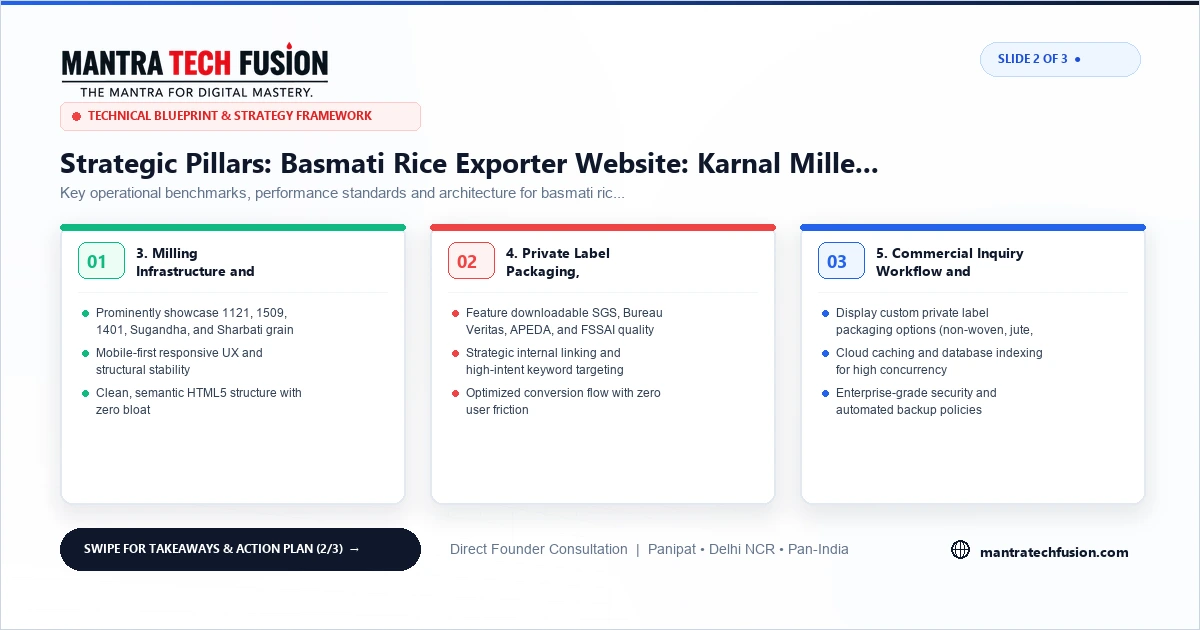
Modern grain buyers demand proof that milling operations meet international hygiene, sorting, and contamination standards. Your plant capabilities section must document the physical infrastructure of your Karnal milling unit:
- Paddy Storage & Aging Facilities: Detail temperature-controlled silo storage and traditional covered warehousing, emphasizing natural aging protocols (e.g., 1-year aged, 2-year aged) that enhance basmati aroma and cooking elongation.
- Sorting & Cleaning Technology: Highlight multi-stage pre-cleaners, de-stoners, huskers, and advanced Japanese or European optical color sorters (Buhler, Satake, or equivalent) that eliminate discolored grains and foreign matter.
- Metal Detection & Magnet Separators: Document inline neodymium rare-earth magnets and industrial metal detectors ensuring zero metallic contamination.
- Laboratory Testing Protocols: Detail your in-house laboratory equipment for measuring moisture, grain length calipers, cooking test apparatus, and PCR (Polymerase Chain Reaction) testing or tie-ups with NABL-accredited labs for DNA purity verification.
- Maximum Residue Limits (MRL) Compliance: Address testing for pesticide residue, aflatoxins, and heavy metals, particularly when catering to strict EU and US FDA import thresholds.
4. Private Label Packaging, Palletization, and Container Logistics
International rice buyers frequently require customized retail packaging under their own proprietary brands. Your packaging section must detail:
- Packaging Materials: Non-woven fabric bags, BOPP (Biaxially Oriented Polypropylene) bags, Jute bags, Poly-pouches, and Master Corrugated Cartons.
- Unit Sizes: Comprehensive retail and food-service ranges (1 kg, 2 kg, 5 kg, 10 kg, 20 kg, 25 kg, and 50 kg / 100 lbs).
- Barcode & Labeling Compliance: Capability to print GS1-standard EAN/UPC barcodes, nutritional tables compliant with target market regulations, and multilingual printing (Arabic, English, French).
- Palletization & Container Stuffing: Document seaworthy container stuffing protocols (FCL 20ft ocean containers typically loading 21 to 26 metric tons depending on packaging and port limits), fumigation procedures, and container desiccant application.
- Shipping Ports: Document logistics routes from Karnal via Northern Indian ICDs (such as ICD Babarpur, ICD Piyala, or ICD Patli) to gateway container ports including Mundra Port and Nhava Sheva (JNPT).
Interactive 3-Slide Article Visual Guide
5. Commercial Inquiry Workflow and Documented Trade Terms
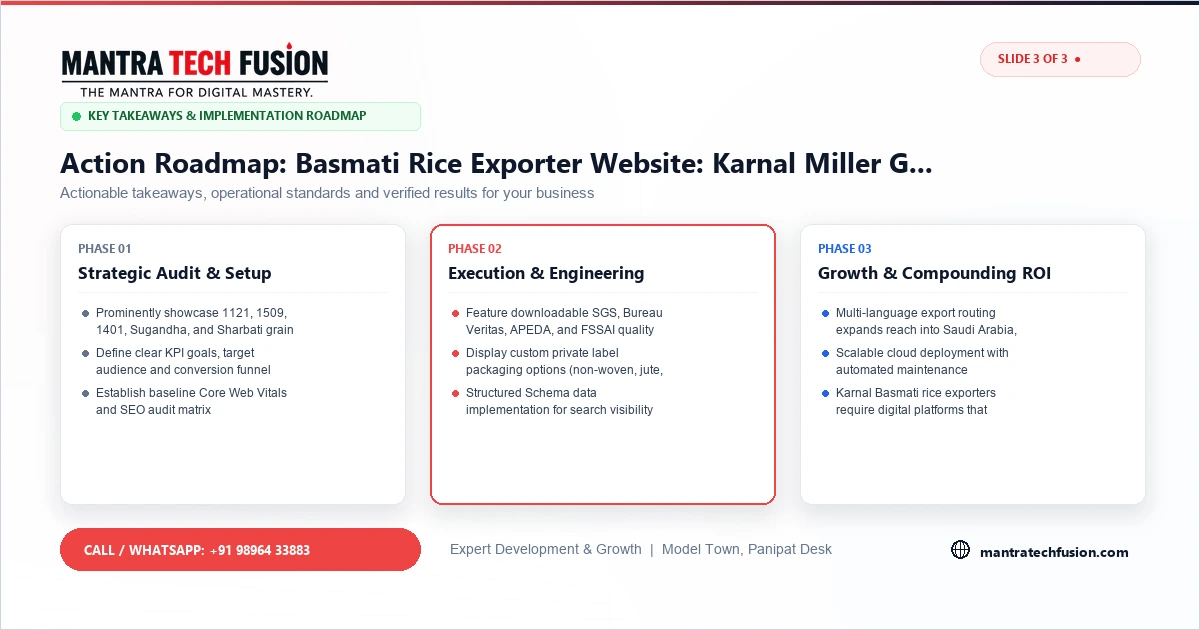
Facilitate serious commercial discussions by establishing an export-focused inquiry funnel:
- Targeted RFQ Fields: Prompt buyers to specify variety (e.g., 1121 Golden Sella), processing type, packing size, total volume in metric tons (or number of 20ft FCLs), and target destination port.
- Incoterms Transparency: Offer clear quotation options under standard Incoterms 2020 (FOB Mundra/JNPT, CIF destination port, or CFR).
- Payment Terms Clarification: Note accepted commercial instruments (Irrevocable Confirmed Letter of Credit at sight, or structured CAD/Advance wire transfer terms).
- Direct Export Desk Access: Provide dedicated export director contact details, official corporate email domains, and direct WhatsApp links for rapid communication across international time zones.
Recommended Page Structure for Karnal Rice Export Websites
- Home: Plant overview, export varieties, international compliance badges, and quick RFQ trigger.
- Rice Varieties: Individual sub-pages for 1121, 1509, Traditional, 1401, and Sharbati with downloadable technical specification sheets.
- Milling & Plant Infrastructure: Color sorter census, silos, aging facilities, and laboratory equipment photos.
- Quality & Lab Testing: MRL compliance policies, DNA purity testing, ISO/FSSC/HACCP/Halal certificates.
- Private Label Packaging: BOPP, non-woven, and jute packaging options with retail container calculations.
- Logistics & Supply Chain: Inland transit routes, ICD connections, ocean freight container packing photos.
- Request Quotation (RFQ): Comprehensive form with metric tonnage, cultivar, and destination port selectors.
A basmati export website is not a generic digital catalog. It is an evidentiary asset that proves regulatory compliance, grain purity, processing capacity, and logistical reliability to institutional buyers worldwide.
To discuss technical website architecture tailored for agro-commodity exporters, see our web development services and explore our regional solutions on our Karnal web development page. For broader commercial pricing context across corporate platforms, read our analysis on website design cost in Panipat & Haryana.