
When evaluating ambala scientific instruments, Known across the subcontinent as the "City of Scientific Instruments," Ambala in northern Haryana produces a substantial share of India’s educational, clinical, and industrial laboratory apparatus. From precision microscopes, refractometers, and polarimeters to borosilicate glassware, autoclave sterilizers, and digital spectrophotometers, Ambala’s instrument clusters on Jagadhri Road, Science Market, and the Industrial Area supply domestic schools, universities, pharmaceutical research laboratories, and global testing facilities across Africa, Southeast Asia, the Middle East, and Europe.
Yet despite decades of manufacturing heritage, many Ambala instrument makers present digital catalogs that fail to satisfy modern institutional procurement protocols. When an overseas laboratory manager, university purchasing committee, or hospital biomedical engineer searches for testing hardware, they operate with precise technical checklists. A website that displays grainy product photographs without comprehensive physical and electronic specifications forces the buyer to look elsewhere. Below is the technical architecture required for a high-performing scientific instrument catalog website.
Strategic Overview: Ambala Scientific Instruments and Industry Best Practices
In the scientific and testing instrumentation sector, commercial buyers do not purchase based on generalized marketing claims such as "high precision" or "durable construction." Procurement specifications are strictly quantitative. Your catalog database must support structured, searchable attribute fields tailored to each instrument category:
- Optical Instrumentation (Microscopes, Polarimeters, Telescopes): Optical system (Achromatic, Plan Achromatic, Infinity corrected), numerical aperture (NA), magnification ranges (40x to 1000x), field of view diameter, illumination type (LED 3W with intensity control, Halogen 6V/20W), and mechanical stage travel dimensions.
- Thermal & Heating Apparatus (Ovens, Incubators, Water Baths): Temperature operating range (ambient +5°C to 250°C), temperature controller accuracy (PID digital controller with ±0.1°C sensitivity), chamber volume in liters, interior metallurgy (Grade 304 stainless steel), and insulation material (mineral wool, ceramic fiber).
- Laboratory Glassware & Volumetric Ware: Glass composition (Borosilicate 3.3 expansion coefficient), Class A or Class B volumetric certification, compliance with DIN ISO 3819 / ASTM E438 standards, and chemical resistance ratings.
- Electrical & Power Parameters: Operating voltage (220V AC 50Hz / 110V AC 60Hz switchable for export), power consumption in watts, fuse ratings, and surge protection features.
2. Compliance, Calibration, and International Certification Gates
Laboratory equipment and analytical devices cannot enter institutional laboratories without verifiable quality accreditations. Instead of hiding certificates in an unorganized gallery, implement structured compliance displays on every product page:
- NABL Calibration Traceability: Document whether instruments are calibrated against standards traceable to the National Accreditation Board for Testing and Calibration Laboratories (NABL) or equivalent international metrology bodies.
- CE & RoHS Marking: European buyers mandate CE conformity (Low Voltage Directive and Electromagnetic Compatibility Directive) along with Restriction of Hazardous Substances (RoHS) documentation. Provide clear certificate references.
- ISO 9001:2015 & ISO 13485: For clinical and medical apparatus, showcase medical device quality management standard ISO 13485 with certificate validity dates.
- Material Test Reports: For autoclaves, pressure vessels, and specialized glassware, offer on-demand material compliance test certificates.
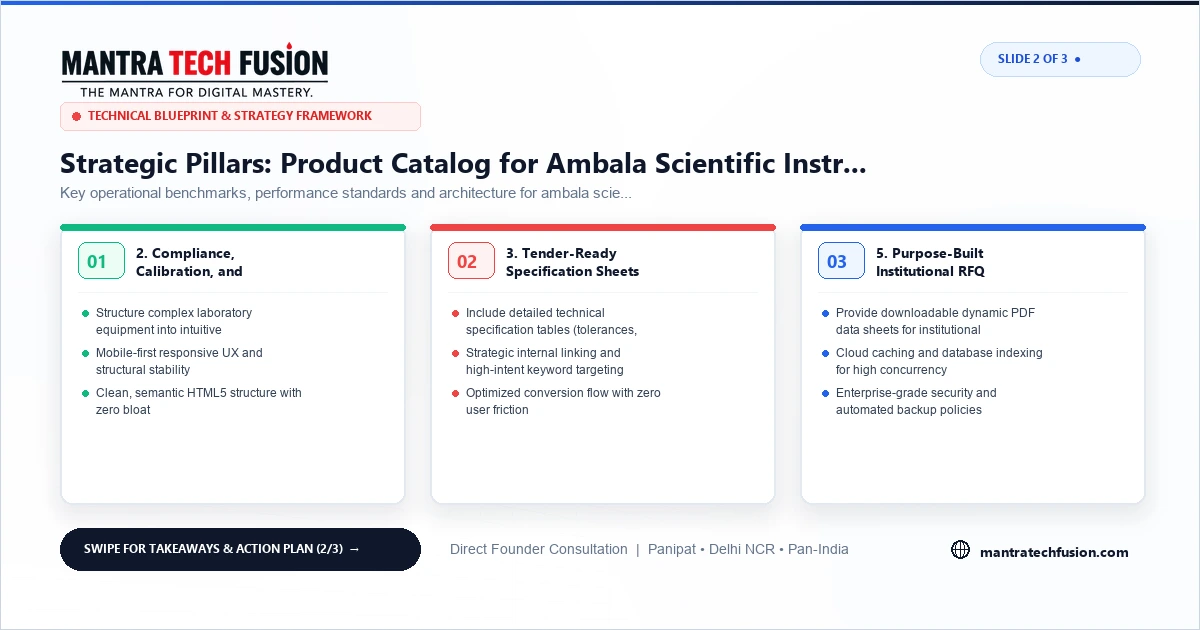
3. Tender-Ready Specification Sheets (Dynamic PDF Generation)
A distinctive feature of institutional scientific buying is the formal procurement committee review. Professors, laboratory directors, and procurement officers rarely place orders on impulse; they compile specification comparison files to justify budget expenditures or tender compliance. Your website architecture should include:
- One-Click "Download Technical Datasheet": An automated server-side mechanism that formats the product's live specification table, dimensional line drawings, standard accessories, and company contact details into a clean, professional PDF file.
- Tender Compliance Clause Copy: Provide a copyable text block of standard technical tender clauses that procurement officers can paste directly into tender documentation when specifying your equipment.
- Standard vs Optional Accessories List: Clearly delineate what is included in the standard shipping box (e.g., dust cover, immersion oil, power cord, calibration certificate) versus optional upgrades (e.g., digital CMOS camera adapters, darkfield condensers, phase contrast sets).
4. Industrial Packaging, Volumetric Shipping, and Fragility Protection
Scientific instruments and optical devices are inherently sensitive to shock, vibration, and moisture during long-haul transit. International buyers frequently abandon inquiries if they lack confidence in the supplier's overseas shipping capabilities:
- Transit Protection Transparency: Document standard packaging protocols (e.g., custom styrofoam-moulded inner boxes, heavy-duty five-ply corrugated outer cartons, and export-grade fumigated wooden crates with ISPM-15 stamps).
- Gross Weight & Volumetric Weight Data: State approximate packaged dimensions and net/gross weights per unit, allowing overseas freight forwarders to estimate air freight and ocean container costs rapidly.
- Fragile Freight Handling: Detail desiccant silica-gel inclusion and drop-tested shock resistance procedures.
Interactive 3-Slide Article Visual Guide
5. Purpose-Built Institutional RFQ Workflow
Standard e-commerce shopping carts with credit card checkout are ill-suited for commercial laboratory instrumentation. An effective B2B scientific inquiry engine must capture:
- Institutional/Organization Entity Name (University, Research Institute, Quality Control Lab, Trading Company).
- Designation of Purchaser (Procurement Head, Chief Lab Technician, Department Chair).
- Project/Tender Reference Number (if quoting against a formal tender).
- Required Voltage and Plug Type (Type C, G, D, etc., depending on destination country).
- Delivery Incoterm requested (FOB Delhi Airport / Nhava Sheva, or CIF destination port).
When an Ambala manufacturer presents detailed technical data, clear calibration traceability, and seamless quotation tools, overseas buyers treat the firm as an authoritative engineering partner rather than an unverified low-cost supplier.
To explore custom catalog development engineered for manufacturing exporters, see our e-commerce and catalog solutions and learn about our regional service footprint on our Haryana state web development hub. If your operation is preparing for local and international search visibility, review our foundational guide on how SEO-friendly development accelerates business growth.
Comprehensive Implementation Framework for Ambala Scientific Instruments
To execute ambala scientific instruments with high precision and measurable ROI, modern digital organizations must establish clear standard operating procedures across engineering, design, and content operations. Aligning technical infrastructure with commercial business objectives ensures sustained organic performance, maximum brand authority, and consistent customer acquisition.
Furthermore, technical teams should continuously monitor Core Web Vitals, server response latencies, and security headers to guarantee an uncompromising standard of user experience across both desktop and mobile viewports.
Key Operational Benchmarks and Performance Standards
Deploying a successful initiative requires measuring performance against verified industry standards and technical benchmarks:
- Sub-Second Page Rendering: Ensure Largest Contentful Paint (LCP) remains under 1.8 seconds on real-world 4G mobile networks.
- Verified Conversion Paths: Streamline quote request funnels and contact touchpoints with real-time input validation and instant CRM lead alerts.
- Robust Data Security: Protect client interactions with strict SSL/TLS encryption, prepared database queries, and automated off-site backups.
- Semantic Search Indexing: Structure content with Schema.org JSON-LD markup to capture rich SERP snippets and answer engine citations.
- Mobile Ergonomics: Provide minimum 48px touch targets and zero horizontal viewport scrolling on all mobile displays.
Strategic Architecture and Maintenance Best Practices
Maintaining long-term leadership requires routine performance audits, content refreshes, and proactive security patching. Implementing automated staging environments and continuous integration workflows prevents code regressions and ensures flawless operational continuity across all commercial channels.
By prioritizing user intent fulfillment, transparent product specifications, and high-converting calls to action, your enterprise creates an enduring competitive advantage in today's digital marketplace.
Technical Checklist for Modern Digital Infrastructure
Ensure your digital deployment adheres strictly to the following enterprise engineering protocols:
- Zero Layout Shifts (CLS < 0.05): Declare explicit width and height attributes on all media and dynamic components.
- Strict MIME Type Validation: Prevent arbitrary file execution by validating uploaded assets against strict allowlists.
- Automated Data Redundancy: Maintain daily off-site encrypted database snapshots with rapid point-in-time recovery capabilities.
- Immutable Cache Directives: Leverage long-lived HTTP caching headers for static CSS, JS, and optimized WebP visual assets.
Long-Term Economic Value and Return on Investment
Investing in a high-standard digital strategy yields compounding dividends over multiple financial quarters. By reducing dependency on volatile third-party referral networks and paid PPC channels, your brand builds durable organic equity that drives qualified sales pipelines at a fraction of traditional advertising costs. Furthermore, high Core Web Vitals performance and technical domain stability protect your market share against algorithm updates.
Frequently Asked Questions Regarding Ambala Scientific Instruments
What is the most effective approach to get started with ambala scientific instruments?
Begin with a comprehensive technical audit of your current digital assets, establish clear performance benchmarks, and implement high-priority structural optimizations that directly improve user experience and search indexation.
How does this impact long-term enterprise growth?
By compounding organic search visibility, eliminating code bottlenecks, and streamlining customer conversion funnels, businesses achieve higher profit margins and lower customer acquisition costs over time.