
When evaluating dpdp act compliance checklist, India’s digital regulatory environment has undergone a historic transformation. Following the passage of the Digital Personal Data Protection Act, 2023 (DPDP Act) by Parliament and the subsequent official notification of the Digital Personal Data Protection Rules, 2025 by the Ministry of Electronics and Information Technology (MeitY) in the Gazette of India in November 2025, commercial websites operating in India are subject to binding statutory data governance obligations.
For years, many Indian small and medium-sized enterprises (SMEs) treated website legal pages as an afterthought: copying generic privacy policy templates from foreign websites, embedding pre-ticked consent boxes, and storing customer inquiries across unsecured spreadsheets without retention policies. Under the operational framework established by the 2023 Act and 2025 Rules, any organization collecting digital personal data - including names, mobile numbers, email addresses, physical addresses, or tracking identifiers - operates legally as a Data Fiduciary.
With the Data Protection Board of India (DPBI) established and phased transition deadlines actively running through 2026 toward full operational enforcement by mid-2027, every commercial website must audit its data collection practices. Below is an objective, practical website compliance checklist designed for Indian business owners and webmasters.
Strategic Overview: Dpdp Act Compliance Checklist and Industry Best Practices
Under the DPDP statutory framework, consent is legally invalid unless it is accompanied or preceded by an itemized, transparent notice. Websites can no longer rely on vague footers claiming "by using this website you agree to our terms":
- Itemized Purpose Specification: Before a user submits an inquiry form, Request for Quote (RFQ), or newsletter subscription, the website must present a clear notice stating exactly what personal data is collected and the specific purpose for which it will be processed (e.g., "We collect your name and phone number solely to provide a written quotation and project consultation").
- Multi-Lingual Availability: Section 5 mandates that the notice and consent request must be accessible in English or any of the 22 languages specified in the Eighth Schedule to the Constitution of India (such as Hindi, Punjabi, Bengali, Gujarati, or Tamil).
- Unambiguous Affirmative Action: Consent must be an explicit, affirmative action. Pre-ticked consent checkboxes are strictly prohibited. The user must manually click an unticked checkbox or explicit consent button.
- Right to Withdraw Consent: The notice must explicitly inform the data principal that they have the right to withdraw consent at any time with an ease of withdrawal comparable to giving consent.
2. Comprehensive Privacy Policy Modernization
Generic privacy policies downloaded from international generators frequently reference European GDPR articles or California CCPA provisions that have no legal standing under Indian law. A DPDP-compliant privacy policy must include:
- Identity & Contact of the Data Fiduciary: Exact legal corporate entity name, registered office address, corporate identification number (CIN/LLPIN/GSTIN), and official contact email.
- Data Principal Rights Enumeration: Explicitly delineate user rights under the DPDP Act: the right to access a summary of personal data being processed, the right to correction and erasure of inaccurate or outdated data, the right to grievance redressal, and the right to nominate an individual in the event of death or incapacity.
- Third-Party Processors & Data Sharing: Disclose categories of third-party Data Processors with whom personal data is shared (e.g., cloud hosting providers, payment gateways, CRM software, SMS/WhatsApp notification gateways) and state that processing is bound by strict contractual data safeguards.
- Cross-Border Transfer Transparency: Disclose whether personal data is stored on servers located outside India, noting alignment with Central Government notifications regarding international data transfers.
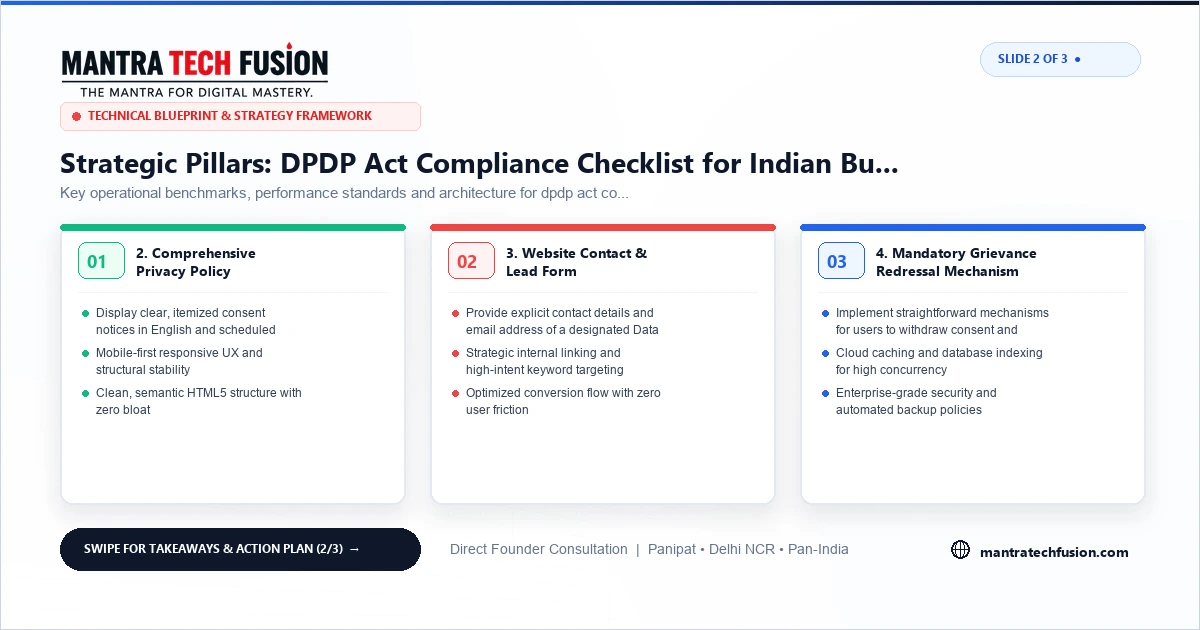
3. Website Contact & Lead Form Architectural Overhaul
Standard lead capture forms must be technically re-engineered to reflect data minimization principles:
- Data Minimization Principle: Collect only data strictly necessary for the transaction. If an inquiry form only requires contacting a buyer, do not mandate secondary fields such as personal dates of birth, PAN numbers, or home addresses.
- Clear Opt-In Checkboxes: Place an explicit, unticked checkbox adjacent to the submission button: "I consent to the collection and processing of my contact information in accordance with the Privacy Policy for the purpose of receiving project consultation."
- Separation of Commercial Marketing Consent: If you intend to use customer phone numbers for marketing newsletters or promotional WhatsApp broadcasts, this must be separated into a distinct, optional checkbox. You cannot condition core service delivery on consenting to promotional marketing.
4. Mandatory Grievance Redressal Mechanism Display
Section 8(10) of the Act and the 2025 Rules require every Data Fiduciary to establish an effective, publicly accessible grievance redressal mechanism:
- Prominently Display Grievance Officer Details: Your website’s contact page, privacy policy, and dedicated Grievance Redressal page must publish the official name, designation, physical office address, and contact email of your designated Grievance Officer.
- Statutory Response Timelines: Organizations must maintain internal protocols to acknowledge grievances promptly and resolve complaints within the statutory timeframes established under the Rules before the user escalates the matter to the Data Protection Board of India.
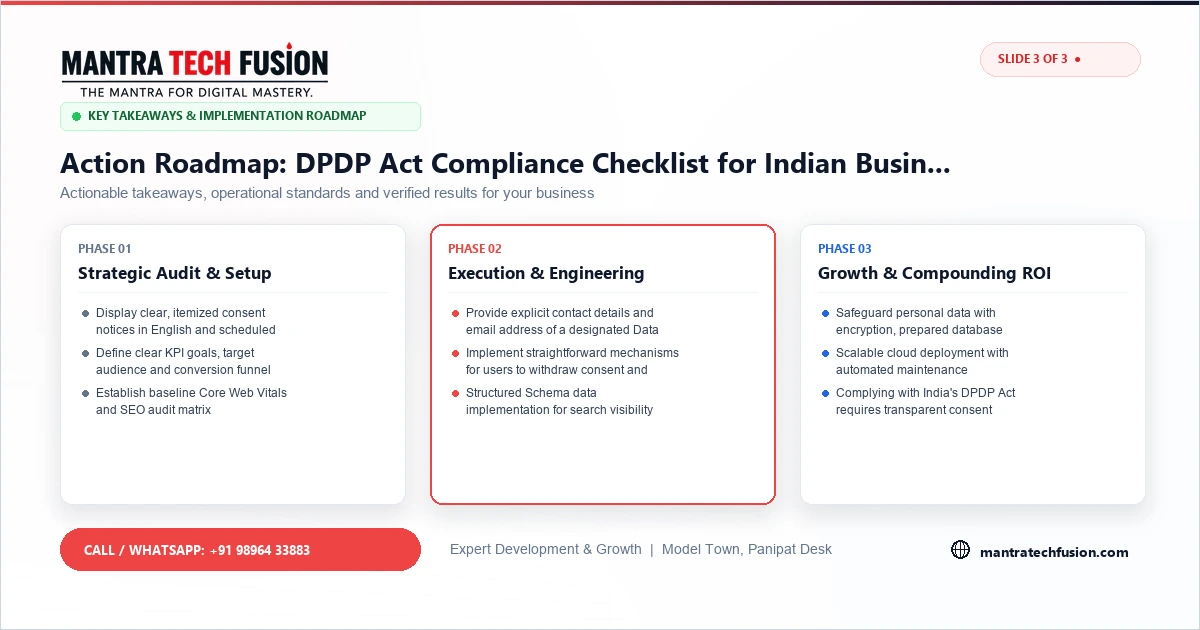
Interactive 3-Slide Article Visual Guide
5. Protection of Children’s Personal Data (Section 9)
For educational academies, coaching institutes, schools, and children-oriented digital portals, the DPDP Act imposes strict restrictions:
- Verifiable Parental Consent: Processing the personal data of a child (defined as an individual under 18 years of age) requires obtaining verifiable parental or legal guardian consent before data collection.
- Absolute Ban on Tracking & Targeted Ads: Organizations are strictly prohibited from tracking, behavioral monitoring, or serving targeted advertisements directed at children.
6. Data Security Safeguards and Breach Preparedness
Section 8(5) requires Data Fiduciaries to implement reasonable technical security safeguards to prevent personal data breaches under threat of severe financial penalties (up to ₹250 crore for significant failures):
- Mandatory SSL/TLS Encryption: Enforce end-to-end HTTPS encryption across all pages, forms, and administrative endpoints.
- Database Protection: Implement parameterized SQL queries (PDO/prepared statements) to prevent SQL injection vulnerabilities, hash user passwords using modern algorithms (Argon2id or bcrypt), and restrict database administrative access via multi-factor authentication (MFA).
- Data Retention & Erasure Protocols: Establish automated database hygiene routines to purge personal data once the specified commercial purpose has been fulfilled and statutory tax/accounting retention periods have expired.
Aligning your corporate website with the DPDP Act and 2025 Rules is not simply a legal compliance exercise; it is a powerful differentiator that builds institutional trust with consumers, enterprise clients, and overseas trading partners.
To inspect secure web development architectures, explore our custom web development services and examine our published privacy policy framework. For deeper technical strategies on protecting business portals from digital vulnerabilities, review our complete guide on why every modern business needs a professional, compliant website.