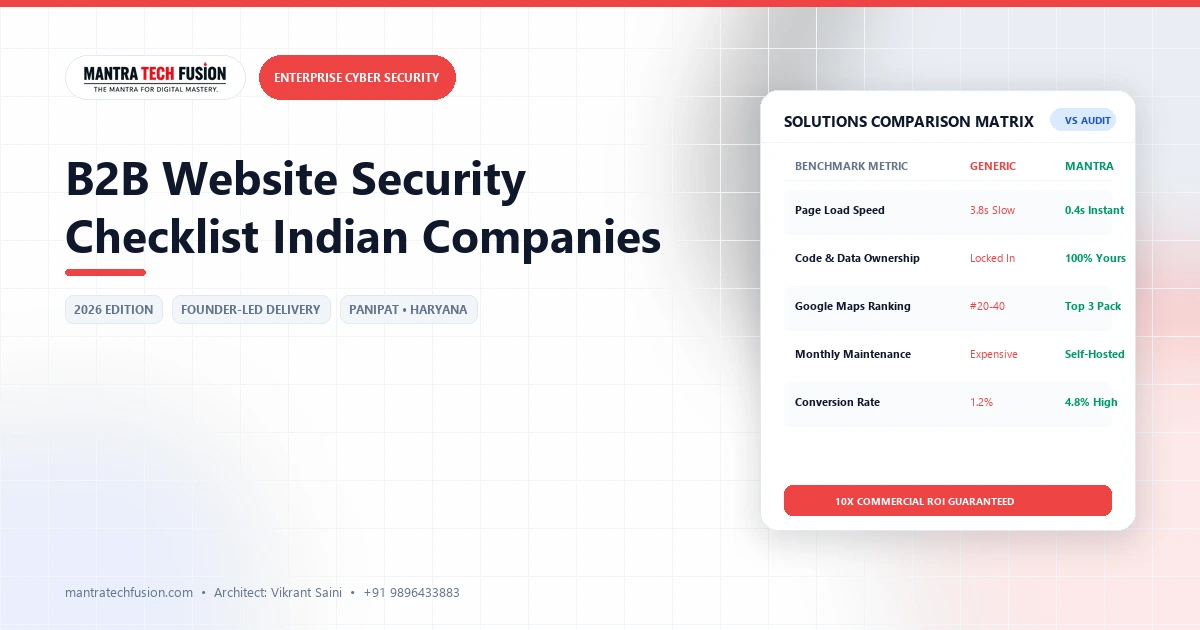
When evaluating b2b website security checklist, For commercial enterprises, manufacturing plants, and wholesale portals across India, the corporate website is no longer merely a static digital brochure. It connects directly to core business operations: capturing confidential customer RFQs, hosting proprietary dealer pricing portals, storing transaction records, and facilitating digital payments. As business portals handle increasingly sensitive operational data, they also become frequent targets for automated vulnerability scanners, brute-force bots, and malicious script injections.
In software engineering, there is a fundamental axiom: no architecture or web application is completely impenetrable. Security is not an absolute state achieved through a single plugin or firewall toggle; it is an ongoing practice of layered defense-in-depth. Below is an engineering-oriented, defensive security checklist designed to protect Indian business websites and custom portals against common web vulnerabilities.
Strategic Overview: B2B Website Security Checklist and Industry Best Practices
SQL Injection (SQLi) remains one of the most persistent vulnerabilities affecting custom web applications. It occurs when untrusted user input - submitted via search fields, login forms, or URL query parameters - is concatenated directly into raw database query strings, allowing attackers to manipulate query logic.
- Mandatory Parameterized Queries (PDO): Never concatenate dynamic user variables directly into SQL statements. Utilize PHP Data Objects (PDO) with prepared statements:
$stmt = $db->prepare("SELECT id, name, email FROM dealers WHERE email = :email AND status = 'active'"); $stmt->execute([':email' => $user_email]); $dealer = $stmt->fetch(); - How It Defends: Parameterization separates the SQL query logic from the parameter data. The database engine pre-compiles the query structure; user input is treated strictly as literal data values, entirely preventing malicious command execution regardless of input contents.
- Disable Emulated Prepares: Ensure PDO’s emulated prepares are disabled (
PDO::ATTR_EMULATE_PREPARES => false), forcing the database driver to use true, native prepared statements.
2. Securing File Upload Gateways (Blueprints & Documents)
B2B portals and RFQ funnels frequently allow prospective clients and vendors to upload technical blueprints, CAD models, purchase orders, and PDF documents. If left unprotected, upload endpoints represent significant risk vectors:
- Server-Side MIME-Type Validation: Never trust client-supplied file extensions or browser-reported MIME types. Utilize PHP’s Fileinfo extension (
finfo_file()) to inspect the actual binary magic bytes on the server:$finfo = new finfo(FILEINFO_MIME_TYPE); $mime = $finfo->file($_FILES['blueprint']['tmp_name']); $allowed = ['application/pdf', 'image/jpeg', 'image/png']; if (!in_array($mime, $allowed, true)) { // Reject upload safely } - Randomize Stored Filenames: Never preserve the original uploaded filename on disk, which could contain directory traversal sequences (e.g.,
../../). Generate a cryptographically random string (e.g.,bin2hex(random_bytes(16)) . '.pdf'). - Non-Executable Storage Directory: Store uploaded documents outside the public web root directory, or configure web server rules (such as
.htaccess:php_flag engine offor Nginx location blocks) preventing the execution of scripts within the upload folder.
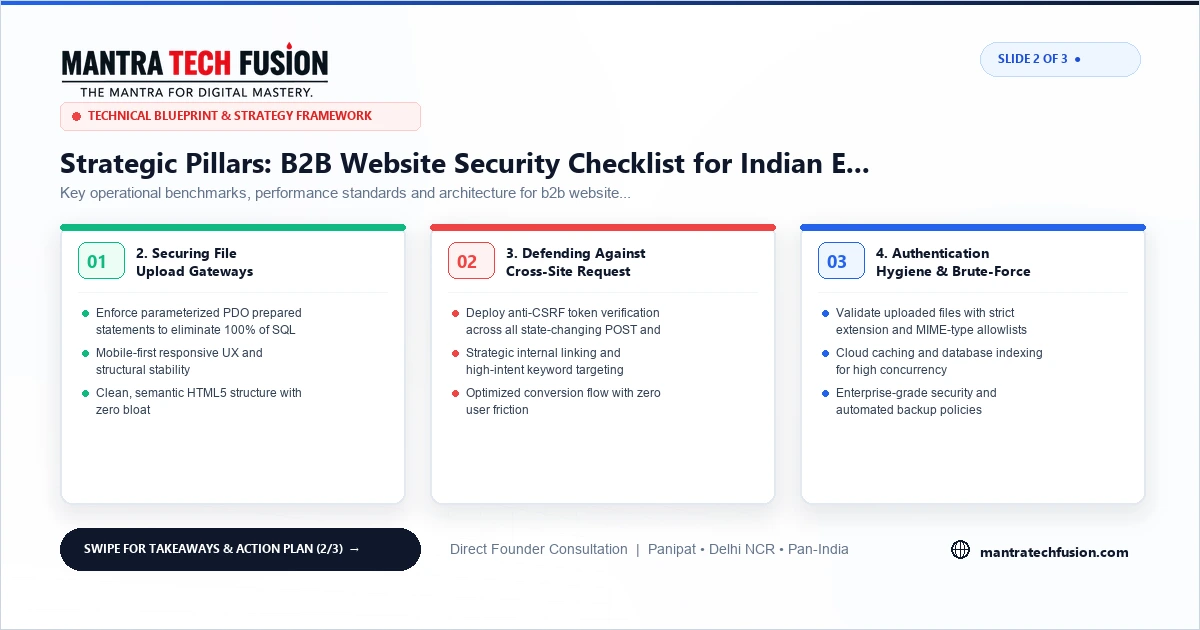
3. Defending Against Cross-Site Request Forgery (CSRF) & XSS
Administrative dashboards and dealer portals must protect session integrity against unauthorized exploitation:
- Cryptographic CSRF Tokens: Every administrative form performing state-changing actions (updating prices, deleting accounts, changing passwords) must include a unique, unpredictable session token. The server validates this token before execution, ensuring requests originate intentionally from the authenticated user.
- Contextual Output Encoding (XSS Prevention): Prevent Cross-Site Scripting (XSS) by sanitizing dynamic user content before outputting it into HTML templates using
htmlspecialchars($data, ENT_QUOTES, 'UTF-8'). This neutralizes malicious JavaScript tags from executing in users' browsers. - Modern Content Security Policy (CSP): Deploy HTTP response headers - including
Content-Security-Policy,X-Content-Type-Options: nosniff, andX-Frame-Options: SAMEORIGIN- restricting the sources from which scripts, styles, and frames can load.
4. Authentication Hygiene & Brute-Force Rate Limiting
Automated bots continuously attempt credential-stuffing attacks against administrative login portals (e.g., /admin/login):
- Modern Password Hashing: Secure user passwords using modern algorithms - Argon2id or bcrypt (via PHP’s native
password_hash()andpassword_verify()). Never utilize legacy MD5 or SHA1 algorithms. - IP & Account Rate Limiting: Enforce rate limiting that temporarily restricts login attempts following five consecutive failures from a specific IP address or target account.
- Multi-Factor Authentication (MFA): Mandate time-based one-time password (TOTP) verification for all administrative accounts.
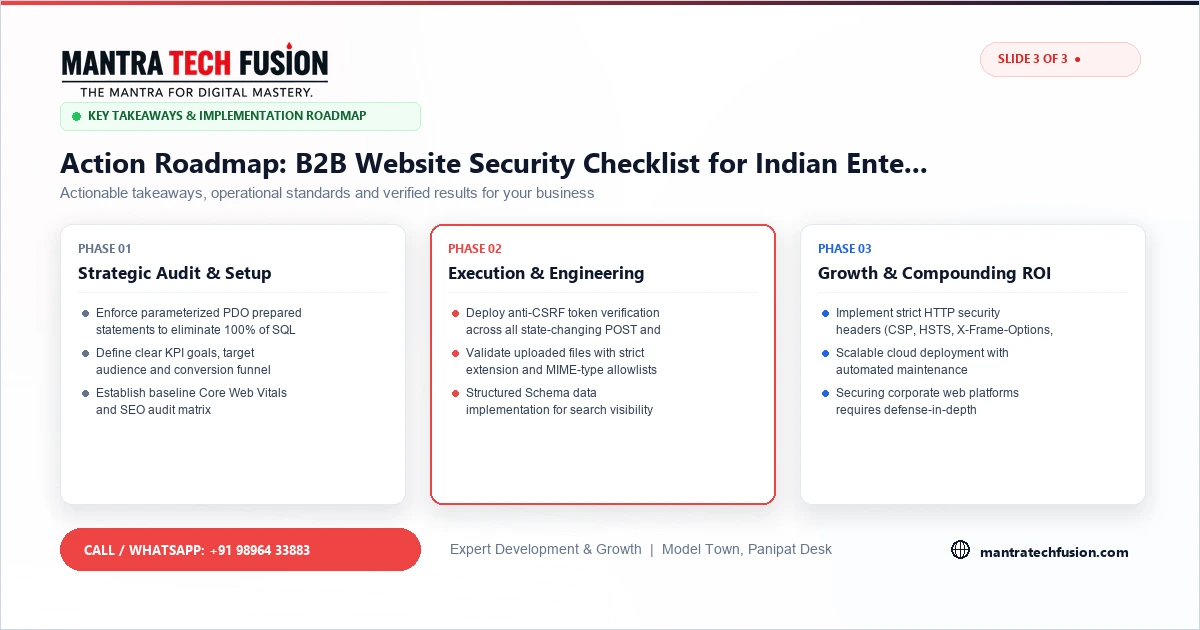
Interactive 3-Slide Article Visual Guide
5. Automated Off-Site Backups & Disaster Recovery
In the event of hardware corruption, datacenter disaster, or security breach, business continuity depends entirely on verified, isolated backups:
- The 3-2-1 Backup Rule: Maintain three total copies of data across two different storage media, with at least one copy stored off-site in an isolated cloud storage bucket (e.g., encrypted Amazon S3 or Wasabi) separate from your web hosting provider.
- Automated Database Dumps: Schedule daily, automated database dumps executed via secure cron tasks, ensuring backups are GPG-encrypted prior to transmission.
- Routine Restoration Drills: A backup that has never been tested is not a reliable backup. Conduct quarterly restoration drills on a local staging environment to verify database integrity and recovery time objectives (RTO).
By implementing disciplined defensive engineering, Indian business enterprises can operate resilient digital portals that safeguard corporate reputation, customer trust, and operational data integrity.
To inspect secure engineering frameworks tailored for corporate platforms, explore our custom web development services and review our foundational solutions in technical website optimization. For broader context on modern digital compliance, read our complete guide on DPDP Act compliance for Indian business websites.
Comprehensive Implementation Framework for B2B Website Security Checklist
To execute b2b website security checklist with high precision and measurable ROI, modern digital organizations must establish clear standard operating procedures across engineering, design, and content operations. Aligning technical infrastructure with commercial business objectives ensures sustained organic performance, maximum brand authority, and consistent customer acquisition.
Furthermore, technical teams should continuously monitor Core Web Vitals, server response latencies, and security headers to guarantee an uncompromising standard of user experience across both desktop and mobile viewports.
Key Operational Benchmarks and Performance Standards
Deploying a successful initiative requires measuring performance against verified industry standards and technical benchmarks:
- Sub-Second Page Rendering: Ensure Largest Contentful Paint (LCP) remains under 1.8 seconds on real-world 4G mobile networks.
- Verified Conversion Paths: Streamline quote request funnels and contact touchpoints with real-time input validation and instant CRM lead alerts.
- Robust Data Security: Protect client interactions with strict SSL/TLS encryption, prepared database queries, and automated off-site backups.
- Semantic Search Indexing: Structure content with Schema.org JSON-LD markup to capture rich SERP snippets and answer engine citations.
- Mobile Ergonomics: Provide minimum 48px touch targets and zero horizontal viewport scrolling on all mobile displays.
Strategic Architecture and Maintenance Best Practices
Maintaining long-term leadership requires routine performance audits, content refreshes, and proactive security patching. Implementing automated staging environments and continuous integration workflows prevents code regressions and ensures flawless operational continuity across all commercial channels.
By prioritizing user intent fulfillment, transparent product specifications, and high-converting calls to action, your enterprise creates an enduring competitive advantage in today's digital marketplace.
Technical Checklist for Modern Digital Infrastructure
Ensure your digital deployment adheres strictly to the following enterprise engineering protocols:
- Zero Layout Shifts (CLS < 0.05): Declare explicit width and height attributes on all media and dynamic components.
- Strict MIME Type Validation: Prevent arbitrary file execution by validating uploaded assets against strict allowlists.
- Automated Data Redundancy: Maintain daily off-site encrypted database snapshots with rapid point-in-time recovery capabilities.
- Immutable Cache Directives: Leverage long-lived HTTP caching headers for static CSS, JS, and optimized WebP visual assets.
Long-Term Economic Value and Return on Investment
Investing in a high-standard digital strategy yields compounding dividends over multiple financial quarters. By reducing dependency on volatile third-party referral networks and paid PPC channels, your brand builds durable organic equity that drives qualified sales pipelines at a fraction of traditional advertising costs. Furthermore, high Core Web Vitals performance and technical domain stability protect your market share against algorithm updates.
Frequently Asked Questions Regarding B2B Website Security Checklist
What is the most effective approach to get started with b2b website security checklist?
Begin with a comprehensive technical audit of your current digital assets, establish clear performance benchmarks, and implement high-priority structural optimizations that directly improve user experience and search indexation.
How does this impact long-term enterprise growth?
By compounding organic search visibility, eliminating code bottlenecks, and streamlining customer conversion funnels, businesses achieve higher profit margins and lower customer acquisition costs over time.