
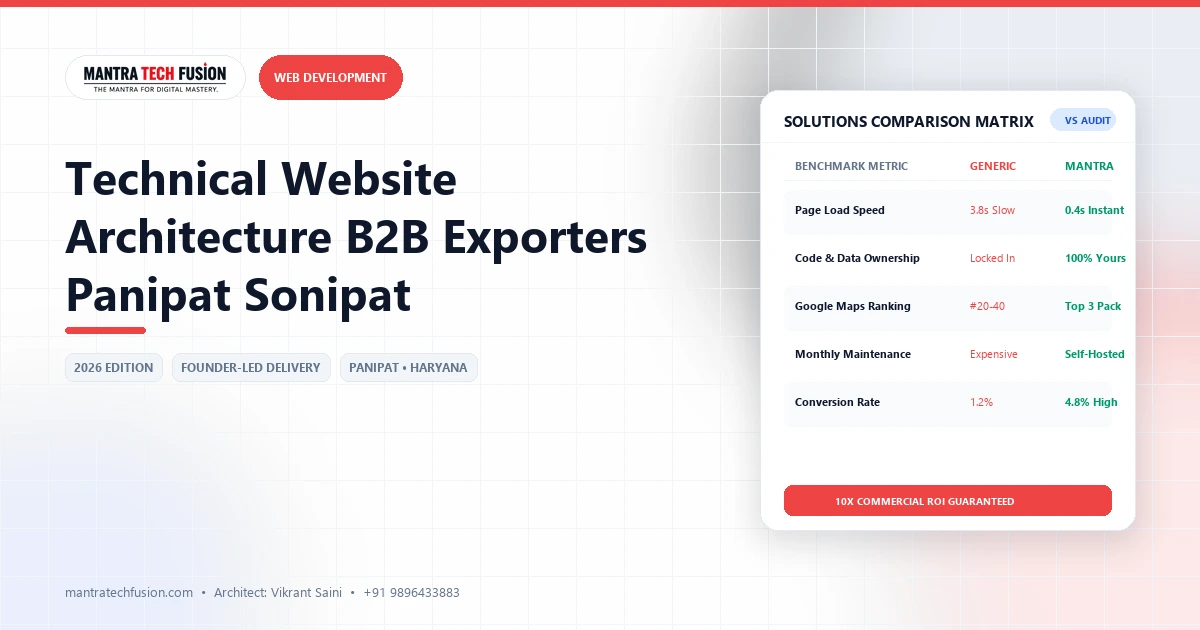
When evaluating technical website architecture b2b exporters, The industrial corridor spanning northern Haryana along National Highway 44 - anchored by the global home textile cluster of Panipat and the engineering, automotive components, and food processing zones of Sonipat (including Kundli and Rai) - generates billions in annual international export trade. Enterprise manufacturing units across this belt supply leading department stores, automotive OEMs, construction conglomerates, and hospitality chains across North America, Europe, the Middle East, and Australia.
Yet, when international procurement committees and sourcing directors inspect the digital infrastructure of many prominent Indian export manufacturers, they frequently encounter sluggish, mobile-unfriendly brochure websites. Outdated WordPress installations, missing technical parameters, unorganized product galleries, and slow overseas loading speeds fail to project the precision engineering and institutional reliability that these factories demonstrate on the ground. Below is a detailed technical architecture blueprint tailored for industrial B2B exporters operating across the Panipat and Sonipat manufacturing clusters.
Strategic Overview: Technical Website Architecture B2B Exporters and Industry Best Practices
A frequent blind spot for Indian industrial suppliers is evaluating website performance solely from their domestic factory desktop connections. While a site hosted on a domestic server in Delhi or Mumbai may render acceptably within Haryana, an overseas sourcing agent in Chicago, Hamburg, or Dubai faces trans-oceanic fiber transit hops:
- The Physical Latency Tax: Data packets traveling from India to North America incur a minimum of 180ms to 240ms of round-trip transmission latency. Without edge caching, rendering a complex product page with 30 image assets can take 4 to 8 seconds.
- Global Anycast CDN Architecture: Deploy an enterprise Content Delivery Network (such as Cloudflare Enterprise or AWS CloudFront). Static CSS, JavaScript, compiled WebP imagery, and downloadable PDF datasheets must be cached across edge nodes in Frankfurt, London, Ashburn, and Singapore.
- Tiered Caching Rules: Configure strict cache headers (
Cache-Control: public, max-age=31536000, immutable) for versioned technical assets, reducing origin server requests and ensuring overseas buyers experience sub-second page transitions.
2. Relational Product Database Architecture vs Flat CMS Posts
Export buyers do not browse websites like consumer lifestyle shoppers. They evaluate products against rigorous industrial and commercial specifications. A flat blogging architecture cannot handle deep technical catalogs:
- Normalized Relational Schemas: Organize products using structured database relationships. A textile exporter requires hierarchical schemas linking yarn counts, fabric compositions (e.g., 100% Recycled Cotton, Poly-Blend), weave densities (GSM), dye fastness grades, and container load capacities. An engineering component exporter in Kundli requires fields for alloy grades (SS304, SS316, Brass CW614N), CNC dimensional tolerances (±0.005mm), and surface finishing treatments.
- Parametric Faceted Filtering: Implement client-side or AJAX-driven faceted search allowing procurement agents to filter instantly by technical properties rather than manually opening dozens of individual catalog pages.
- Dynamic PDF Datasheet Generation: Enable backend scripts to dynamically compile product parameters, laboratory test certifications, and packaging specs into downloadable, branded PDF datasheets with a single click.
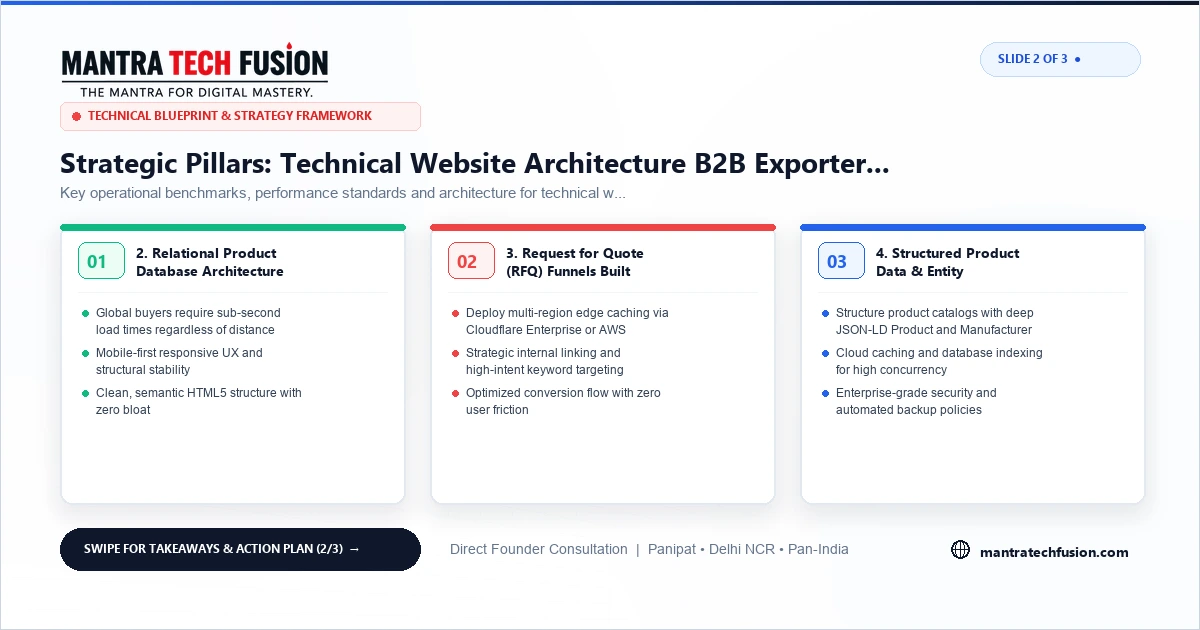
3. Request for Quote (RFQ) Funnels Built for Procurement Protocols
As detailed in our specialized B2B analysis, commercial export transactions cannot be finalized via retail shopping carts. The RFQ architecture must reflect international trade conventions:
- Incoterms & Port Destination Selectors: Provide clear dropdown menus for agreed delivery terms: FOB (Free on Board - Mundra / Nhava Sheva / Pipavav), CIF (Cost, Insurance, and Freight), or Ex-Works, allowing your commercial export desk to calculate accurate proforma quotes.
- Container Load Sizing: Allow buyers to specify requirements in 20ft Full Container Loads (FCL), 40ft High Cube (HC) containers, or Less than Container Load (LCL) pallet volumes.
- Secure Blueprint & Technical Spec Gateways: Support secure multi-file upload for CAD files (.step, .dwg, .dxf) and technical packaging specs, validated server-side using
finfo_file()with randomized storage outside the public web root.
4. Structured Product Data & Entity Optimization for Global Search
To capture high-intent international search queries (such as "custom recycled cotton throws manufacturer India" or "precision CNC brass turned parts exporter"), deploy Schema.org structured data with surgical accuracy:
- Comprehensive Product Schema: Mark up each commercial line with
Productschema, nesting themanufacturerproperty referencing your verified corporate entity. - Material & Property Markup: Utilize
additionalPropertynodes to describe specific technical parameters (e.g., tensile strength, yarn count, thread rating) so search engine crawlers and semantic AI answer engines understand your exact capabilities. - Preserving Data Integrity: Never generate fictitious inventory counts or fake review schemas. Where minimum order quantities (MOQ) apply, specify them transparently using
QuantitativeValuestructures.
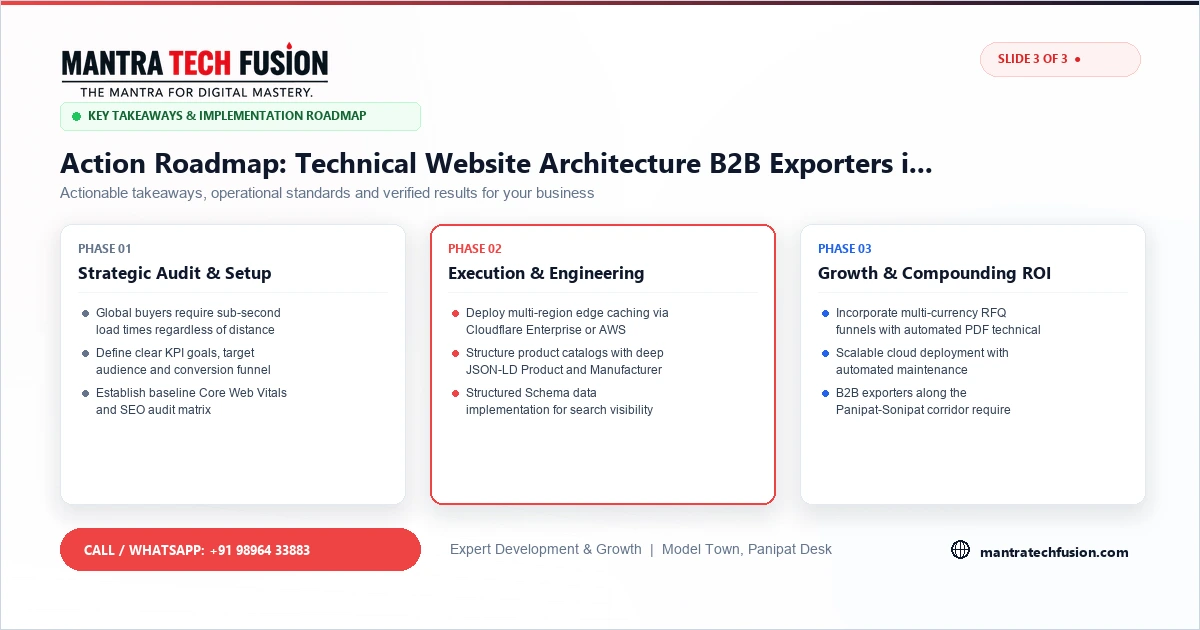
Interactive 3-Slide Article Visual Guide
5. Local Reality & Professional Transparency
In B2B trade, credibility is paramount. Exporters along the GT Road belt should never mimic generic international trading agencies. Be completely transparent regarding physical manufacturing reality: showcase high-resolution photography of actual factory floor machinery, automated looms, CNC machining centers, QA testing laboratories, and social compliance audit certificates (SEDEX, BSCI, ISO 9001). This authenticity provides institutional reassurance that third-party commission brokers cannot replicate.
To inspect engineered web architectures designed for manufacturing enterprises, explore our custom web design services and examine our foundational capabilities in custom web development. For related insights on industrial digital assets, read our specialized guide on product catalogue architecture for scientific manufacturers.
Comprehensive Implementation Framework for Technical Website Architecture B2B Exporters
To execute technical website architecture b2b exporters with high precision and measurable ROI, modern digital organizations must establish clear standard operating procedures across engineering, design, and content operations. Aligning technical infrastructure with commercial business objectives ensures sustained organic performance, maximum brand authority, and consistent customer acquisition.
Furthermore, technical teams should continuously monitor Core Web Vitals, server response latencies, and security headers to guarantee an uncompromising standard of user experience across both desktop and mobile viewports.
Key Operational Benchmarks and Performance Standards
Deploying a successful initiative requires measuring performance against verified industry standards and technical benchmarks:
- Sub-Second Page Rendering: Ensure Largest Contentful Paint (LCP) remains under 1.8 seconds on real-world 4G mobile networks.
- Verified Conversion Paths: Streamline quote request funnels and contact touchpoints with real-time input validation and instant CRM lead alerts.
- Robust Data Security: Protect client interactions with strict SSL/TLS encryption, prepared database queries, and automated off-site backups.
- Semantic Search Indexing: Structure content with Schema.org JSON-LD markup to capture rich SERP snippets and answer engine citations.
- Mobile Ergonomics: Provide minimum 48px touch targets and zero horizontal viewport scrolling on all mobile displays.
Strategic Architecture and Maintenance Best Practices
Maintaining long-term leadership requires routine performance audits, content refreshes, and proactive security patching. Implementing automated staging environments and continuous integration workflows prevents code regressions and ensures flawless operational continuity across all commercial channels.
By prioritizing user intent fulfillment, transparent product specifications, and high-converting calls to action, your enterprise creates an enduring competitive advantage in today's digital marketplace.
Technical Checklist for Modern Digital Infrastructure
Ensure your digital deployment adheres strictly to the following enterprise engineering protocols:
- Zero Layout Shifts (CLS < 0.05): Declare explicit width and height attributes on all media and dynamic components.
- Strict MIME Type Validation: Prevent arbitrary file execution by validating uploaded assets against strict allowlists.
- Automated Data Redundancy: Maintain daily off-site encrypted database snapshots with rapid point-in-time recovery capabilities.
- Immutable Cache Directives: Leverage long-lived HTTP caching headers for static CSS, JS, and optimized WebP visual assets.
Long-Term Economic Value and Return on Investment
Investing in a high-standard digital strategy yields compounding dividends over multiple financial quarters. By reducing dependency on volatile third-party referral networks and paid PPC channels, your brand builds durable organic equity that drives qualified sales pipelines at a fraction of traditional advertising costs. Furthermore, high Core Web Vitals performance and technical domain stability protect your market share against algorithm updates.
Frequently Asked Questions Regarding Technical Website Architecture B2B Exporters
What is the most effective approach to get started with technical website architecture b2b exporters?
Begin with a comprehensive technical audit of your current digital assets, establish clear performance benchmarks, and implement high-priority structural optimizations that directly improve user experience and search indexation.
How does this impact long-term enterprise growth?
By compounding organic search visibility, eliminating code bottlenecks, and streamlining customer conversion funnels, businesses achieve higher profit margins and lower customer acquisition costs over time.