When evaluating multilingual b2b website, India’s manufacturing landscape serves two fundamentally distinct commercial audiences: a vast domestic market operating across vibrant regional languages (Hindi, Gujarati, Marathi, Tamil, Telugu), and an extensive global export market spanning Europe, Latin America, and East Asia. For industrial equipment makers, textile mills, pharmaceutical packaging providers, and agricultural processing equipment manufacturers, offering content exclusively in English can create an artificial ceiling on commercial inquiries.
However, simply embedding a client-side "Google Translate" dropdown widget on an English website achieves neither search visibility nor professional credibility. Search engines cannot index client-side JavaScript translations, and unverified machine translations frequently distort complex engineering, metallurgical, and legal terms. Designing an effective multilingual B2B website requires a disciplined architectural foundation. Below is an engineering guide to implementing multilingual B2B web infrastructure for Indian enterprises.
Strategic Overview: Multilingual B2B Website and Industry Best Practices
Before translating a single paragraph, you must establish how distinct language assets will be hosted and indexed:
- Subdirectories (Recommended for Most Indian SMEs): Structuring language versions as subdirectories on your primary domain (e.g.,
mantratechfusion.com/for English,mantratechfusion.com/hi/for Hindi,mantratechfusion.com/de/for German) concentrates all backlink equity and domain authority under one root domain. It is cost-effective, straightforward to maintain, and easy to measure in Google Search Console. - Subdomains: Hosting versions on subdomains (e.g.,
de.example.com) allows hosting on separate regional servers. However, search engines treat subdomains as distinct entities, requiring independent link-building efforts. - Country-Code Top-Level Domains (ccTLDs): Purchasing country-specific domains (e.g.,
example.de,example.fr) provides the strongest local geo-targeting signals but requires substantial financial and operational overhead, justifying adoption only for large multinational enterprises with physical overseas entities.
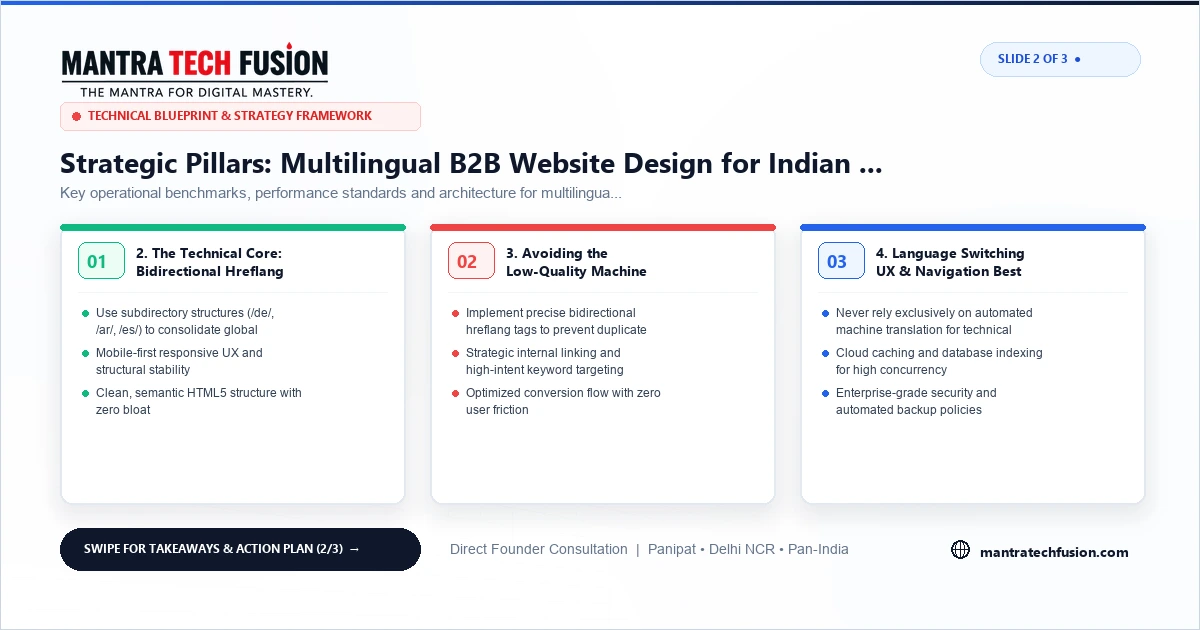
2. The Technical Core: Bidirectional Hreflang Implementation
The hreflang attribute is the technical cornerstone of international and multilingual SEO. It informs search engine crawlers about the relationship between alternate language versions of the same content:
- Mandatory Reciprocity: Hreflang tags must be fully bidirectional. If page A links to page B via an alternate hreflang tag, page B must return an identical tag pointing back to page A. If reciprocal tags are missing, search crawlers ignore the annotations entirely.
- Self-Referential Links: Every page must include a self-referential hreflang tag referencing its own URL.
- The x-default Fallback: Always include an
x-defaulttag pointing to your primary international landing page for users whose language preference is not explicitly mapped:<link rel="alternate" hreflang="en" href="https://example.com/services/" /> <link rel="alternate" hreflang="hi" href="https://example.com/hi/services/" /> <link rel="alternate" hreflang="de" href="https://example.com/de/services/" /> <link rel="alternate" hreflang="x-default" href="https://example.com/services/" />
3. Avoiding the Low-Quality Machine Translation Trap
Google’s search quality evaluator guidelines place strong emphasis on content accuracy and helpfulness. Deploying unedited, raw machine translations on crawlable URLs creates severe risks:
- Technical Term Distortion: Automated tools often translate precision engineering terms literally, resulting in nonsensical descriptions that confuse buyers (e.g., translating "die casting" or "lathe chuck" into inappropriate colloquial terms).
- Algorithmic Demotion: Pages populated with raw, uncurated machine translation can be flagged as auto-generated thin content under Google’s anti-spam algorithms, degrading the organic reputation of your entire domain.
- Human-in-the-Loop Review: Always utilize bilingual industry practitioners to review, refine, and validate technical terminology, ensuring that localized pages convey professional authority.
4. Language Switching UX & Navigation Best Practices
How users and search crawlers interact with language versions dictates conversion success:
- No Forced Automatic IP Redirection: Never automatically redirect visitors based solely on their IP address. An executive traveling in Germany may prefer browsing in English, while domestic buyers across India frequently search using English queries. Furthermore, search engine crawlers that originate from US data centers could be permanently locked out of regional language content.
- Intuitive, Crawlable Selectors: Provide an accessible language switcher in the header navigation using standard HTML anchor links (
<a href="/hi/">हिन्दी</a>) rather than un-crawlable JavaScript event handlers. - Preserve Context Across Swaps: Ensure that selecting a language switches to the exact translated equivalent of the current page, rather than dumping the user back to the foreign-language homepage.
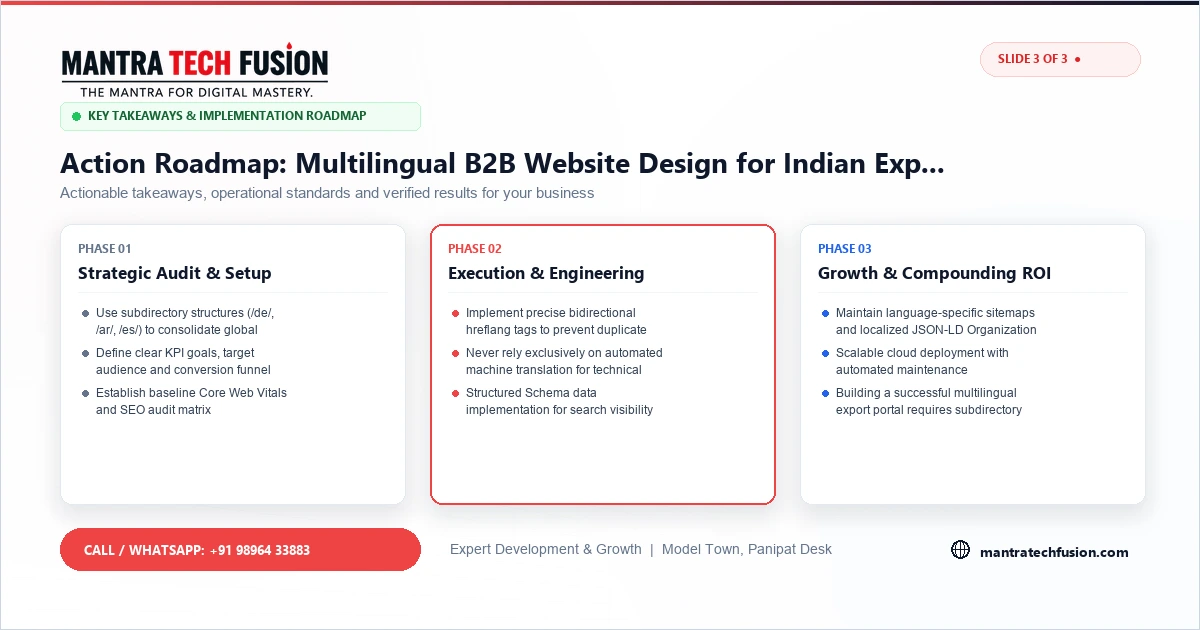
Interactive 3-Slide Article Visual Guide
5. Localizing Metadata, Sitemaps, and Technical Assets
True localization extends beyond body paragraphs. Ensure that meta titles, meta descriptions, image alt text, Open Graph tags, and structured data match the target language. Additionally, submit dedicated XML sitemaps for each language cluster or include localized alternate URLs directly within your main XML sitemap file to streamline discovery by Googlebot.
6. Font Optimization and Typography for Indic Scripts
Deploying regional Indian languages (such as Devanagari for Hindi or Marathi, Gurmukhi, or Dravidian scripts) requires careful typographic engineering:
- Subset Web Fonts: Unicode font families covering all Indian scripts can be several megabytes in size. Use Google Fonts or self-hosted WOFF2 fonts with dynamic unicode-range subsetting to deliver only the character glyphs required for rendered content.
- Vertical Line-Height Adjustments: Complex Indic conjunct characters and vowel diacritics extend above and below standard Latin baseline boundaries. Increase CSS
line-heightto at least 1.6 to 1.8 for vernacular text blocks to prevent character clipping. - Consistent Input Encoding: Ensure database tables, collation (
utf8mb4_unicode_ci), and HTTP response headers explicitly enforce UTF-8 character encoding to prevent garbled character display.
To inspect comprehensive multilingual architectures and global SEO strategies, explore our custom web development services and examine our foundational solutions in search engine optimization. For related insights on website scaling, read our detailed analysis on custom web architectures versus rigid templates.
Comprehensive Implementation Framework for Multilingual B2B Website
To execute multilingual b2b website with high precision and measurable ROI, modern digital organizations must establish clear standard operating procedures across engineering, design, and content operations. Aligning technical infrastructure with commercial business objectives ensures sustained organic performance, maximum brand authority, and consistent customer acquisition.
Furthermore, technical teams should continuously monitor Core Web Vitals, server response latencies, and security headers to guarantee an uncompromising standard of user experience across both desktop and mobile viewports.
Key Operational Benchmarks and Performance Standards
Deploying a successful initiative requires measuring performance against verified industry standards and technical benchmarks:
- Sub-Second Page Rendering: Ensure Largest Contentful Paint (LCP) remains under 1.8 seconds on real-world 4G mobile networks.
- Verified Conversion Paths: Streamline quote request funnels and contact touchpoints with real-time input validation and instant CRM lead alerts.
- Robust Data Security: Protect client interactions with strict SSL/TLS encryption, prepared database queries, and automated off-site backups.
- Semantic Search Indexing: Structure content with Schema.org JSON-LD markup to capture rich SERP snippets and answer engine citations.
- Mobile Ergonomics: Provide minimum 48px touch targets and zero horizontal viewport scrolling on all mobile displays.
Strategic Architecture and Maintenance Best Practices
Maintaining long-term leadership requires routine performance audits, content refreshes, and proactive security patching. Implementing automated staging environments and continuous integration workflows prevents code regressions and ensures flawless operational continuity across all commercial channels.
By prioritizing user intent fulfillment, transparent product specifications, and high-converting calls to action, your enterprise creates an enduring competitive advantage in today's digital marketplace.
Technical Checklist for Modern Digital Infrastructure
Ensure your digital deployment adheres strictly to the following enterprise engineering protocols:
- Zero Layout Shifts (CLS < 0.05): Declare explicit width and height attributes on all media and dynamic components.
- Strict MIME Type Validation: Prevent arbitrary file execution by validating uploaded assets against strict allowlists.
- Automated Data Redundancy: Maintain daily off-site encrypted database snapshots with rapid point-in-time recovery capabilities.
- Immutable Cache Directives: Leverage long-lived HTTP caching headers for static CSS, JS, and optimized WebP visual assets.
Long-Term Economic Value and Return on Investment
Investing in a high-standard digital strategy yields compounding dividends over multiple financial quarters. By reducing dependency on volatile third-party referral networks and paid PPC channels, your brand builds durable organic equity that drives qualified sales pipelines at a fraction of traditional advertising costs. Furthermore, high Core Web Vitals performance and technical domain stability protect your market share against algorithm updates.
Frequently Asked Questions Regarding Multilingual B2B Website
What is the most effective approach to get started with multilingual b2b website?
Begin with a comprehensive technical audit of your current digital assets, establish clear performance benchmarks, and implement high-priority structural optimizations that directly improve user experience and search indexation.
How does this impact long-term enterprise growth?
By compounding organic search visibility, eliminating code bottlenecks, and streamlining customer conversion funnels, businesses achieve higher profit margins and lower customer acquisition costs over time.