When evaluating service location page cannibalization, In the competitive arena of Indian business services, manufacturing, and digital agencies, multi-city expansion is a common strategic objective. A company operating from an industrial hub like Panipat or Gurugram naturally seeks commercial visibility across neighbouring commercial clusters such as Sonipat, Karnal, Rohtak, and Delhi NCR. To capture this search volume, marketing teams frequently deploy automated programmatic scripts to generate hundreds of location pages: "Web Development in Panipat", "Web Development in Sonipat", "Web Development in Karnal", and so forth.
In initial months, this tactic occasionally generates sporadic search impressions. Soon after, however, organic performance across the entire domain stalls. Core national service pages decline in rank, new city pages fail to index, and Google Search Console reveals erratic URL flipping. This technical failure is known as service-location page cannibalization, compounded by algorithmic flags under Google’s long-standing doorway page guidelines. Below is an engineering and technical SEO analysis on diagnosing, resolving, and safely structuring multi-location architecture across Indian commercial regions.
Strategic Overview: Service Location Page Cannibalization and Industry Best Practices
Cannibalization occurs when search engine algorithms cannot establish which URL on your domain represents the definitive, authoritative source for a given search query. In local SEO, this conflict manifests across three structural tiers:
- National Service Page vs City Page: Your root service page (e.g.,
/web-development/) targets broad commercial intent. When you introduce/web-development-panipat/without distinct contextual depth, both URLs compete for geo-modified and geo-implicit user searches originating from that district. - City Page vs Regional Hub: If your website maintains a provincial or state hub (such as
/india/haryana/) alongside individual city URLs (such as/india/haryana/panipat/), both pages can fragment link equity if their internal linking hierarchies and semantic entity scopes overlap without clear boundaries. - The Search Engine Dilemma: Confronted with multiple internal pages targeting the same topic with near-identical text, Google splits internal ranking signals, resulting in depressed search positions for both pages rather than a dominant top-three ranking for either.
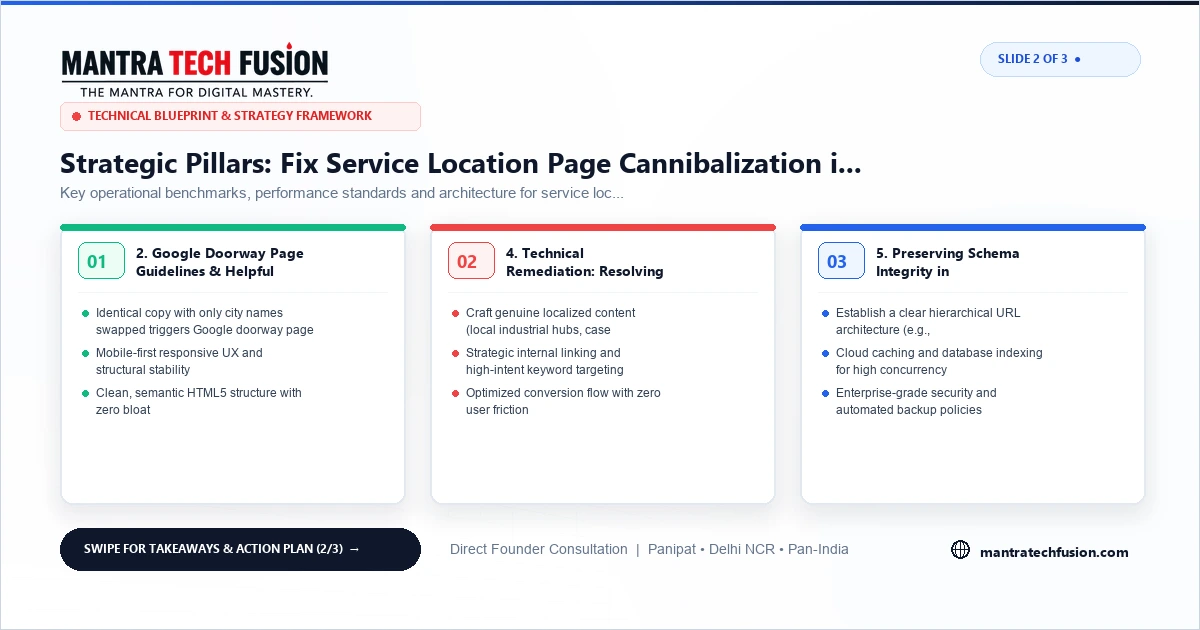
2. Google Doorway Page Guidelines & Helpful Content Principles
Google’s official developer documentation strictly defines doorway pages as sites or pages created to rank for specific, similar search queries - frequently location-based - that channel users to an essentially identical page. Common architectural patterns that trigger algorithmic devaluation include:
- Template Parameter Swapping: Changing only the city name in headings, body paragraphs, and meta titles across 50 pages while preserving 90% identical paragraph structure.
- Manufactured Local Statistics: Fabricating unverifiable regional population figures, arbitrary market shares, or generic district trivia that provides zero commercial utility to the reader.
- Empty Local Footprints: Promoting full-service physical delivery capabilities in municipalities where the company has no physical presence, no localized personnel, and no documented local portfolio.
3. A Pragmatic Framework: Determining When Location Pages Are Justified
Rather than adopting an all-or-nothing approach, evaluate location page generation against a transparent operational matrix:
| Criterion | Create Dedicated City Page | Consolidate into Regional Hub |
|---|---|---|
| Physical Infrastructure | Registered physical office, staff, or workshop | Remote delivery via video call or regional branch visits |
| Client Portfolio | Verifiable completed projects within the municipal boundary | Broader provincial or cross-state client accounts |
| Content Uniqueness | Substantive, tailored local industry insights (>80% unique) | High similarity to generic core service descriptions |
| Indexation Directive | index, follow with self-referential canonical |
noindex, follow or 301 redirect to parent regional hub |
4. Technical Remediation: Resolving Existing Cannibalization
If your website currently suffers from multi-location cannibalization, execute systematic technical remediation:
- Conduct a Full GSC Query Audit: Map impressions and clicks for target location keywords. Identify pairs of URLs competing for identical queries.
- Differentiate Search Intent: Position your core service pages to target national, technical, and high-level enterprise queries (e.g., "custom PHP web development"). Restrict location pages strictly to local intent queries combined with regional business context (e.g., "textile exporter web development Panipat").
- Implement Prudent Meta Robots Controls: For secondary towns where you cannot produce genuinely distinct, high-value editorial content, set the robots meta tag to
<meta name="robots" content="noindex, follow">. This preserves internal link discovery for search crawlers while preventing thin duplicate assets from diluting your domain’s indexation quality score. - Hierarchical Internal Breadcrumb Navigation: Reinforce clear entity relationships using structured breadcrumb links:
Home > Locations > Haryana > Panipat. This structure signals unambiguous parent-child relationships to Googlebot.
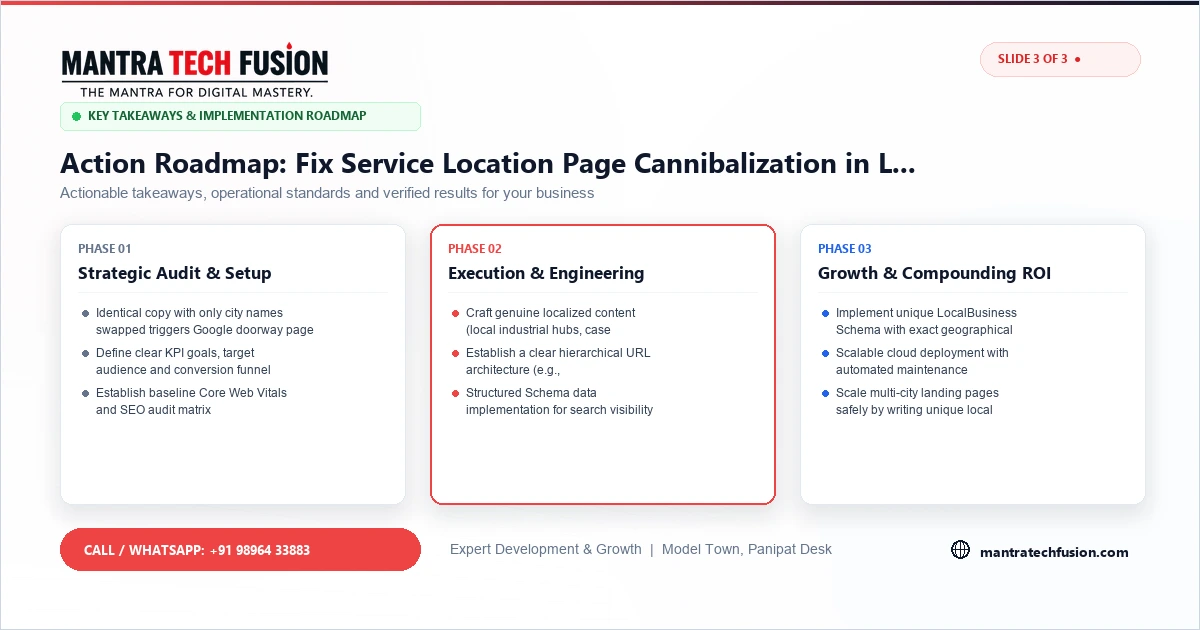
Interactive 3-Slide Article Visual Guide
5. Preserving Schema Integrity in Multi-Location Architectures
When applying structured data, ensure absolute consistency with physical reality. Do not attach LocalBusiness schema containing fake postal addresses or virtual office suites to secondary city landing pages. Where a genuine physical branch exists, deploy fully qualified LocalBusiness markup including accurate geo-coordinates and telephone details. For service areas without physical premises, rely on Organization schema combined with areaServed properties referencing authoritative Wikidata or Google Knowledge Graph entities.
To inspect disciplined local search strategies and technical search engineering, explore our comprehensive search engine optimization services and review our foundational solutions in custom web development. For related guidance on city-level search signals, consult our practical guide on Google Business Profile optimization for regional businesses.
Comprehensive Implementation Framework for Service Location Page Cannibalization
To execute service location page cannibalization with high precision and measurable ROI, modern digital organizations must establish clear standard operating procedures across engineering, design, and content operations. Aligning technical infrastructure with commercial business objectives ensures sustained organic performance, maximum brand authority, and consistent customer acquisition.
Furthermore, technical teams should continuously monitor Core Web Vitals, server response latencies, and security headers to guarantee an uncompromising standard of user experience across both desktop and mobile viewports.
Key Operational Benchmarks and Performance Standards
Deploying a successful initiative requires measuring performance against verified industry standards and technical benchmarks:
- Sub-Second Page Rendering: Ensure Largest Contentful Paint (LCP) remains under 1.8 seconds on real-world 4G mobile networks.
- Verified Conversion Paths: Streamline quote request funnels and contact touchpoints with real-time input validation and instant CRM lead alerts.
- Robust Data Security: Protect client interactions with strict SSL/TLS encryption, prepared database queries, and automated off-site backups.
- Semantic Search Indexing: Structure content with Schema.org JSON-LD markup to capture rich SERP snippets and answer engine citations.
- Mobile Ergonomics: Provide minimum 48px touch targets and zero horizontal viewport scrolling on all mobile displays.
Strategic Architecture and Maintenance Best Practices
Maintaining long-term leadership requires routine performance audits, content refreshes, and proactive security patching. Implementing automated staging environments and continuous integration workflows prevents code regressions and ensures flawless operational continuity across all commercial channels.
By prioritizing user intent fulfillment, transparent product specifications, and high-converting calls to action, your enterprise creates an enduring competitive advantage in today's digital marketplace.
Technical Checklist for Modern Digital Infrastructure
Ensure your digital deployment adheres strictly to the following enterprise engineering protocols:
- Zero Layout Shifts (CLS < 0.05): Declare explicit width and height attributes on all media and dynamic components.
- Strict MIME Type Validation: Prevent arbitrary file execution by validating uploaded assets against strict allowlists.
- Automated Data Redundancy: Maintain daily off-site encrypted database snapshots with rapid point-in-time recovery capabilities.
- Immutable Cache Directives: Leverage long-lived HTTP caching headers for static CSS, JS, and optimized WebP visual assets.
Long-Term Economic Value and Return on Investment
Investing in a high-standard digital strategy yields compounding dividends over multiple financial quarters. By reducing dependency on volatile third-party referral networks and paid PPC channels, your brand builds durable organic equity that drives qualified sales pipelines at a fraction of traditional advertising costs. Furthermore, high Core Web Vitals performance and technical domain stability protect your market share against algorithm updates.
Frequently Asked Questions Regarding Service Location Page Cannibalization
What is the most effective approach to get started with service location page cannibalization?
Begin with a comprehensive technical audit of your current digital assets, establish clear performance benchmarks, and implement high-priority structural optimizations that directly improve user experience and search indexation.
How does this impact long-term enterprise growth?
By compounding organic search visibility, eliminating code bottlenecks, and streamlining customer conversion funnels, businesses achieve higher profit margins and lower customer acquisition costs over time.