When evaluating schema org structured data, As search engines evolve from traditional keyword-matching algorithms into semantic Knowledge Graph and Large Language Model (LLM) retrieval engines, the way web content is represented to crawlers has fundamentally transformed. Search bots no longer simply scan for occurrences of a phrase; they construct relational entity graphs: What entity provides this capability? Who manufactures this equipment? Where is the physical plant located? What technical specifications define this product line?
For Indian B2B enterprises, industrial suppliers, and corporate service firms, Schema.org structured data represents the definitive vocabulary for communicating these entity relationships. However, structured data implementation across the Indian digital landscape is frequently plagued by errors: outdated Microdata tags, broken JSON syntax, duplicate conflicting entity declarations, and spammy markups designed to chase search snippets. Below is an engineering guide to architecting a clean, valid, and entity-accurate Schema.org strategy for Indian commercial websites.
Strategic Overview: Schema Org Structured Data and Industry Best Practices
While Schema.org vocabulary can theoretically be implemented via Microdata, RDFa, or JSON-LD, Google’s search engineering team has established JSON-LD (JavaScript Object Notation for Linked Data) as the universal standard:
- Separation of Concerns: JSON-LD is encapsulated within self-contained
<script type="application/ld+json">blocks. It does not clutter presentation HTML with complex inline attributes, enabling backend developers to generate structured data programmatically from database records. - Maintainability & Nested Objects: Complex relational structures - such as nesting an
Organizationinside aProductschema as themanufacturer- are straightforward to express in JSON-LD’s clean hierarchical syntax without breaking template layouts.
2. Essential B2B Schema Classes & Entity Mapping
A. Organization & LocalBusiness Schemas
Every commercial website must define its core corporate entity on the homepage:
- Organization: Declare corporate legal name, primary logo, official website URL, customer care contact points, and verified social Knowledge Graph profiles (
sameAslinks pointing to verified LinkedIn company pages, YouTube channels, and regulatory registries). - LocalBusiness (Conditional Reality): Only implement
LocalBusinesson pages representing verified physical operations (head offices, registered manufacturing facilities, or physical branch workshops). Include authentic postal addresses, verified geo-coordinates (latitude/longitude), and official telephone numbers. Never generate fictitious LocalBusiness markups for cities where no physical premises exist.
B. Product Schema with Manufacturer Attribution
For manufacturing enterprises along industrial corridors (such as Panipat, Sonipat, Ambala, and Yamunanagar), accurately marking up industrial catalogs is vital:
- Preserving the Manufacturer Property: Never strip out the
manufacturernode simply for code economy. Linking theProductto yourOrganizationsignals that your company is the primary OEM rather than a third-party reseller:{ "@context": "https://schema.org", "@type": "Product", "name": "Precision CNC Turned Brass Fitting", "description": "High-precision CNC machined brass components with ±0.005mm tolerance.", "manufacturer": { "@type": "Organization", "name": "Your Manufacturing Entity", "url": "https://example.com" }, "additionalProperty": [ { "@type": "PropertyValue", "name": "Material Grade", "value": "Brass CW614N" } ] } - Avoiding Fictitious Offers: If your industrial product lines do not feature fixed consumer retail prices, omit the
Offerproperty or declare price inquiry terms legitimately rather than injecting arbitrary \$1 or ₹1 values, which trigger search quality warnings.
C. Service Schema
For engineering, web development, and corporate consulting capabilities, deploy Service schema detailing service type, provider entity, and geographic service areas (areaServed) referenced via authoritative administrative entities.
D. BreadcrumbList & Article Schemas
Every internal page must feature structured BreadcrumbList schema reflecting unambiguous directory depth (e.g., Home > Services > Custom Web Development). On technical knowledge hubs and blog articles, deploy Article or BlogPosting schema detailing published dates, author entities, and primary headlines.
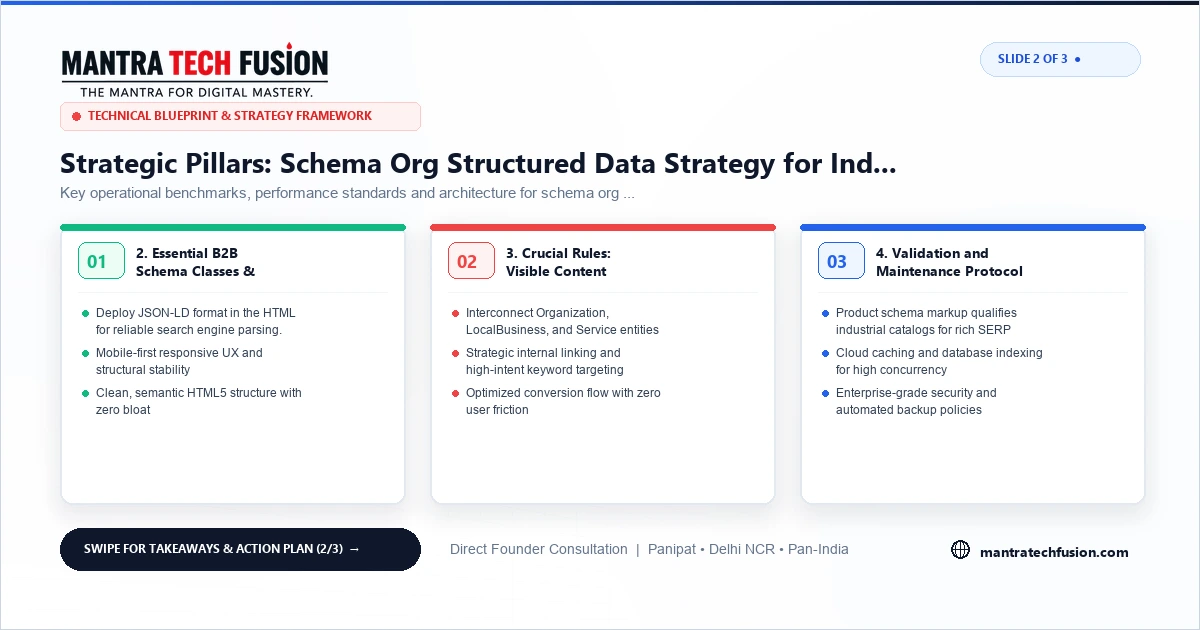
3. Crucial Rules: Visible Content Consistency & Spam Prevention
Google enforces strict guidelines governing structured data hygiene:
- 100% Visual Parity: Every piece of information declared in JSON-LD markup must be clearly visible and legible to human visitors reading the webpage. Hidden schema - such as including FAQs in JSON-LD that do not appear on the visible page - is treated as deceptive manipulation and can result in domain-wide structured data penalties.
- No Fabricated Reviews: Self-serving review markups generated from unverified internal testimonials are prohibited in Google’s Rich Results guidelines. Restrict review schema exclusively to third-party verified platforms where genuine independent validation exists.
4. Validation and Maintenance Protocol
Before deploying structured data to production, test every template using Google’s official Rich Results Test tool and the Schema.org Schema Markup Validator. Monitor Search Console’s "Enhancements" reports weekly to resolve syntax warnings and deprecated property notices.
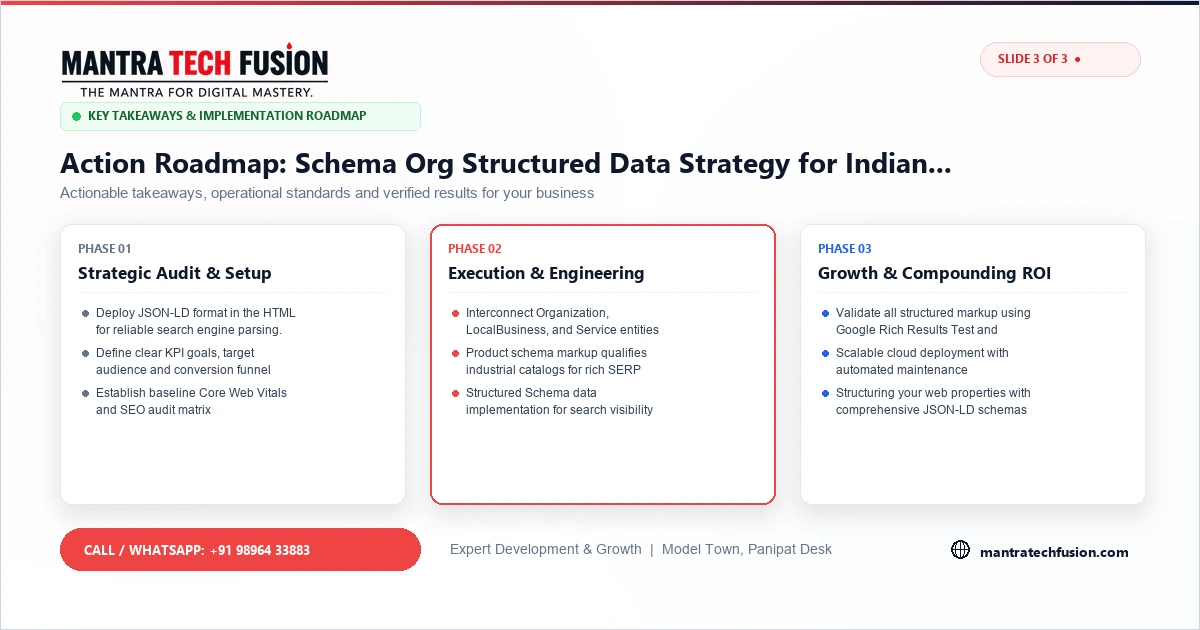
Interactive 3-Slide Article Visual Guide
5. Entity Disambiguation and the sameAs Attribute
One of the most effective capabilities of Schema.org is establishing unambiguous semantic identity through external knowledge graphs:
- Authoritative Wikidata Linking: In your
OrganizationorLocalBusinessmarkup, populate thesameAsarray with URLs pointing to your company's official corporate registration filings (such as MCA/Zauba Corp profiles), verified Wikipedia/Wikidata entries, and official trade directory registrations. - Disambiguating Geographic Entities: When defining
areaServedinServiceschemas, avoid using ambiguous text strings like "Haryana". Instead, reference the exact administrative Wikidata entity (e.g.,https://www.wikidata.org/wiki/Q1174for Haryana orhttps://www.wikidata.org/wiki/Q1025558for Panipat), enabling search engines and AI agents to map your operational footprint without geographic confusion.
To inspect advanced technical search architecture, explore our search engine optimization services and review our foundational solutions in custom web development. For related insights on technical search foundations, consult our guide on white hat SEO strategies for Indian businesses.
Comprehensive Implementation Framework for Schema Org Structured Data
To execute schema org structured data with high precision and measurable ROI, modern digital organizations must establish clear standard operating procedures across engineering, design, and content operations. Aligning technical infrastructure with commercial business objectives ensures sustained organic performance, maximum brand authority, and consistent customer acquisition.
Furthermore, technical teams should continuously monitor Core Web Vitals, server response latencies, and security headers to guarantee an uncompromising standard of user experience across both desktop and mobile viewports.
Key Operational Benchmarks and Performance Standards
Deploying a successful initiative requires measuring performance against verified industry standards and technical benchmarks:
- Sub-Second Page Rendering: Ensure Largest Contentful Paint (LCP) remains under 1.8 seconds on real-world 4G mobile networks.
- Verified Conversion Paths: Streamline quote request funnels and contact touchpoints with real-time input validation and instant CRM lead alerts.
- Robust Data Security: Protect client interactions with strict SSL/TLS encryption, prepared database queries, and automated off-site backups.
- Semantic Search Indexing: Structure content with Schema.org JSON-LD markup to capture rich SERP snippets and answer engine citations.
- Mobile Ergonomics: Provide minimum 48px touch targets and zero horizontal viewport scrolling on all mobile displays.
Strategic Architecture and Maintenance Best Practices
Maintaining long-term leadership requires routine performance audits, content refreshes, and proactive security patching. Implementing automated staging environments and continuous integration workflows prevents code regressions and ensures flawless operational continuity across all commercial channels.
By prioritizing user intent fulfillment, transparent product specifications, and high-converting calls to action, your enterprise creates an enduring competitive advantage in today's digital marketplace.
Technical Checklist for Modern Digital Infrastructure
Ensure your digital deployment adheres strictly to the following enterprise engineering protocols:
- Zero Layout Shifts (CLS < 0.05): Declare explicit width and height attributes on all media and dynamic components.
- Strict MIME Type Validation: Prevent arbitrary file execution by validating uploaded assets against strict allowlists.
- Automated Data Redundancy: Maintain daily off-site encrypted database snapshots with rapid point-in-time recovery capabilities.
- Immutable Cache Directives: Leverage long-lived HTTP caching headers for static CSS, JS, and optimized WebP visual assets.
Long-Term Economic Value and Return on Investment
Investing in a high-standard digital strategy yields compounding dividends over multiple financial quarters. By reducing dependency on volatile third-party referral networks and paid PPC channels, your brand builds durable organic equity that drives qualified sales pipelines at a fraction of traditional advertising costs. Furthermore, high Core Web Vitals performance and technical domain stability protect your market share against algorithm updates.
Frequently Asked Questions Regarding Schema Org Structured Data
What is the most effective approach to get started with schema org structured data?
Begin with a comprehensive technical audit of your current digital assets, establish clear performance benchmarks, and implement high-priority structural optimizations that directly improve user experience and search indexation.
How does this impact long-term enterprise growth?
By compounding organic search visibility, eliminating code bottlenecks, and streamlining customer conversion funnels, businesses achieve higher profit margins and lower customer acquisition costs over time.