When evaluating b2b website conversion rate optimization, When business leadership notices that website traffic is increasing while incoming sales orders remain stagnant, the immediate reaction is frequently to demand more marketing expenditure: more search engine optimization, higher Google Ads budgets, or aggressive social media campaigns. However, pouring additional traffic into a leaky digital bucket rarely solves commercial growth challenges. If your website fails to communicate technical authority, clarify order parameters, or reassure risk-averse procurement teams, additional visitors simply bounce faster.
In consumer retail, Conversion Rate Optimization (CRO) revolves around button colors, countdown timers, and discount banners. In B2B manufacturing, engineering, and enterprise services, that approach is completely ineffective. Enterprise buyers do not make impulsive multi-lakh or multi-crore procurement decisions based on bright call-to-action buttons. B2B CRO is an engineering discipline: systematically identifying and dismantling points of cognitive friction across the entire evaluation journey. Below is a comprehensive 16-point B2B CRO audit protocol designed to turn web traffic into qualified commercial pipeline.
Strategic Overview: B2B Website Conversion Rate Optimization and Industry Best Practices
- 1. Search Intent Congruence: Does the landing page content match the explicit commercial intent of the incoming search query or ad click? If a visitor searches for "precision CNC brass fittings exporter" and lands on a generic company overview talking about "excellence and innovation," the cognitive disconnect triggers an immediate exit.
- 2. Traffic Source Segmentation: Evaluate conversion behavior across distinct channels: organic search, paid search ads, direct visits, and referral directories. High-intent search clicks frequently require detailed technical datasheets, whereas referral traffic may require broader company background context.
- 3. Value Proposition Clarity Above the Fold: Can a visiting plant manager or purchasing agent answer three fundamental questions within five seconds: What specific equipment or components do you manufacture? What technical standards do you meet? Who do you serve?
Phase 2: Technical Credibility & Institutional Reassurance
- 4. Objective Quality Proofs: B2B buyers are risk-averse; recommending the wrong industrial vendor can jeopardize production schedules or result in corporate reprimand. Display verified quality certifications (ISO 9001, CE, BIS, REACH) with high-resolution certificates available for inspection.
- 5. Authentic Operational Reality: Replace stock photography of generic smiling models with authentic high-resolution imagery and video of your actual factory floor, specialized machinery, testing laboratories, and finished palletized inventory.
- 6. Traceable Application Case Studies: Present concise technical case studies outlining the client’s operational challenge, the specific material or software solution engineered, and the measurable outcome achieved.
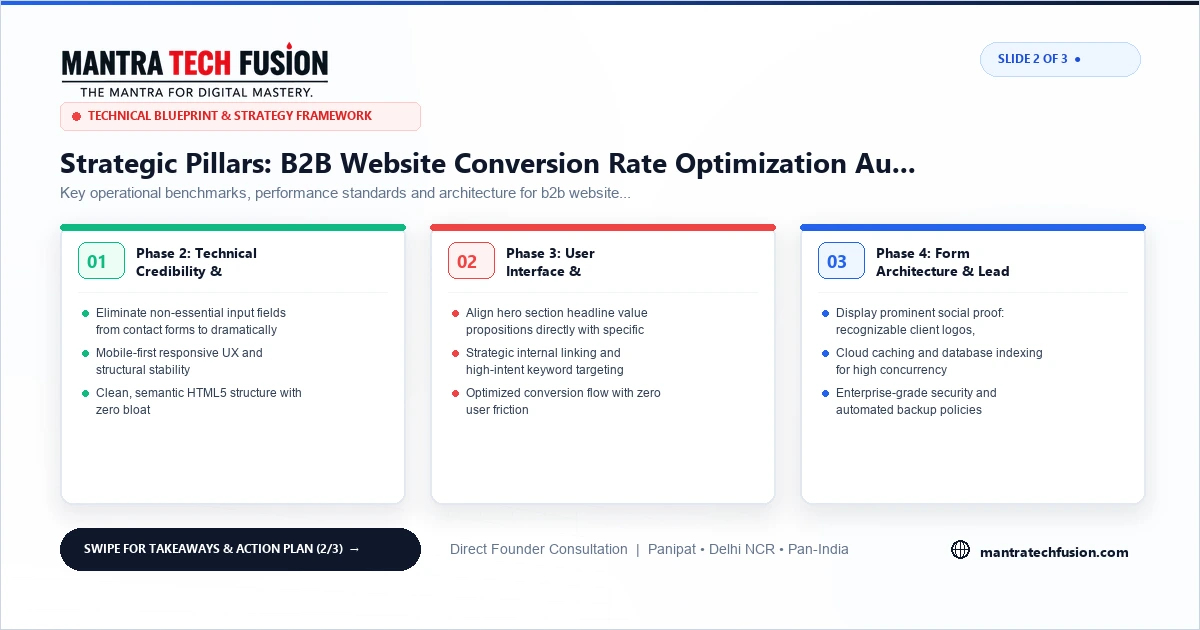
Phase 3: User Interface & Information Accessibility
- 7. Call-to-Action (CTA) Specificity: Eliminate vague, uninviting CTAs like "Submit" or "Click Here." Deploy action-oriented, professional copy: "Request Technical Quotation", "Download Component Datasheet", or "Schedule Engineering Review".
- 8. Mobile Ergonomics & Tap Targets: Factory owners and procurement officers frequently inspect websites on mobile devices while walking plant floors or traveling. Ensure form fields, dropdown selectors, and PDF download buttons feature generous tap targets (minimum 48x48 pixels) without horizontal page overflow.
- 9. Baseline Performance & Core Web Vitals: Page speed is a conversion baseline. If a product catalog takes five seconds to render on a 4G mobile connection, bounce rates escalate drastically. Maintain sub-second Time to First Byte (TTFB) and stable visual layouts.
Phase 4: Form Architecture & Lead Qualification
- 10. Progressive Multi-Step Information Gathering: Replace monolithic 15-field forms with clean multi-step progressive forms that group technical questions logically before requesting corporate contact details.
- 11. Strategic Friction for Quality Qualification: Paradoxically, reducing form fields to merely "Name and Email" often harms B2B sales efficiency. Introducing targeted qualification fields - such as order volume estimates, material grades, or project timeline dropdowns - filters out irrelevant retail inquiries and equips sales teams with actionable context.
- 12. Technical Drawing Upload Support: Ensure forms accommodate engineering drawings (.step, .dwg, .pdf) with clear file size limits and non-disclosure agreement (NDA) checkboxes.
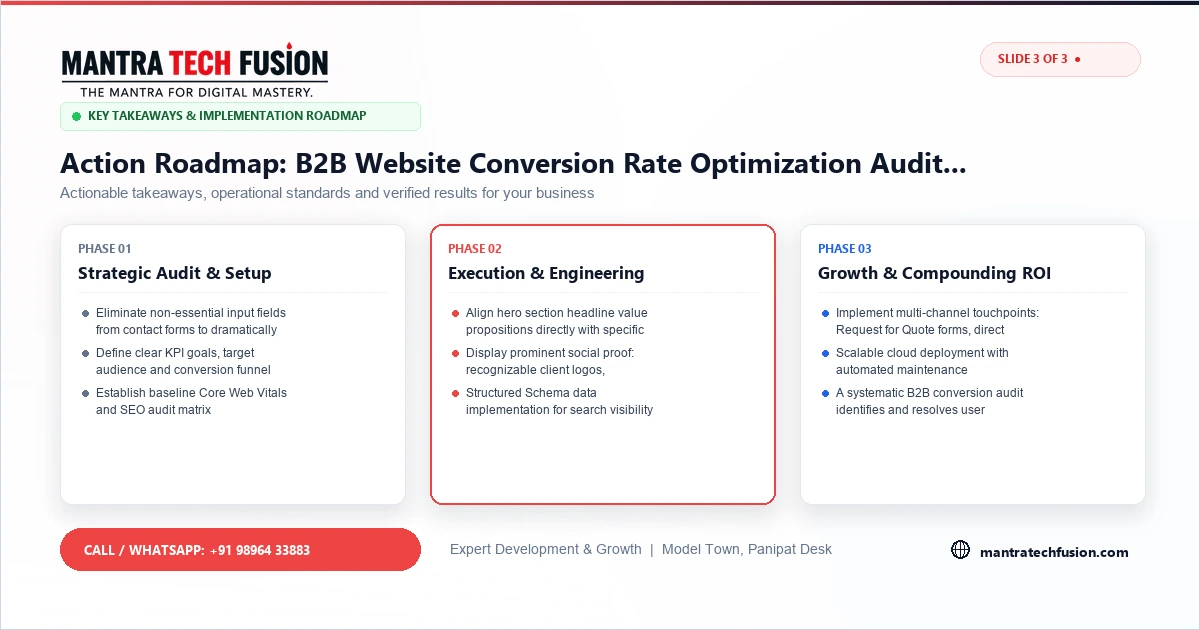
Interactive 3-Slide Article Visual Guide
Phase 5: Analytics, Attribution & Sales Hand-off
- 13. Micro and Macro Conversion Tracking: Configure Google Analytics 4 to track both primary macro-conversions (RFQ submissions, direct phone calls) and secondary micro-conversions (technical datasheet downloads, specification tab clicks).
- 14. First-Touch UTM Marketing Attribution: Pass incoming UTM parameters (campaign source, medium, ad group) invisibly through hidden form fields directly into your CRM to identify which marketing channels drive actual closed revenue rather than vanity traffic.
- 15. Immediate Post-Submission UX: Display an immediate confirmation screen with an assigned Inquiry Reference Number and realistic response timelines (e.g., "Our engineering desk reviews technical drawings within 24 working hours").
- 16. Sales Velocity and Lead Follow-Up Protocol: The most optimized website funnel fails if internal sales teams take four days to respond to inquiries. Implement automated CRM notifications (via email and WhatsApp) alerting technical leads instantly when a qualified RFQ is logged.
Conclusion: Measuring Qualified Pipeline Over Vanity Metrics
A successful B2B website conversion audit is not measured by whether total contact form fills increased by 50%. The true measure of commercial return is whether your sales engineering team spends less time handling unqualified solicitations and more time delivering profitable proforma quotations to institutional buyers who convert into long-term commercial accounts.
To inspect conversion-oriented website audits and technical optimization frameworks, explore our website redesign services and review our foundational solutions in search engine optimization. For related practical guidance on inquiry architecture, consult our comprehensive guide on building high-converting B2B Request for Quote funnels.
Comprehensive Implementation Framework for B2B Website Conversion Rate Optimization
To execute b2b website conversion rate optimization with high precision and measurable ROI, modern digital organizations must establish clear standard operating procedures across engineering, design, and content operations. Aligning technical infrastructure with commercial business objectives ensures sustained organic performance, maximum brand authority, and consistent customer acquisition.
Furthermore, technical teams should continuously monitor Core Web Vitals, server response latencies, and security headers to guarantee an uncompromising standard of user experience across both desktop and mobile viewports.
Key Operational Benchmarks and Performance Standards
Deploying a successful initiative requires measuring performance against verified industry standards and technical benchmarks:
- Sub-Second Page Rendering: Ensure Largest Contentful Paint (LCP) remains under 1.8 seconds on real-world 4G mobile networks.
- Verified Conversion Paths: Streamline quote request funnels and contact touchpoints with real-time input validation and instant CRM lead alerts.
- Robust Data Security: Protect client interactions with strict SSL/TLS encryption, prepared database queries, and automated off-site backups.
- Semantic Search Indexing: Structure content with Schema.org JSON-LD markup to capture rich SERP snippets and answer engine citations.
- Mobile Ergonomics: Provide minimum 48px touch targets and zero horizontal viewport scrolling on all mobile displays.
Strategic Architecture and Maintenance Best Practices
Maintaining long-term leadership requires routine performance audits, content refreshes, and proactive security patching. Implementing automated staging environments and continuous integration workflows prevents code regressions and ensures flawless operational continuity across all commercial channels.
By prioritizing user intent fulfillment, transparent product specifications, and high-converting calls to action, your enterprise creates an enduring competitive advantage in today's digital marketplace.
Technical Checklist for Modern Digital Infrastructure
Ensure your digital deployment adheres strictly to the following enterprise engineering protocols:
- Zero Layout Shifts (CLS < 0.05): Declare explicit width and height attributes on all media and dynamic components.
- Strict MIME Type Validation: Prevent arbitrary file execution by validating uploaded assets against strict allowlists.
- Automated Data Redundancy: Maintain daily off-site encrypted database snapshots with rapid point-in-time recovery capabilities.
- Immutable Cache Directives: Leverage long-lived HTTP caching headers for static CSS, JS, and optimized WebP visual assets.
Long-Term Economic Value and Return on Investment
Investing in a high-standard digital strategy yields compounding dividends over multiple financial quarters. By reducing dependency on volatile third-party referral networks and paid PPC channels, your brand builds durable organic equity that drives qualified sales pipelines at a fraction of traditional advertising costs. Furthermore, high Core Web Vitals performance and technical domain stability protect your market share against algorithm updates.
Frequently Asked Questions Regarding B2B Website Conversion Rate Optimization
What is the most effective approach to get started with b2b website conversion rate optimization?
Begin with a comprehensive technical audit of your current digital assets, establish clear performance benchmarks, and implement high-priority structural optimizations that directly improve user experience and search indexation.
How does this impact long-term enterprise growth?
By compounding organic search visibility, eliminating code bottlenecks, and streamlining customer conversion funnels, businesses achieve higher profit margins and lower customer acquisition costs over time.