When evaluating landing page vs full website, When planning a digital marketing initiative, business owners and marketing executives frequently face a strategic fork in the road: should the budget be allocated to building a targeted, single-page lead generation landing page, or is a comprehensive multi-page corporate website required to achieve measurable commercial return?
Neither format is universally superior. A standalone landing page engineered for a specific paid advertising campaign operates under fundamentally different conversion dynamics than a 25-page corporate website built for organic search and institutional credibility. Choosing the wrong asset for your primary customer acquisition channel can lead to wasted advertising budgets or missed organic search opportunities. Below is an objective analysis contrasting both digital architectures.
Strategic Overview: Landing Page Vs Full Website and Industry Best Practices
| Dimension | Single-Page Landing Page | Multi-Page Corporate Website |
|---|---|---|
| Primary Purpose | Direct conversion on a single specific action (call, form, demo) | Comprehensive brand presence, education, multi-channel trust |
| Navigation | Strictly stripped; zero outbound links to retain focus | Full header, footer, breadcrumbs, hierarchical menus |
| Traffic Channels | Paid Search (Google Ads), Paid Social (Meta, LinkedIn), Email | Organic Search (SEO), Direct, Referral, Brand Marketing |
| Sales Cycle Suitability | Short, high-intent consideration cycles | Complex B2B, enterprise, multi-stakeholder evaluations |
2. When a Standalone Landing Page Wins
Standalone landing pages deliver maximum efficiency when the traffic source is controlled, paid, and tightly targeted:
- Paid Search & Social Media Ad Campaigns: When bidding on specific high-intent search terms (e.g., "commercial rooftop solar installation Panipat"), sending clicks to a stripped landing page focused solely on commercial solar yields higher conversion focus than sending them to a generalized corporate homepage.
- Elimination of Decision Paralysis: Landing pages adhere to the 1:1 attention ratio: one campaign message matched to one explicit call-to-action. By removing main menus, blog sidebars, and unrelated service links, visitors focus entirely on evaluating the primary offer without cognitive distraction.
- Rapid A/B Hypothesis Testing: Marketers can test headline variations, lead form lengths, layout sequences, and proof points rapidly without altering core corporate infrastructure or risking live website operations.
- Micro-Conversion Tracking: Tracking exact cost-per-acquisition (CPA) is straightforward because conversion paths are linear, isolated, and directly attributed to specific ad spend.
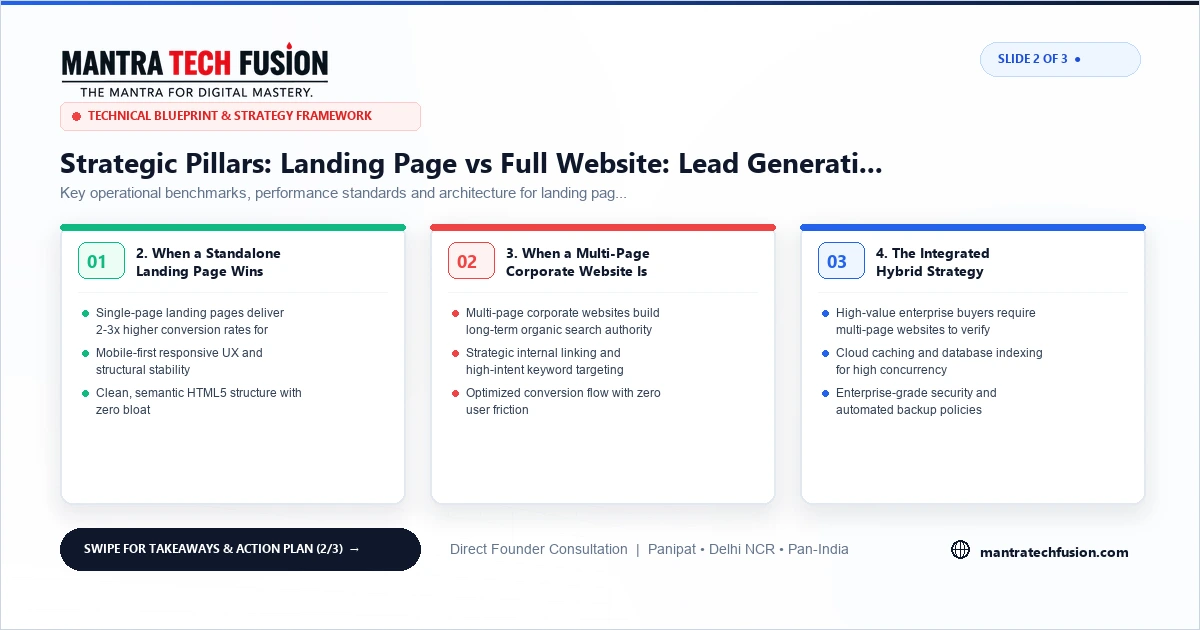
3. When a Multi-Page Corporate Website Is Mandatory
Despite the campaign efficiency of landing pages, relying exclusively on a single-page digital footprint creates severe commercial limitations:
- Organic Search Authority (SEO): Google ranks individual web pages based on relevance and topical authority. A single-page site cannot simultaneously rank for dozens of distinct commercial keywords, service categories, and localized search queries. A multi-page architecture establishes dedicated topical hubs that capture ongoing organic traffic across multiple user intents.
- Institutional Due Diligence: Enterprise procurement officers, bank loan officers, and corporate partners do not commit capital based on a single marketing page. They inspect "About Us" executive profiles, historical company milestones, compliance certifications, technical case studies, and registered office details to verify organizational stability.
- Complex Product Lines: Manufacturers producing diverse machinery or materials cannot adequately present technical datasheets, CAD downloads, quality standards, and operational capacities within a single scrolling page.
- Customer Lifecycle Support: Existing clients seeking technical documentation, distributor portals, warranty procedures, or career applications require distinct website sections that cannot fit on a promotional landing page.
4. The Integrated Hybrid Strategy
The most successful commercial organizations avoid choosing one format to the exclusion of the other. They implement an integrated architecture:
- The Corporate Website as Anchor: Maintain an authoritative, multi-page corporate website on your primary domain, serving as the central home for SEO, brand credibility, comprehensive service descriptions, and company governance.
- Dedicated Campaign Landing Pages: Build distraction-free, dedicated landing pages (either on sub-paths or sub-domains) for specific paid advertising campaigns, promotional events, or localized marketing pushes.
- Measurement Alignment: Measure paid advertising conversion efficiency on landing pages while tracking organic pipeline growth and multi-touch lead nurturing across the corporate domain.
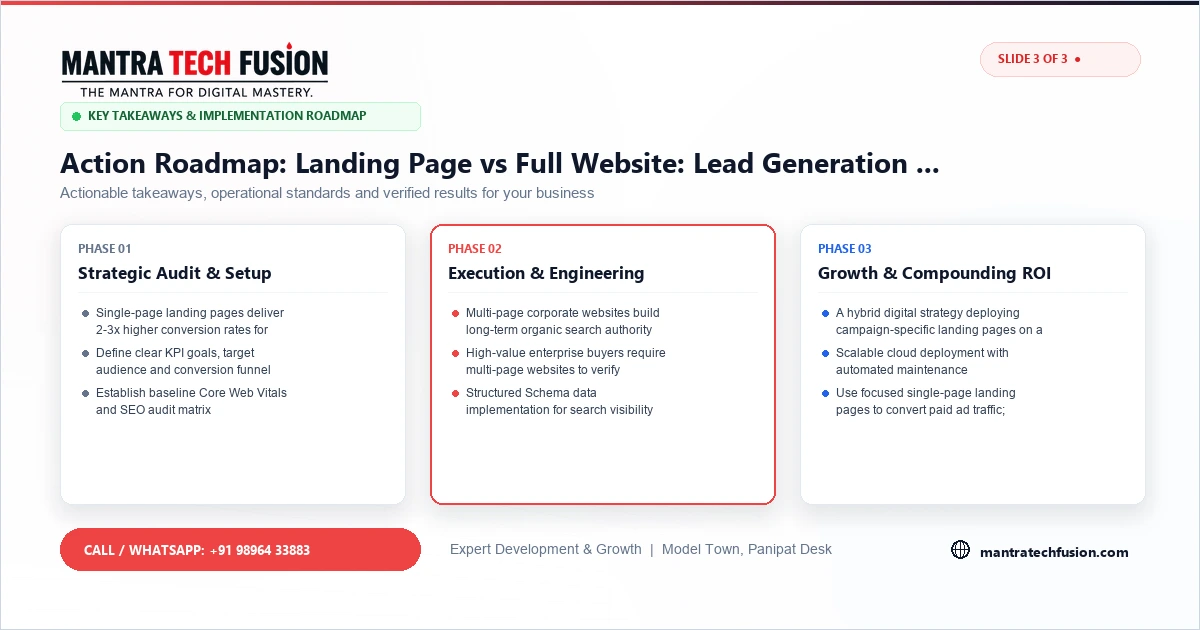
Interactive 3-Slide Article Visual Guide
5. Economic Analysis: Acquisition Costs and Asset Equity
Evaluating landing pages against corporate websites also requires understanding their distinct financial profiles and cost structures over a multi-year horizon:
- The Ongoing Cost of Paid Traffic: A standalone landing page reliant solely on paid Google Ads or Meta Ads is an active operational expense. The moment advertising budgets cease, lead acquisition halts immediately. While initial velocity is high, customer acquisition cost (CAC) tends to climb over time as competitive ad auctions increase keyword click prices.
- The Compounding Value of Domain Equity: In contrast, an authoritative multi-page corporate website represents an appreciating digital asset. In-depth informational articles, technical datasheets, case studies, and localized service hubs build topical authority that compounds month after month. Once established, high-intent organic rankings deliver steady inbound inquiries with zero marginal advertising expenditure.
- Multi-Touch Attribution in B2B Trade: In industrial and high-value corporate deals, buyers rarely convert on their first visit. A buyer might first encounter an informative technical guide via organic search, bookmark the site, review executive credentials a week later, and finally submit an RFQ. A multi-page corporate website accommodates this non-linear decision journey.
To inspect conversion-focused design tailored for high-performance marketing, explore our landing page design services and examine our comprehensive capabilities in corporate website design. For related strategic guidance on digital channel selection, read our analysis on evaluating websites against third-party platforms.
Comprehensive Implementation Framework for Landing Page Vs Full Website
To execute landing page vs full website with high precision and measurable ROI, modern digital organizations must establish clear standard operating procedures across engineering, design, and content operations. Aligning technical infrastructure with commercial business objectives ensures sustained organic performance, maximum brand authority, and consistent customer acquisition.
Furthermore, technical teams should continuously monitor Core Web Vitals, server response latencies, and security headers to guarantee an uncompromising standard of user experience across both desktop and mobile viewports.
Key Operational Benchmarks and Performance Standards
Deploying a successful initiative requires measuring performance against verified industry standards and technical benchmarks:
- Sub-Second Page Rendering: Ensure Largest Contentful Paint (LCP) remains under 1.8 seconds on real-world 4G mobile networks.
- Verified Conversion Paths: Streamline quote request funnels and contact touchpoints with real-time input validation and instant CRM lead alerts.
- Robust Data Security: Protect client interactions with strict SSL/TLS encryption, prepared database queries, and automated off-site backups.
- Semantic Search Indexing: Structure content with Schema.org JSON-LD markup to capture rich SERP snippets and answer engine citations.
- Mobile Ergonomics: Provide minimum 48px touch targets and zero horizontal viewport scrolling on all mobile displays.
Strategic Architecture and Maintenance Best Practices
Maintaining long-term leadership requires routine performance audits, content refreshes, and proactive security patching. Implementing automated staging environments and continuous integration workflows prevents code regressions and ensures flawless operational continuity across all commercial channels.
By prioritizing user intent fulfillment, transparent product specifications, and high-converting calls to action, your enterprise creates an enduring competitive advantage in today's digital marketplace.
Technical Checklist for Modern Digital Infrastructure
Ensure your digital deployment adheres strictly to the following enterprise engineering protocols:
- Zero Layout Shifts (CLS < 0.05): Declare explicit width and height attributes on all media and dynamic components.
- Strict MIME Type Validation: Prevent arbitrary file execution by validating uploaded assets against strict allowlists.
- Automated Data Redundancy: Maintain daily off-site encrypted database snapshots with rapid point-in-time recovery capabilities.
- Immutable Cache Directives: Leverage long-lived HTTP caching headers for static CSS, JS, and optimized WebP visual assets.
Long-Term Economic Value and Return on Investment
Investing in a high-standard digital strategy yields compounding dividends over multiple financial quarters. By reducing dependency on volatile third-party referral networks and paid PPC channels, your brand builds durable organic equity that drives qualified sales pipelines at a fraction of traditional advertising costs. Furthermore, high Core Web Vitals performance and technical domain stability protect your market share against algorithm updates.
Frequently Asked Questions Regarding Landing Page Vs Full Website
What is the most effective approach to get started with landing page vs full website?
Begin with a comprehensive technical audit of your current digital assets, establish clear performance benchmarks, and implement high-priority structural optimizations that directly improve user experience and search indexation.
How does this impact long-term enterprise growth?
By compounding organic search visibility, eliminating code bottlenecks, and streamlining customer conversion funnels, businesses achieve higher profit margins and lower customer acquisition costs over time.