When evaluating woocommerce vs custom php, For Indian manufacturers, distributors, and bulk stockists expanding their digital operations, transitioning from manual WhatsApp messages and telephone orders to an online wholesale portal is a critical milestone. However, technology leadership faces a foundational architectural decision: deploy an established open-source e-commerce platform such as WooCommerce on WordPress, or engineer a custom PHP framework architecture (using modern PHP 8.2+ or Laravel)?
There is no universally superior choice. Claiming that custom PHP is always faster or that WooCommerce is universally inadequate ignores real operational trade-offs. The correct choice depends on transaction volume, SKU complexity, customer-specific pricing structures, Indian GST workflows, and long-term maintenance budgets. Below is a practical, engineering-focused comparison to help Indian B2B enterprises make an informed platform decision.
Strategic Overview: Woocommerce Vs Custom Php and Industry Best Practices
The primary technical difference between WooCommerce and a custom PHP cart lies in how data is structured in MySQL or MariaDB:
- WooCommerce Data Model: Historically, WooCommerce relied on WordPress’s standard schema, storing products as posts in
wp_postsand individual product attributes, stock quantities, and custom wholesale metadata inwp_postmetausing an Entity-Attribute-Value (EAV) design. While WooCommerce’s High-Performance Order Storage (HPOS) has separated orders into dedicated tables, querying complex wholesale catalogs - where a product has six tiered price points, multiple volume discounts, and custom dealer permissions - can generate heavy SQL join operations that increase CPU utilization under high concurrency. - Custom PHP / Normalized Relational Schema: A bespoke application structures B2B operations into purpose-built, indexed relational tables (e.g.,
dealers,price_tiers,contract_prices,order_items). Retrieving a customer-specific price matrix for a 40-item order sheet executes in a single indexed query, maintaining fast sub-100ms response times even across catalogs with tens of thousands of SKUs.
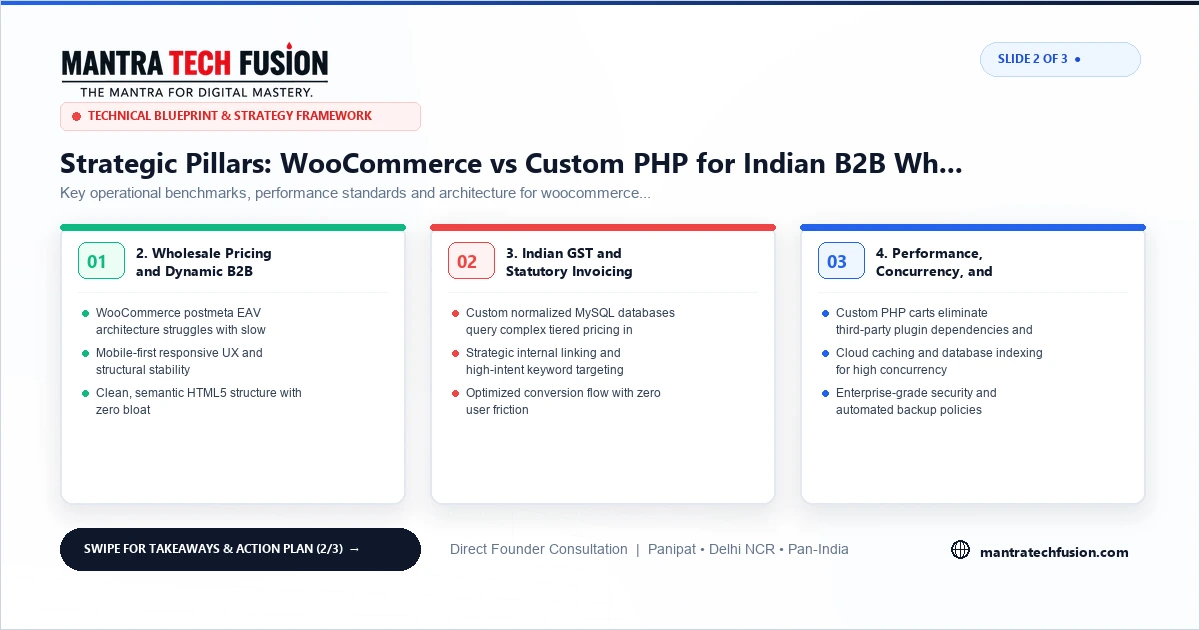
2. Wholesale Pricing and Dynamic B2B Workflows
Retail e-commerce features fixed, transparent pricing: every visitor sees the same price tag. In contrast, Indian wholesale transactions depend on relationship-based commercial terms:
- Customer-Specific Contract Pricing: In industrial sectors, Dealer A in Delhi may buy an item at ₹450 per unit based on annual volume commitments, while Dealer B in Sonipat pays ₹485. While WooCommerce supports this through third-party wholesale plugins, stacking multiple extensions often introduces database bloat and cache invalidation challenges. A custom cart handles multi-tier pricing natively at the database layer.
- Minimum Order Quantities (MOQ) and Case Packs: Wholesale items are rarely sold as single pieces; they are purchased in master cartons, inner boxes, or minimum pallet quantities. Both platforms can enforce MOQs, but custom systems allow complex rules (e.g., "minimum order of 100 units across any combination of three related sizes").
- Credit Limits and Pay-on-Account: B2B portals frequently require "Order on Credit" workflows, checking against approved credit limits and outstanding ledger balances before order confirmation. Custom architectures integrate seamlessly with internal accounting databases or ERP systems.
3. Indian GST and Statutory Invoicing Workflows
B2B transactions in India are strictly governed by Goods and Services Tax (GST) compliance. An enterprise wholesale platform must handle complex fiscal logic:
- Intra-State vs Inter-State Tax Logic: Correctly calculating CGST (9%) + SGST (9%) for deliveries within the supplier’s state versus IGST (18%) for out-of-state shipments, dynamically validated against the buyer’s registered GSTIN format.
- HSN/SAC Code Level Taxation: Associating distinct tax rates (e.g., 5%, 12%, 18%, 28%) across varied industrial product categories on a single multi-item invoice.
- Direct e-Invoice and e-Way Bill API Connectivity: For enterprises crossing mandatory B2B e-Invoicing thresholds, custom PHP backends can communicate directly with the government’s National Informatics Centre (NIC) e-Invoice API to generate digitally signed IRNs (Invoice Reference Numbers) and QR codes instantly upon order dispatch. In WooCommerce, this typically requires complex third-party connector plugins that demand continuous maintenance.
4. Performance, Concurrency, and Resource Sizing
It is inaccurate to claim that WooCommerce is inherently slow. An expertly configured WooCommerce store utilizing Redis object caching, a Content Delivery Network (CDN), and High-Performance Order Storage running on a dedicated cloud server handles substantial traffic reliably. However, scaling characteristics differ:
- Plugin Overhead: Achieving full B2B functionality in WooCommerce often requires six to ten separate plugins (Wholesale Prices, Tiered Pricing, Quote Request, GST Invoicing, Custom Checkout Fields, User Role Management). Each plugin enqueues additional CSS, JavaScript, and database hooks, compounding operational maintenance.
- Lean Application Footprint: A custom PHP application includes only the code necessary for your specific workflow. With zero unused features and optimized database indexes, memory consumption per request is dramatically lower, allowing high order concurrency on modest server sizing.
Interactive 3-Slide Article Visual Guide
5. Strategic Decision Framework
| Evaluation Criteria | Choose WooCommerce | Choose Custom PHP / Laravel |
|---|---|---|
| Catalog Size | Under 5,000 SKUs | 10,000+ SKUs with deep attributes |
| Pricing Complexity | Standard wholesale tiers (Gold/Silver) | Customer-specific contracts & ledger credit |
| ERP Integration | Standard REST API or third-party sync | Direct bi-directional database/API hooks |
| Deployment Timeline | Rapid deployment (3 to 6 weeks) | Custom engineering cycle (8 to 16 weeks) |
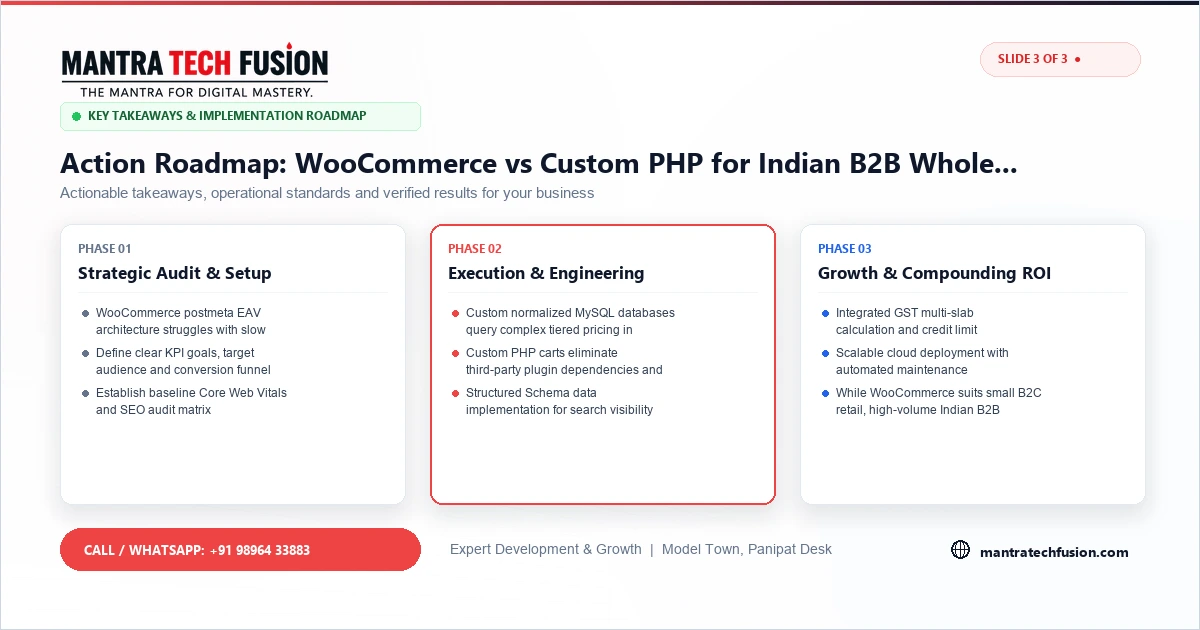
For many emerging wholesale businesses, starting with WooCommerce provides a fast, cost-effective market entry. As catalog complexity, order line volume, and custom ERP integration requirements expand, migrating to a custom PHP or Laravel architecture becomes commercially justified.
To inspect engineered e-commerce solutions tailored for manufacturers, explore our e-commerce website development services and examine our foundational capabilities in custom web development. For broader technical context on software sizing, read our practical analysis on evaluating custom software against packaged tools.
Comprehensive Implementation Framework for Woocommerce Vs Custom Php
To execute woocommerce vs custom php with high precision and measurable ROI, modern digital organizations must establish clear standard operating procedures across engineering, design, and content operations. Aligning technical infrastructure with commercial business objectives ensures sustained organic performance, maximum brand authority, and consistent customer acquisition.
Furthermore, technical teams should continuously monitor Core Web Vitals, server response latencies, and security headers to guarantee an uncompromising standard of user experience across both desktop and mobile viewports.
Key Operational Benchmarks and Performance Standards
Deploying a successful initiative requires measuring performance against verified industry standards and technical benchmarks:
- Sub-Second Page Rendering: Ensure Largest Contentful Paint (LCP) remains under 1.8 seconds on real-world 4G mobile networks.
- Verified Conversion Paths: Streamline quote request funnels and contact touchpoints with real-time input validation and instant CRM lead alerts.
- Robust Data Security: Protect client interactions with strict SSL/TLS encryption, prepared database queries, and automated off-site backups.
- Semantic Search Indexing: Structure content with Schema.org JSON-LD markup to capture rich SERP snippets and answer engine citations.
- Mobile Ergonomics: Provide minimum 48px touch targets and zero horizontal viewport scrolling on all mobile displays.
Strategic Architecture and Maintenance Best Practices
Maintaining long-term leadership requires routine performance audits, content refreshes, and proactive security patching. Implementing automated staging environments and continuous integration workflows prevents code regressions and ensures flawless operational continuity across all commercial channels.
By prioritizing user intent fulfillment, transparent product specifications, and high-converting calls to action, your enterprise creates an enduring competitive advantage in today's digital marketplace.
Technical Checklist for Modern Digital Infrastructure
Ensure your digital deployment adheres strictly to the following enterprise engineering protocols:
- Zero Layout Shifts (CLS < 0.05): Declare explicit width and height attributes on all media and dynamic components.
- Strict MIME Type Validation: Prevent arbitrary file execution by validating uploaded assets against strict allowlists.
- Automated Data Redundancy: Maintain daily off-site encrypted database snapshots with rapid point-in-time recovery capabilities.
- Immutable Cache Directives: Leverage long-lived HTTP caching headers for static CSS, JS, and optimized WebP visual assets.
Long-Term Economic Value and Return on Investment
Investing in a high-standard digital strategy yields compounding dividends over multiple financial quarters. By reducing dependency on volatile third-party referral networks and paid PPC channels, your brand builds durable organic equity that drives qualified sales pipelines at a fraction of traditional advertising costs. Furthermore, high Core Web Vitals performance and technical domain stability protect your market share against algorithm updates.
Frequently Asked Questions Regarding Woocommerce Vs Custom Php
What is the most effective approach to get started with woocommerce vs custom php?
Begin with a comprehensive technical audit of your current digital assets, establish clear performance benchmarks, and implement high-priority structural optimizations that directly improve user experience and search indexation.
How does this impact long-term enterprise growth?
By compounding organic search visibility, eliminating code bottlenecks, and streamlining customer conversion funnels, businesses achieve higher profit margins and lower customer acquisition costs over time.