When evaluating micro animations interaction design, In modern web development, the boundary between an intuitive, polished digital interface and a frustratingly sluggish user experience frequently comes down to interaction design. For industrial manufacturers, machinery suppliers, and B2B platforms, there is often a sharp division in perspective: one camp views industrial websites as purely utilitarian portals where animations are dismissed as frivolous marketing fluff, while the other adopts extravagant WebGL transitions, auto-playing video reels, and heavy scroll-jacking effects that cripple mobile performance.
Both extremes miss the engineering objective. B2B buyers - plant managers, laboratory technicians, procurement agents, and corporate directors - visit industrial portals under clear task-driven missions: evaluating technical tolerances, comparing equipment specifications, downloading schematics, or submitting quotations. When executed with restraint and technical discipline, functional micro-animations clarify interface states, provide instant feedback, and reduce cognitive fatigue without adding bloat. Below is an engineering framework for deploying interaction design on industrial B2B websites.
Strategic Overview: Micro Animations Interaction Design and Industry Best Practices
To prevent interaction design from devolving into decorative clutter, every animation must fulfill one of four specific functional roles:
- State Feedback & System Status: When a user submits an RFQ form, uploads a 20MB blueprint, or applies a catalog filter, the interface must confirm that the system is processing the request. A clean, subtle loading indicator inside the submission button prevents repetitive double-clicks and reassures the buyer that their inquiry is being transmitted.
- Affordance & Hover Intent: Subtle interactive cues - such as a 2-pixel vertical lift or a slight border highlight on service cards and catalog items - signal clickability without distracting from technical copy.
- Contextual Navigation & Spatial Continuity: Smooth accordion transitions in technical FAQ sections or slide-over drawer menus in complex product catalogs help users maintain spatial awareness of where they are in the information hierarchy.
- Error Prevention: Inline form field animations - such as a gentle red border transition when a required phone number is missing an international dial code - guide users toward error resolution before they encounter a hard submission failure.
2. Hardware Acceleration: Restricting Animation to the Compositor Thread
Browsers process web page rendering through three sequential stages: Layout (Reflow), Paint (Repaint), and Composite. Triggering animations that force the browser to recalculate layout or repaint pixels across the CPU thread causes frame drops and sluggish responsiveness:
- The Dangerous Properties (Never Animate): Avoid animating properties that alter geometry or layout, such as
width,height,top,left,margin, orpadding. Animating these properties forces the browser to recalculate the positions of neighboring DOM elements on every single frame. - The Compositor-Safe Properties: Restrict 95% of web animations to
transform(translate, scale, rotate) andopacity. Modern browsers offload these operations directly to the device’s Graphics Processing Unit (GPU), maintaining a consistent 60 frames per second (fps) even on budget mobile devices. - Use the will-change Property Sparingly: While
will-change: transformhints to the browser to promote an element to its own GPU layer, applying it indiscriminately consumes excessive video memory (VRAM). Apply it selectively only during active interaction states.
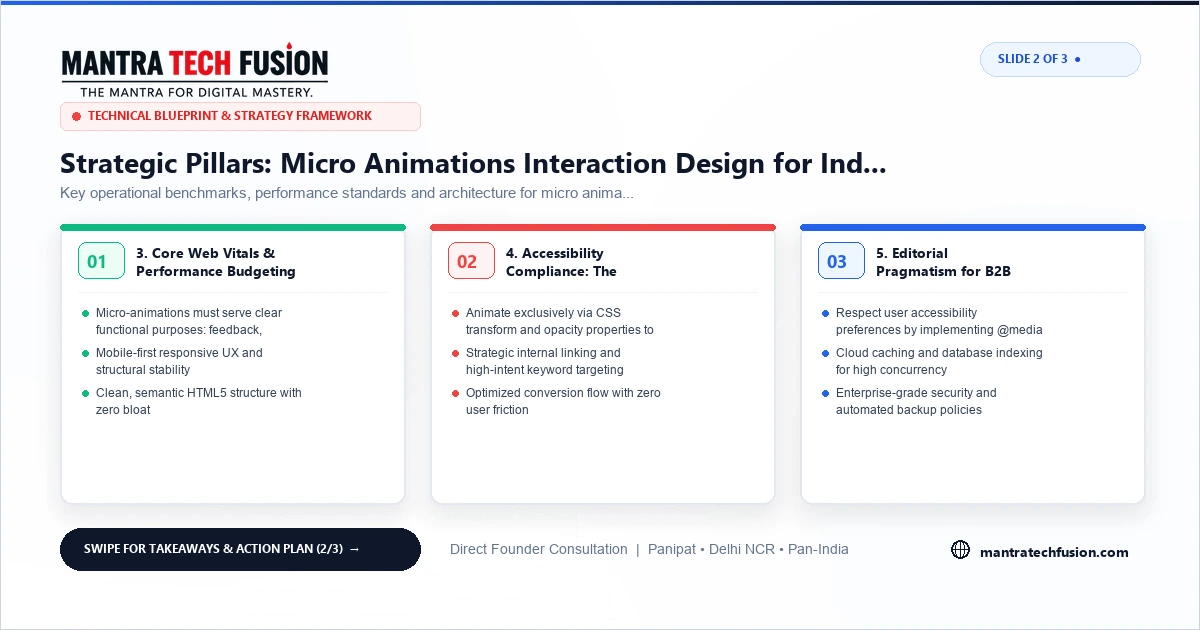
3. Core Web Vitals & Performance Budgeting
Interaction design intersects directly with Google's Core Web Vitals framework. Uncontrolled animations represent a frequent root cause of performance degradation:
- Cumulative Layout Shift (CLS): If interactive elements or banner transitions cause text blocks to jump unexpectedly while loading, your CLS score degrades immediately. Always reserve explicit container dimensions for expanding elements, tooltips, and image carousels.
- Interaction to Next Paint (INP): Heavy JavaScript animation loops competing on the main thread delay the browser from processing user inputs (taps, keystrokes, button clicks). Keep interaction scripts lightweight, utilizing native CSS transitions wherever feasible.
- Avoid Scroll-Jacking: Never hijack the user’s native mouse wheel or mobile touch scrolling physics. Scroll-jacking disorients technical users, breaks assistive technology, and introduces severe lag on touch devices.
4. Accessibility Compliance: The prefers-reduced-motion Standard
For individuals with vestibular disorders, inner ear sensitivities, or cognitive conditions, motion effects - such as parallax scrolling, spinning loaders, and dramatic scale zooms - can cause physical disorientation and nausea. Modern web accessibility standards (WCAG 2.2) mandate respecting the user’s operating system accessibility preferences:
/* Standard smooth micro-transitions */
.btn-primary {
  transition: transform 0.2s ease, background-color 0.2s ease;
}
.btn-primary:hover {
  transform: translateY(-2px);
}

/* Accessibility override: eliminate non-essential motion */
@media (prefers-reduced-motion: reduce) {
  *, *::before, *::after {
    animation-duration: 0.01ms !important;
    animation-iteration-count: 1 !important;
    transition-duration: 0.01ms !important;
    scroll-behavior: auto !important;
  }
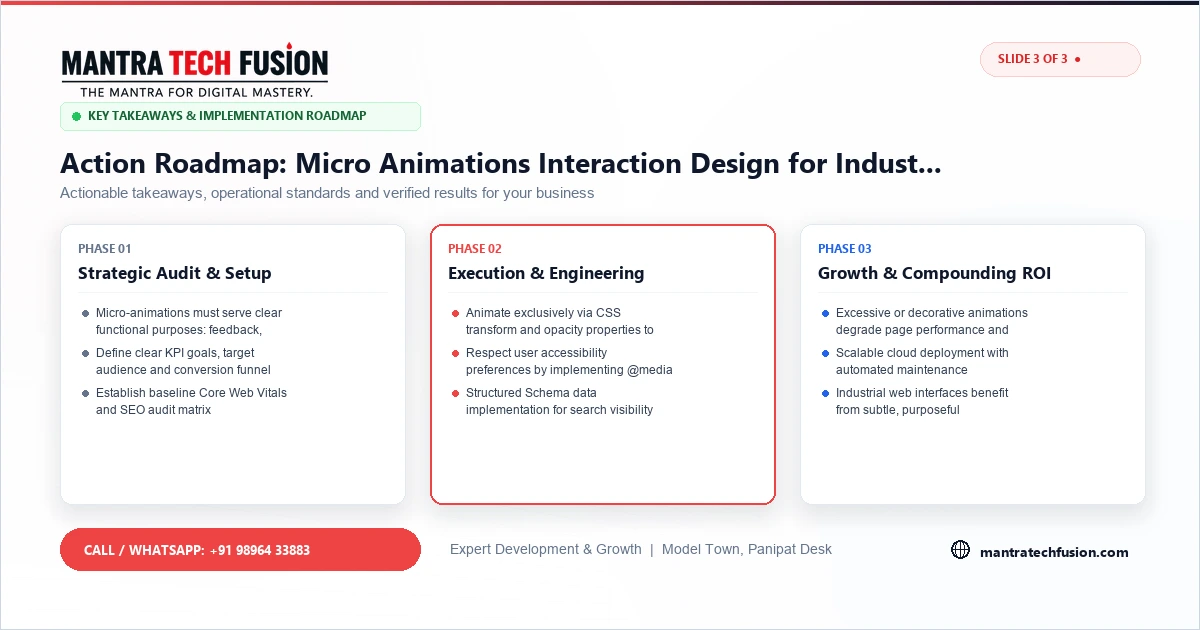
}Interactive 3-Slide Article Visual Guide
5. Editorial Pragmatism for B2B Industrial Brands
The highest compliment an industrial website can receive from an enterprise procurement manager is not "what a flashy website," but rather "we found the technical specifications, verified their manufacturing credentials, and submitted our RFQ in under two minutes." Micro-animations should be the invisible grease that makes that digital journey effortless, not an obstacle course of animated delays.
To inspect performance-focused UI/UX engineering, explore our specialized custom web design services and examine our foundational solutions in custom web development. For additional guidance on frontend speed, read our practical troubleshooting guide on optimizing Core Web Vitals for Indian business websites.
Comprehensive Implementation Framework for Micro Animations Interaction Design
To execute micro animations interaction design with high precision and measurable ROI, modern digital organizations must establish clear standard operating procedures across engineering, design, and content operations. Aligning technical infrastructure with commercial business objectives ensures sustained organic performance, maximum brand authority, and consistent customer acquisition.
Furthermore, technical teams should continuously monitor Core Web Vitals, server response latencies, and security headers to guarantee an uncompromising standard of user experience across both desktop and mobile viewports.
Key Operational Benchmarks and Performance Standards
Deploying a successful initiative requires measuring performance against verified industry standards and technical benchmarks:
- Sub-Second Page Rendering: Ensure Largest Contentful Paint (LCP) remains under 1.8 seconds on real-world 4G mobile networks.
- Verified Conversion Paths: Streamline quote request funnels and contact touchpoints with real-time input validation and instant CRM lead alerts.
- Robust Data Security: Protect client interactions with strict SSL/TLS encryption, prepared database queries, and automated off-site backups.
- Semantic Search Indexing: Structure content with Schema.org JSON-LD markup to capture rich SERP snippets and answer engine citations.
- Mobile Ergonomics: Provide minimum 48px touch targets and zero horizontal viewport scrolling on all mobile displays.
Strategic Architecture and Maintenance Best Practices
Maintaining long-term leadership requires routine performance audits, content refreshes, and proactive security patching. Implementing automated staging environments and continuous integration workflows prevents code regressions and ensures flawless operational continuity across all commercial channels.
By prioritizing user intent fulfillment, transparent product specifications, and high-converting calls to action, your enterprise creates an enduring competitive advantage in today's digital marketplace.
Technical Checklist for Modern Digital Infrastructure
Ensure your digital deployment adheres strictly to the following enterprise engineering protocols:
- Zero Layout Shifts (CLS < 0.05): Declare explicit width and height attributes on all media and dynamic components.
- Strict MIME Type Validation: Prevent arbitrary file execution by validating uploaded assets against strict allowlists.
- Automated Data Redundancy: Maintain daily off-site encrypted database snapshots with rapid point-in-time recovery capabilities.
- Immutable Cache Directives: Leverage long-lived HTTP caching headers for static CSS, JS, and optimized WebP visual assets.
Long-Term Economic Value and Return on Investment
Investing in a high-standard digital strategy yields compounding dividends over multiple financial quarters. By reducing dependency on volatile third-party referral networks and paid PPC channels, your brand builds durable organic equity that drives qualified sales pipelines at a fraction of traditional advertising costs. Furthermore, high Core Web Vitals performance and technical domain stability protect your market share against algorithm updates.
Frequently Asked Questions Regarding Micro Animations Interaction Design
What is the most effective approach to get started with micro animations interaction design?
Begin with a comprehensive technical audit of your current digital assets, establish clear performance benchmarks, and implement high-priority structural optimizations that directly improve user experience and search indexation.
How does this impact long-term enterprise growth?
By compounding organic search visibility, eliminating code bottlenecks, and streamlining customer conversion funnels, businesses achieve higher profit margins and lower customer acquisition costs over time.